





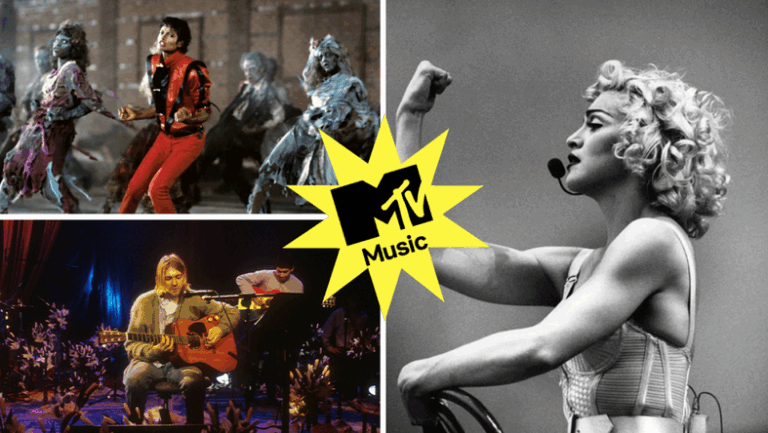
It was midnight on August 1, 1981, when MTV aired for the first time — the channel that would go on to revolutionize not only the global music and television landscape but also the broader world of pop culture. Today, 44 years later, the MTV phenomenon is approaching its end, following the recent announcement that on December 31, five of its channels — MTV Music, MTV 80s, MTV 90s, Club MTV, and MTV Live — will shut down, starting in the United Kingdom and Ireland, with France, Germany, Austria, Poland, Hungary, Australia, and Brazil to follow gradually.
It is, without a doubt, the end of an era — something best understood by those who grew up in the ’80s and ’90s. Because MTV wasn’t just the first music channel in television history to broadcast music videos seven days a week, 24 hours a day. It was a major cultural phenomenon that profoundly influenced music, completely transforming how it was presented and redefining the relationship between artists and audiences, as well as influencing cinema, fashion, lifestyle, and youth culture. In other words, it was something like today’s TikTok — for younger generations to grasp what we mean.
When, in its very first broadcast, host Mark Goodman declared, “Ladies and gentlemen, rock and roll,” and the video played showing an astronaut planting the MTV flag on the moon, no one could have predicted that the wild idea of a group of young people would spark such a revolution. Even record companies were initially against it, as they were being asked to dig deep into their pockets to create videos for the songs of the artists they represented.
Yet in a very short time, the MTV tidal wave swept everything away, becoming the No. 1 live source of music content worldwide. Young people abandoned radios, Walkmans, headphones, and music magazines, gathering alone or with friends for hours in front of the TV to watch their musical idols — alive, charismatic, and in motion — as if they could almost touch them. The premiere of every new music video was met with unprecedented anticipation and dominated teenage conversations.
In this atmosphere of excitement, artists found in MTV a powerful new ally — one that demanded something different: to turn their music and lyrics into visuals as convincingly and impressively as possible. Thus began an intense competition that, while it may have increased the commercialization of music, also offered it a new creative form of expression that gave birth to masterpieces.
Both established and emerging artists began to invest in image, accompanying their songs with short videos reminiscent of mini-movies. Who could forget Michael Jackson’s iconic 14-minute “Thriller” video that catapulted his career; Madonna’s “Vogue” with its artistic black-and-white aesthetic, sensual close-ups, and signature choreography; the heartbreaking “November Rain” by Guns N’ Roses, with idol Axl Rose mourning under a torrential downpour the loss of his bride just hours after their wedding; or George Michael’s “Freedom” featuring a parade of the most highly paid supermodels of the time — including a short-haired Linda Evangelista and Naomi Campbell?
However, MTV didn’t just boost the careers of already established stars of the time — it also created new musical heroes, introducing them to international audiences before they skyrocketed to fame. Among them were Nirvana, Duran Duran, Prince, R.E.M., and later Britney Spears, the Spice Girls, and many others. If it weren’t for MTV, some of these artists might never have become known to the world.
Its influence grew steadily through new, groundbreaking ideas — such as MTV Unplugged, featuring live acoustic performances by artists like Nirvana and Bob Dylan, which remain rare and valuable musical documents; contests offering unique prizes like “24 hours with your favorite artist”; and, of course, the MTV Music Awards, which became one of the most popular and prestigious global music institutions.
MTV’s dominance lasted for roughly two decades. With the arrival of the new millennium — and especially after 2010 — music gradually gave way to reality shows, dramatically changing the identity of the channel.
Time is ruthless, eras change, and the famous line “Video killed the radio star” — the title of the song by The Buggles, the very first video ever broadcast on MTV — turned out to be prophetic for MTV itself. Because streaming music services, algorithms, and the flood of personalized social media videos ultimately killed MTV, sealing away in history the memories of an entire generation.
Ask me anything
Explore related questions




