





Sotiris Lymberopoulos: Greek cuisine depends on the existence of producers
“Seasonality is a very important factor in gastronomy. Greek cuisine is a cuisine of seasonality. The climate conditions are completely different in northern Greece compared to the south, so for me, whatever is produced in Greece is in season,” said Mr. Lymberopoulos.
He emphasized that Greek cuisine could not exist without the production of Greek products.
“Greek cuisine depends on the existence of producers,” he underlined.
Mr. Lymberopoulos explained that the country’s microclimate allows for the production of fresh goods at different times of the year, creating a new kind of year-round seasonality.
“When you eat a tomato, you think it’s summer. But today, with the temperatures we have, you can’t find a good tomato in summer. On the other hand, a tomato from Crete in February, when it’s 22–23 degrees, is wonderful. It’s all-time,” he said.
He stressed that Greek cuisine is, by its very nature, a cuisine of seasonality and locality.
“Primarily, Greek cuisine is based on seasonality. These things matter. I think we’re now realizing this more and more, and we’re all trying to use seasonal ingredients.”
Speaking about local identity, he noted that in a country like Greece — with such rich cultural and geographical diversity — the concept of local identity is multifaceted and dynamic.
He also highlighted that the connection between local products, sustainability, and culinary creativity can become Greece’s strongest tool for building its international food identity.
Referring to the relationship between tradition and modern gastronomy, he said that tradition “is not something static but a living, constantly evolving system.”
“You look at a 200-year-old recipe, and we have no idea what it actually tasted like back then. We interpret it through today’s lens. In general, we tend to think of tradition as something fixed — carved in stone. That’s simply not true.”
He used the example of the avocado to show how new products can be organically integrated into Greek gastronomy:
“Avocados have been cultivated in Crete for 60 years. It’s not a new product. In 50 years, it might even become a symbol of Greek cuisine. Young generations love it, it’s grown here, and it’s conquering Greek kitchens — both home and professional.”
He concluded with a clear message:
“Tradition is not static. It’s something that constantly changes. It’s a journey — and every generation leaves its own mark along the way.”
At the podium of the 3rd Cantina Academy: Cobi Bitton, Innovation & Trade Relations Expert
October 22, 2025 – 13:49
Apostolos Apostolákos: “Greenhouses are the new food industry”
Greece must move from the theory of food security to the practice of productive self-sufficiency, emphasized Apostolos Apostolákos, Strategy Advisor for Agrologistics and Nutrition, during his speech at the 3rd Cantina Academy panel titled “Next-generation greenhouses: The solution to climate change.”
“We want to have food security as a country. But we don’t just want food security — we need productive self-sufficiency,” said Apostolákos, pointing out that recent global events such as the war in Ukraine and the energy crisis proved that “without our own food, we cannot move forward.”
He underlined that next-generation greenhouses are a key solution not only to climate change but also to the demand for modern, sustainable production.
“The greenhouse is the modern food industry for fresh produce. For a farmer to be sustainable, he must have low costs and high income — and the greenhouse allows him to achieve that,” he noted.
Speaking about the Greek reality, Apostolákos stressed the importance of combining traditional producers’ experience with new technological knowledge:
“The average age of Greek farmers is over 57. A farmer cannot suddenly become the CEO of a multinational company, but he has immense experience that must be utilized — and the greenhouse needs that experience.”
He also raised the issue of the lack of a national identity for Greek agricultural products:
“There is no national ‘Grown in Greece’ label — and there should be. Just as there is ‘Made in Greece’ for industrial products, we need the same for our agricultural goods.”
Apostolákos further emphasized the need to organize production and markets:
“Large retail chains cannot negotiate with a thousand small farmers in Messinia. They need a single, reliable representative — one who is organized, resilient, committed, and capable of signing credible contracts.”
As for the advantages of greenhouses, he explained that they offer solutions to energy and environmental challenges:
“A greenhouse produces efficiently, uses little water, requires fewer pesticides and imported fertilizers. It’s more productive, cleaner, and more sustainable.”
He also highlighted the importance of data and market intelligence:
“We talk about artificial intelligence, but does anyone actually know how to forecast demand in Greece? When is there a shortage of microgreens or strawberries? Without data, there can be no strategy.”
Apostolákos particularly emphasized the production potential of the Peloponnese and Greece as a whole:
“The Peloponnese is half the size of the Netherlands — and yet, we haven’t realized it. In strawberry production, we rank fourth in Europe, ahead of the Dutch.”
Linking agriculture, tourism, and services, he stressed that the new era demands new professions and skills:
“A greenhouse doesn’t just need a farmer. It needs modern, better-paid professionals. Tourism demands fresh, specialized products — and greenhouses can provide them.”
In closing, he offered a key reflection on the transition from traditional to modern agriculture:
“Today we lack farm labor because we’re doing traditional farming. But when you have electric carts and automated processes, you need fewer hands — and more specialized ones. That’s the future.”
Ilias Tsafaras: Greenhouses are a distinct part of production
“Greenhouses are a distinct part of production and are designed to contribute to sustainability,” said researcher Ilias Tsafaras from Wageningen University and Research in the Netherlands.
22/10/2025 12:42
Excerpt from the remarks of Antigoni Lymberopoulou
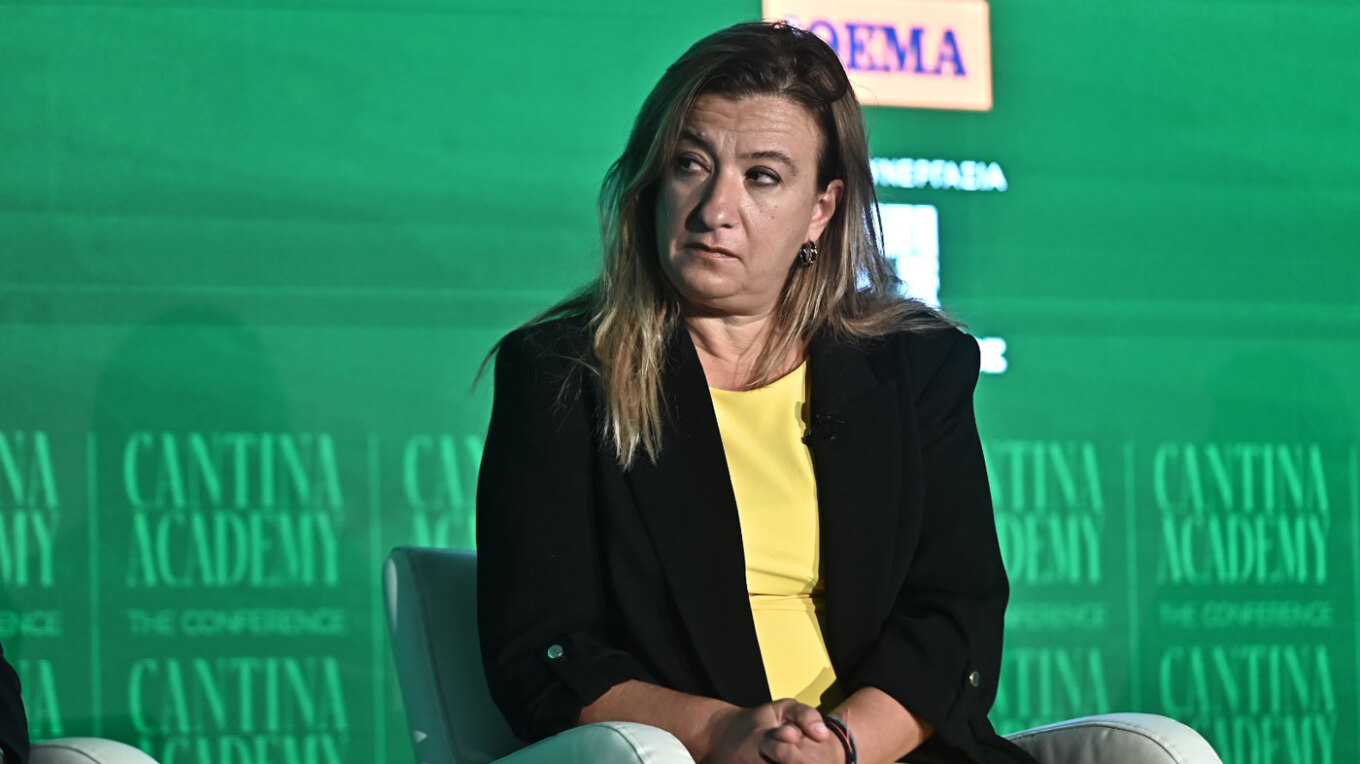
A plan for the future of the Region
Discussion participants:
- Kostas Tsiaras, Minister of Rural Development and Food
- Dimitris Ptochos, Governor of the Peloponnese
- Antigoni Lymberopoulou, CEO of the Hellenic Development Investment Bank
Moderator: Babis Koutras, Director of PROTO THEMA
22/10/2025 11:41
P. Geroulanos: The government is pouring oil on the fire with the amendment for the Monument of the Unknown Soldier
22/10/2025 11:40
Skertsos on the Monument of the Unknown Soldier: We are fighting for the obvious
22/10/2025 11:34
Akis Skertsos: We cannot zero everything out
“Negation, cancellation, and leveling everything do not help,” said Mr. Skertsos, responding to the comments made by P. Geroulanos.
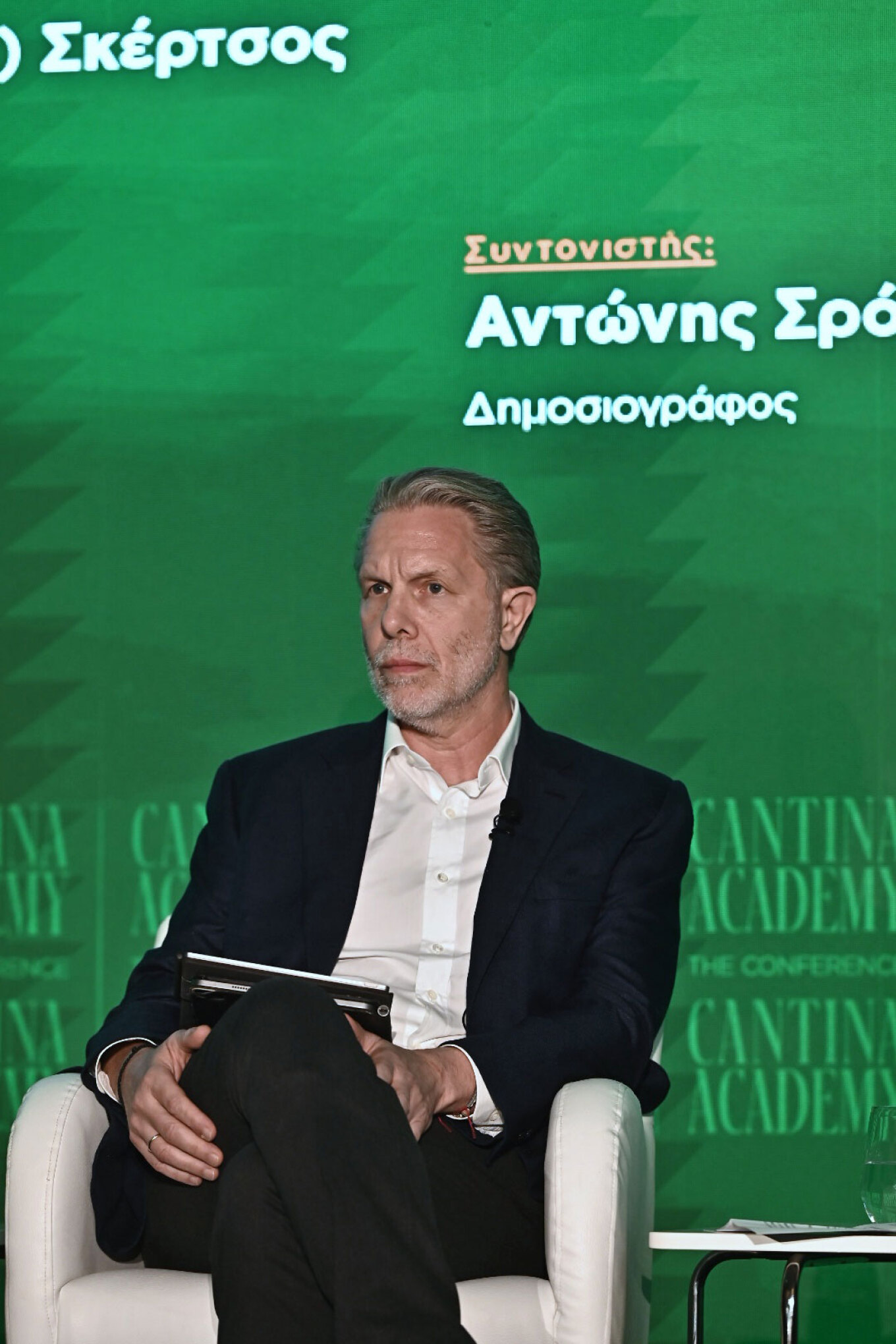
22/10/2025 11:13
Akis Skertsos on OPEKEPE: We must draw a red line on the pathologies
“We are trying to carry out a transformation on the move,” said Mr. Skertsos regarding OPEKEPE and subsidies to farmers, noting that the subsidies must be distributed fairly.
“It is important to implement economic decentralization,” he emphasized at the start of his remarks, highlighting that Messinia is a blessed region that could soar in the future if the right policies are adopted.
22/10/2025 11:05
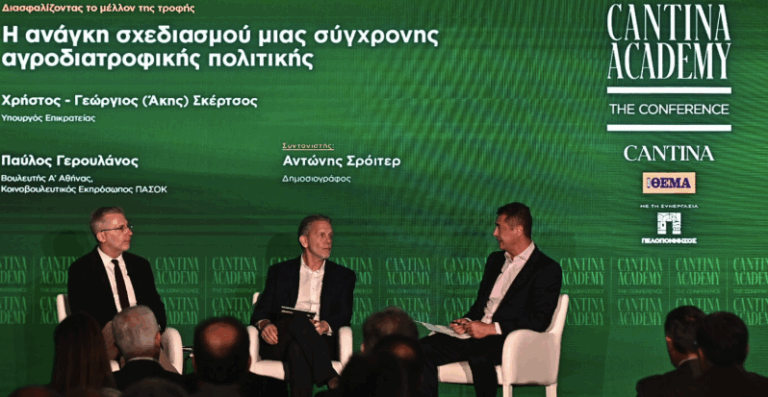
The first panel began on the topic “The need to design a modern agri-food policy.”
Participants include Minister of State Akis Skertsos and PASOK Parliamentary Representative Pavlos Geroulanos. The discussion is moderated by journalist Antonis Sroiter.
22/10/2025 11:03
Excerpt from the speech of the Peloponnese Governor, Dimitris Ptochos
22/10/2025 11:03
The Mayor of Kalamata, Thanasis Vasilopoulos, delivers a greeting
“Cantina Academy is a conference that has become established in our country, in the agri-food sector and in gastronomy. It is an honor for our city to host this conference,” said Mr. Vasilopoulos.
22/10/2025 11:00
Peloponnese Governor Dimitris Ptochos takes the stage
22/10/2025 10:58
[Image placeholder]
22/10/2025 10:57
Peloponnese Governor Dimitris Ptochos at the podium
At the 3rd Cantina Academy, Peloponnese Governor Dimitris Ptochos took the stage.
“It is a pleasure for us to discuss very important issues today — issues related to food, land management, water, and technology,” he said in his greeting.
“Ensuring the future of food is not a theoretical concern. It is one of the greatest challenges we face. On one hand, the population is increasing; on the other, natural resources — land, water, climate — are declining and under pressure. We live in a world that must feed more and more people with fewer resources, and it must do so without exhausting the nature that sustains it. I believe this is the challenge for all of us. This is the challenge in the Peloponnese as well, which does not want to be a spectator; it wants to be a protagonist, a player aiming to win this challenge,” he stressed, among other points.
22/10/2025 10:52
At the conference podium: Cantina magazine editor-in-chief Nana Dareoti
Nana Dareoti, editor-in-chief of Cantina magazine, took the stage at the conference.
22/10/2025 10:49
The 3rd Cantina Academy opens
The 3rd Cantina Academy opened in Kalamata, organized by Proto Thema and Cantina Magazine in collaboration with the Peloponnese Region.
Ask me anything
Explore related questions




