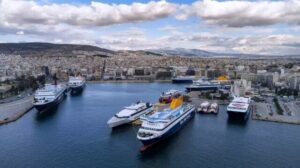
With increased operating costs and reduced demand in the winter months, the Greek shipping industry continues to face increased operating costs and reduced demand in the winter months, as EU environmental obligations, energy costs, and seasonality put pressure on the lines’ sustainability margins.
As a counterbalance, the Ministry of Maritime Affairs and Insular Policy has already proceeded with the announcement of an open international tender for four-year public service contracts for the so-called barren routes, which will be held on 4 November 2025.
These new contracts create a framework of predictability and financial security for companies to proceed with “green” investments in fleet modernization due to EU environmental regulations, but also better and more punctual transport for passengers.
The ETS and the “fuel” of the green transition
It should be noted that the implementation of the European Emission Trading System (EU ETS) has already imposed significant burdens on ships operating on Crete’s routes, as companies are required to purchase carbon dioxide (CO₂) emission allowances.
Currently, the ETS applies to international routes – such as those between Greece and Italy – and to routes to islands with a population of more than 200,000 inhabitants, such as Crete.
From 2029, the exemption that applies to the rest of the Greek islands will expire, leading to the full inclusion of all coastal shipping routes in the A scheme and the FuelEU Maritime regulation, which aims to quantify the carbon intensity of ship exhaust gases.
Daily operating costs are at high levels
According to shipping agents, the daily operating cost of a conventional ship serving the Crete route is around €63,400, of which €6,500 each day alone is the cost of participating in the ETS emissions trading scheme.
Similarly, for the Dodecanese, the daily operating costs of a conventional ship amount to 79,800 euros, and for the Cyclades to 42,000 euros.
Fuel consumption is the biggest expense, with 45,000 euros per day for the Dodecanese, 20,000 euros for Crete, and 18,000 euros for the Cyclades.
This is followed by the daily cost of crew, which reaches 18,000 euros for conventional vessels bound for the Dodecanese, 18,000 for vessels from Crete, and 13,000 for the Cyclades
Repair and maintenance costs are also significant, reaching 11,500 for conventional vessels in the Dodecanese, 14,000 for Cret,e and 8,000 for the Cyclades, which highlights the requirements of operating on high wear and tear and high speed lines.
Insurance and port costs are at more manageable levels, at 3,000 euros for the Dodecanese and 1,700 euros respectively for Crete, while lubricants add around 1,000 euros per day.
As industry executives note, the lack of financial tools for “green” investments combined with increasing emissions obligations creates a competitive disadvantage for Greek shipping, which is required to serve islands with high seasonality and high energy costs.
They also point out the need for a special “Fund & Reward” fund, which will return ETS revenues to the industry, now considered crucial for the sustainability of coastal shipping routes and the financing of new “green” ships with low-emission fuel
It is noted that the average age of the fleet will reach 36 years by 2030, which makes it imperative to renew and technologically upgrade the vessels.
The complete replacement of ships over 25 years old will require investments of more than €3 billion, while the upgrade of younger ships is estimated at more than €200 million.
Restraint this year on ferry tickets
It is noted that in order to curb the increases in tickets and to relieve the industry from the burden of the new environmental regulations and increased fuel costs, the Ministry of Shipping proceeded this year to reduce port charges by 50% for conventional lines.
The measure, which came into effect on May 1, 2025, will last until April 30, 2026, and according to government sources, aims to maintain affordable fares for passengers and islanders.
The fee reduction acted as a cost shield for ferry companies, as it absorbed some of the charges that would have been passed on to tickets — at a time when the imposition of the EU ETS and FuelEU Maritime has already driven up operating costs.
Speaking to APPE-MPA, the president of the Association of Passenger Shipping Enterprises (SEEN), Dionysis Theodoratos, said that “for Greek shipping to become more resilient, we have to let it become more resilient.
He referred to the social policy of compulsory discounts imposed on companies in favour of insularity and specific social groups, noting, however, that“Social policy should be exercised well, but not at the expense of companies, as in other means of transport, the same discounts are subsidised. Not in shipping.”
Changing the service model
The president of SEEN also stressed the need to review the institutional framework and the policy of the routes.“70% of the turnover of the ferry industry is concentrated in the summer months. This is when the bulk of the fleet — conventional and fast ferries — operates. In winter, however, conventional vessels are required to continue to connect the islands with very low passenger traffic and increased operating costs. So we need to look again at the route map and the relationship between conventional and fast ferries. The former operates all year round, the latter only for four months.”
VAT: Greece with the highest rate in Europe
Referring to tax policy, Theodoratos noted that Greece, despite having 18% of Europe’s ferry traffic, still maintains the highest VAT on tickets with 13% on passengers,24% on vehicles, while in other European countries the rates are significantly lower 10% in Spain and Finland, 6% in Sweden, 5% in Italy and 0% in Malta and Denmark.
Asked whether a VAT reduction will be passed on to passengers, the president of the SENI stresses that “if the government reduces VAT, let it check through the price watchdog whether this reduction reaches the passenger.”
The industry is at a crossroads
The Greek shipping industry is currently at a crucial turning point. On the one hand, it has to meet the environmental obligations of the new era, modernise its fleet, and maintain its social mission.
On the other hand, it must do so without permanent financial instruments and with administrative constraints that limit its competitiveness.
Ask me anything
Explore related questions