





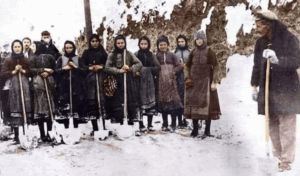
The unexpected Greek victory in the Greco-Italian War of 1940–41, surprising to most, was due to the officers, non-commissioned officers, and soldiers who fought selflessly, the military leadership, and also Ioannis Metaxas—who may be criticized for other matters—but, as is known from people living in remote villages of Epirus at the time, preparations for a military confrontation with the Italians had been underway at least since 1939. Of course, most fortification works were carried out in Macedonia and Thrace, due to fear of an attack from Bulgaria. Italian intentions became clear after the occupation of Albania in April 1939. Greece’s timeframe was now narrow, and the necessary funds were lacking. Yet, what had not been achieved in many areas by October 1940 was accomplished thanks to the civilian but courageous population of Epirus, primarily of Pindus: the elderly, children, but above all, women—the legendary women of Pindus.
The Contribution of Greek Women to the Epic of 1940
When the Greco-Italian War broke out on October 28, 1940, Greek women rushed to help, each in their own way. Women from “high society” and urban areas, who had no experience with labor and deprivation, peasant women—clearly more hardened—who tried to keep agricultural production alive, but above all, the women of Pindus. Marina Petraki’s description is accurate:
“Hard, unsmiling, dressed in black, wearing ‘gournotsaroucha’ and ‘segounia’ (according to the Practical Dictionary of Modern Greek Language of the Academy of Athens: sigkouni & segkouni: a woolen, mainly women’s, upper garment of traditional rural attire < medieval segkouni, from Albanian shegun), the woman of Pindus supported the entire struggle. Spontaneously, voluntarily, with no expectation of recognition or reward, she filled in for the state machinery and care in the rugged mountains of Pindus… When operations began, their concern for the army trapped in the snow and fighting without supplies imbued the anxious hearts of the Pindus inhabitants left behind to ‘guard the homes’ with unmatched courage. Neither the snow nor the approaching enemy could stop ‘the processions of shovels and pickaxes.’ An unstoppable drive and a peculiar enthusiasm characterized this gathering of women and children.”
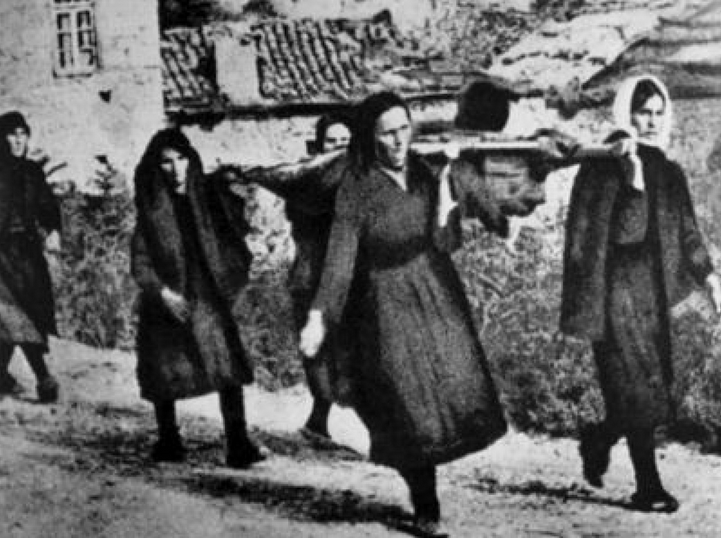
Only by the end of November did newspapers report on the “women of Pindus”
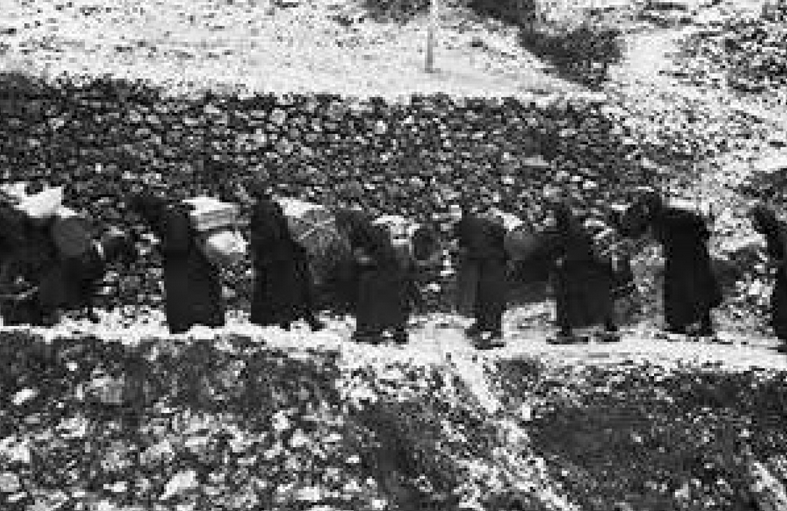
It took almost a month from the start of the war for newspapers to report on the women of Pindus! On November 27, 1940, an article by journalist Manos Karelas, correspondent of the newspaper Asyrmatos at the front, was titled: “The Epic of the Women of Epirus – Transporting Cannons in Inaccessible Mountains.” One of the first heroic acts of the war was the action of the legendary “Davakis Detachment” in Pindus, against the well-equipped and trained Italian alpine divisions. About 2,000 soldiers, exhausted and freezing, made up the “Pindus Detachment.” There were serious shortages of clothing, footwear, bedding, and ammunition. The Mule Company was delayed in arriving, and soldiers also faced the risk of starvation. But where motorized transport stalled—or became useless in the snow, mud, and rugged terrain—the spirit of the Epirote women spoke, carrying food and ammunition to our brave soldiers. Haralambos Katsimitros compares the women of Pindus to the Souliot women:
“The Aoos sector under Lieutenant Colonel Frizis Mardochais had orders to block the mountain passes of the Gamila massif. For the resupply of Frizis’ Detachment south of Aoos, units using private pack animals, generously provided by the locals, served as muleteers. The women of the Zagori and Pindus region, carrying heavy boxes of ammunition, climbed the steep slopes of Gamila and Papigo mountains, delivering ammunition to our fighting men. These are the heroic women of Pindus, who, like the brave Souliot women, assisted in the struggle and offered invaluable service to the Fatherland.”
Gamila or Tymfi: mountain complex in Ioannina Prefecture, 2,497 meters high.
Vivid and realistic description by Marina Petraki:
“Days and nights of endless marches, entire columns of women, a ‘marching army,’ loaded with ammunition and food, crossing rivers, gorges, and cliffs. They climbed mountains like wild animals, looking only ahead.”
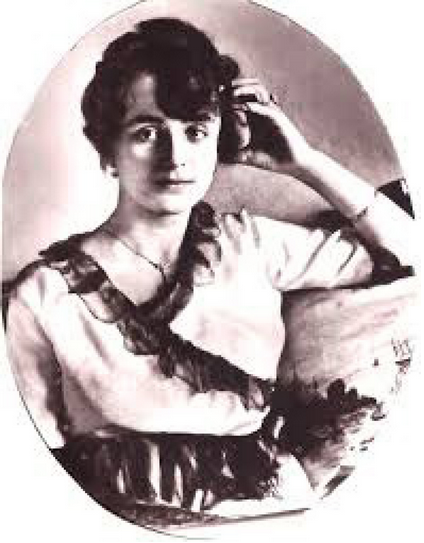
(Frosso Ioannidou)
A remarkable case was that of Epirote woman Frosso Ioannidou (1896–1986), born in Tsepelovo, Zagori. She married young, moved to Ioannina, and developed significant social activity. In 1926, she was a board member of the Lyceum of Greek Women, the Girls’ Orphanage, and the Lyceum Zoodochos Pigi. In 1940, together with other women from Ioannina, she organized the transport of wounded soldiers from the front. About the women of Pindus, she wrote:
“Where are the women? I ask. The women, the sergeant Simitzis tells me, are carrying ammunition and taking it up to Gamila and Astraka. How is it possible? How can women carry loads up these inaccessible mountains where only chamois go? I ask. They are tied with thick ropes at the waist, and the gendarmes pull them from above. And they, heavily loaded, climb like goats, holding on sometimes to protruding rocks, sometimes to roots, kneeling occasionally from the weight, risking slipping and falling into the chasms below. They go up and down continuously, even throwing stones at the enemy below who have reached Tservariotika Kalivia. My breath catches as I hear all this; my mind reels.”
Astraka: peak of Tymfi, 2,436 meters high.
Tservariotika: presumably the huts of the village Tservari, now Elafotopos, Zagori.
Epirote writer Christos Zalokostas, in his book Pindus: The Epic in Albania, writes:
“The women carried ammunition to the top of Gamila. Bent over, doubled from the weight of the crate of bullets on their backs, they climbed with the quiet, tireless step of their iron-strong legs for 18 continuous hours, while their children followed, these Greek little beasts, carrying packs with machine-gun magazines or a mountain artillery shell. On the return, they brought down the wounded, sometimes even Italians, to the hospitals. In Dovra, they were tied with the ropes of the animals that carried the cannons to steep positions. Wherever peasant women were near the battle, they picked up large stones and threw them at the Italians. The villagers fed the army, and because they were poor and had little food to spare, they themselves went hungry. If a soldier’s boot tore, they immediately took it off and gave him their own shoes, continuing barefoot.”
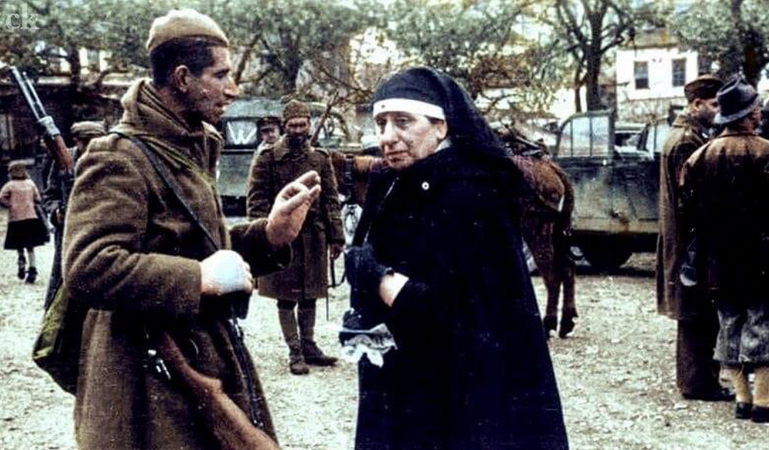
Dovra or Dovrá: the village of Asprangeloi, Zagori
An astonishing story is recounted by Frosso Ioannidou:
“One day, a middle-aged woman passed by the edge of our village, returning from the Pindus front with a pack saddle loaded on her back… She said that, as she was carrying a load to the front, her animal (a mare) fell somewhere.
Then she loaded her mare’s load twice and took it to where it was needed, about an hour’s walk, so that what she was bringing for our Army would not be lost. Afterwards, she returned to the dead mare, loaded the saddle again, and went back to the village. When someone told her not to be upset about the mare because she would be compensated someday, she replied with patriotic pride: ‘I do not grieve that I have two children at war, so why should I grieve for the mare? Let it go as a kurbani (let it be sacrificed, likely a local Epirote adaptation of the Turkish kurban).’ And in a hurry, she set off for her village because she had been away for three days.”*
As we wrote on the blog of Friday, 24/10, the women of Pindus also played the role of bridge-builders.
They repaired broken bridges to allow supply convoys to pass (“at the Kokoris bridge, because the engineers did not have time to repair it quickly, the women waded into the water up to their chests and completed it in no time”), and they also destroyed others to prevent enemy passage.
“Yesterday the Laista Bridge, a strong passage for the Italians, finally burned. It was soaking wet and would not catch fire. Until a local from Laista, with nine cans of oil, gathered by nine women from various villages and carried, wetting their shirts with oil as kindling, finally set it on fire at one o’clock at midnight. When the Italians, ready to cross it in the morning, saw it, they fled in terror. (…) In Bagia and the surrounding villages, in Kapesovo and Laista, 50 to 60 trucks arrived daily and unloaded food and ammunition, which had to be carried on foot for 12 to 15 hours through mud and snow to Vryssochori, and from there as long as daylight lasted, because at night the paths disappeared.”
“I hear about these women carrying machine guns up to Gamila. One night, they were caught in darkness at Drakolimni with freezing cold. It was impossible to continue against a wind that nearly swept them away. They unloaded, huddled together like a bundle, covered themselves with some skins they found there, and made it through the night to continue their journey to Gamila, still loaded. I remember their names,” Frosso Ioannidou recounts with admiration.
Bagia: the village of Kipoi, Zagori
Laista and Kapesovo: villages in Zagori
It was not only the hardened Epirote women, but also the local ladies and noblewomen of Zagori who transported ammunition day and night to Gyftokampos, and from there to Vryssochori. A representative testimony comes from G. Vatziou:
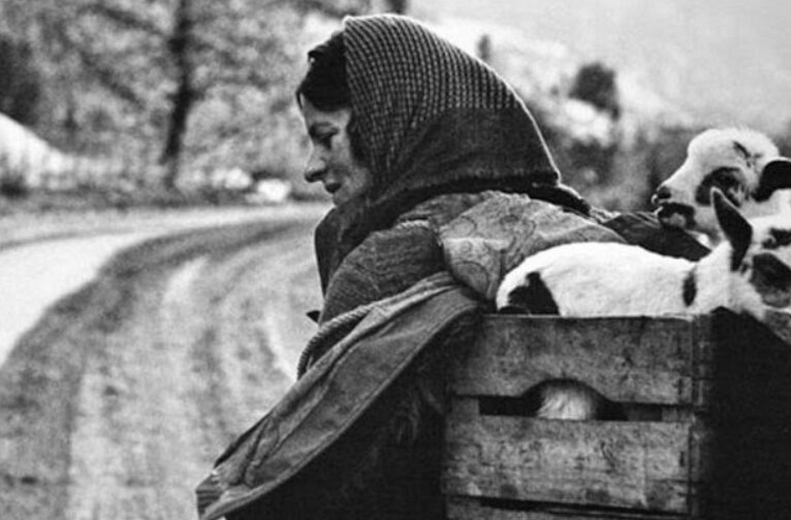
“A young woman scholar who had studied in Istanbul grew tired, and her animal could not go further. She was alone. She tied a rope from the mule’s halter to her hand so it would not escape in the thick darkness and the piercing cold. She also tied herself with a rope to a fir tree and waited for daybreak, amid the lightning and thunder and the groans of the ravines and forests. They found her in the morning frozen and semi-conscious. She was saved by a miracle.”
(This testimony is found in K.P. Lazaridis’ book Zagori and the Women of Pindus.)
The press gradually began to acknowledge the Epirote women. Indeed, Pavlos Palaiologos wrote from the front the first chronicle in Eleftheron Vima about the women of Pindus:
“Reports to the General Administration of Epirus regarding the actions of women, children, and civilians during the Italian invasion of Greek territory arrived late. (…) There was no task they did not undertake. They carried the wounded in their arms (…) and did not limit themselves to acts of humanity alone. They built roads, bridges, transported ammunition, and faced danger alongside the soldiers (…) Outside Tsepelovo, the officer fought with men who had been starving for four days. He called urgently for boots and bread. The lines were cut. A telephone operator from Tsepelovo (…) notified the women (…) they loaded on their backs whatever they had and headed for the peak. (…)
I have conveyed the report in a raw, unordered, unpolished way, as I found it. What need is there for rhetorical embellishment where the facts speak for themselves?”
In K.P. Lazaridis’ book Zagori and the Women of Pindus, there is also the testimony of Chrysostomos Siusopoulos:
“On October 28, around 9:30, the first mules appeared, struggling, loaded with cannons and ammunition, in the village of Soudena. It was impossible to proceed because the slope was steep. The officers unloaded and requested help from the village. (…) The women and girls loaded on their backs the pieces of artillery and boxes of ammunition and transported them to Laista. A photographic team of the 8th Division took many pictures of the women and girls carrying loads. (…)
These photographs are always labeled ‘The Women of Pindus’ and ‘Somewhere on the Front.'”
Soudena: village in Ioannina Prefecture in Zagori, today Kato Pedina
Gradually, recognition came for the women of Pindus, not only in Greece but also abroad, especially in Great Britain, which at the time was suffering from German bombing.
“At the Monsignor Theater in Piccadilly, the latest Greek newsreels were shown, but one had to queue to get inside. (…) Particularly moving was the film of the women of Epirus carrying ammunition and food on their backs to the front line. Often, the audience broke into applause, shouting Bravo and Zito,” proudly noted G. Angeloglou, director of the Greek Section of the BBC in London.
Their actions and contributions are also recognized by the Hellenic Army General Staff, according to one of its reports:
“To address the difficulties of supplying the fighting units, among others, groups of villagers, women, and children were used, who came voluntarily and carried the loads on their shoulders, moving through inaccessible terrain under very adverse weather conditions. In this way, the inhabitants of Pindus presented the fighters with a brilliant example of patriotism and a high sense of duty.”
(Concise History of the Greco-Italian War, 1940–1941, Directorate of Army History, Athens 1985)
But why did it take so long for the contribution of the women of Pindus to become known nationwide? This was because the Metaxas government gave the first permission to a journalist to go to the front on November 19, by which time the Greek counteroffensive and the pushing back of the Italians had already begun. The first journalist to reach the front was Th. Malavetas of Ethnos. On the same day (19/11), Spyros Melas (later a well-known writer and academic) and Th. Amoutzopoulos, both collaborators of Kathimerini, departed. On 20/11, P. Palaiologos and N. Yiokarinis of Eleftheron Vima left for the front. By the capture of Koritsa (22/11/1940), almost all newspapers had correspondents in Epirus.
Battle of Greek Women and Italians!
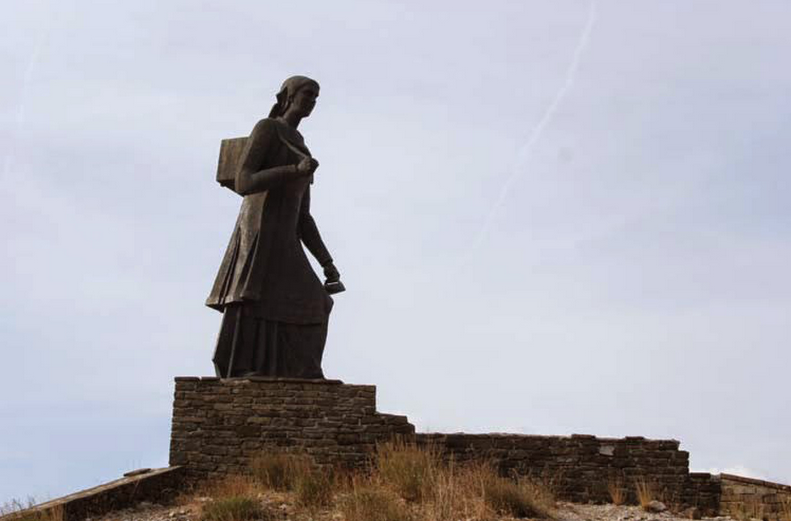
Finally, there is an account of an incident in which women clashed with Italian soldiers on November 20, in the village of Limni (a village of Pogoni, Ioannina Prefecture) in Epirus. A group of Italian soldiers had gathered about ten young women and were taking them to the village school when Evzones suddenly appeared. The Italians were surprised both by the presence of the Evzones and the reaction of the village women, who chased them away with sticks and axes. About ten Italians were killed in the clash, and twenty-five were captured.
We present a flawless description of the women of Pindus by Marina Petraki, from the book 1940 – THE UNKNOWN WAR:
“These women, most of them anonymous, with calloused hands and bent backs, climbing stone by stone the narrow, difficult mountain paths (goat trails) in the inaccessible mountains, in rain and snow, carrying ammunition, transporting the wounded, burying the dead left in the snow, did their duty without expectation of reward or recognition: ‘Well, we were here and held the defense, what else?’ they humbly stated years later.”
Interesting testimonies are also found in the book by Chatzipatera-Fafaliou, Testimonies 1940–1941, Athens, Kedros, 1982. Here are some excerpts:
The women of Pindus
“When we left Larissa to go to Kozani, at Sarantaporo back then the roads were cobblestones and dirt roads. I remember that just before Servia there were women who, on the second day exactly toward the third, were repairing the road, putting stones into the mud. From that day and then continuously in Epirus, these women were admired. They were admired greatly because they transported loads where not even a mule could pass. They put it on their backs, accustomed to it, carrying water and wood. They went to the village one or two hours away, loaded the wood on their backs, and carried it to their homes in the snow. Of course, they had stocked supplies from summer for the winter, enough for about a month. After that, they continued on in the snow…”
(Oral testimony of Takis Trantas, in Chatzipatera-Fafaliou, Testimonies 1940–1941, Athens, Kedros, 1982, p. 103)
Women carrying ammunition
7 November 1940. Today, two children of the 33rd Regiment were killed, and this enraged the soldiers even more. They shouted ‘Forward to Rome.’ This death, instead of discouraging us, gave us more wings to chase the Italians. I encountered women carrying ammunition. One was 88 years old. One told me she locked her little child in a hut to help the army. At night, I saw an old woman holding two little children while their mother was kneading bread for the army by the light of two candles in a glass. The snow, ice, and terrible cold did not seem to frighten them. All, full of joy, wanted to offer the army whatever transport could not bring. Truly, miraculous women. What a difference from the cities!”
(From the War Diary of Argyri Balatsou, in Chatzipatera-Fafaliou, Testimonies 1940–1941, Athens, Kedros, 1982, p. 103)
Living wall
The victors of Pindus advanced. As they reached the Vogiouza River, the fearless women of Pindus saw that the steep stream hindered the engineers in their work, and spontaneously did something that was later repeated in Kalamas and Drinos: they entered the water themselves, holding tightly by the shoulders, forming an embankment that slowed the river’s force and helped the bridge-builders!”
(Takis E. Papagiannopoulos, in Chatzipatera-Fafaliou, Testimonies 1940–1941, Athens, Kedros, 1982, p. 104)
The main source of the article is Marina Petraki’s book 1940 – THE UNKNOWN WAR, Patakis Editions, 2014.
The interpretations of words and information on place names were provided by the author of the article, using sources such as the Practical Dictionary of Modern Greek Language, Academy of Athens, and the Concise Geographical Dictionary of Greece, by Michael Stamatelatos and Fotini Vamva-Stamatelatos, Hermes Editions, 2006.
Ask me anything
Explore related questions




