





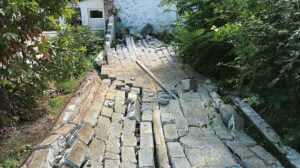
Valtonera. A village 12 kilometers from Amyntaio, Florina, but much closer—just 1,800 meters from the PPC (Public Power Corporation) mine in the area. Like other villages and settlements in the region (Anargyroi, Pedino, Rodonas, Fanos), it was struck by a major landslide at the mine eight years ago. Since then, successive reports from six responsible scientific agencies have classified it as dangerous to live in, particularly the area called the “red zone,” which runs almost vertically through the village, “cutting it in half.”
A village where, since June 10, 2017, when the massive landslide occurred—the strongest of its kind in Europe near an active lignite mine, according to Professor Efthymios Lekkas—the lives of the residents have changed. Most of the 170 residents chose, whether out of necessity or sentiment, to continue living in their village, but they do so at extreme risk. They live in constant, harrowing insecurity, literally on top of fissures. Houses with cracks of varying sizes continue to grow, with residents feeling at any moment that the ground is slipping beneath their feet. Every home is affected; none remain intact.
Some were forced to leave, either to nearby but safer villages, or sent their children or elderly parents to Thessaloniki or other major cities while they stayed behind. Those who remain live in fear of further landslides, new damage, or even threats to their lives. The potential impact of an earthquake or a heavy downpour is not even discussed. Yet, their repeated appeals for urgent relocation procedures have still not been heeded.
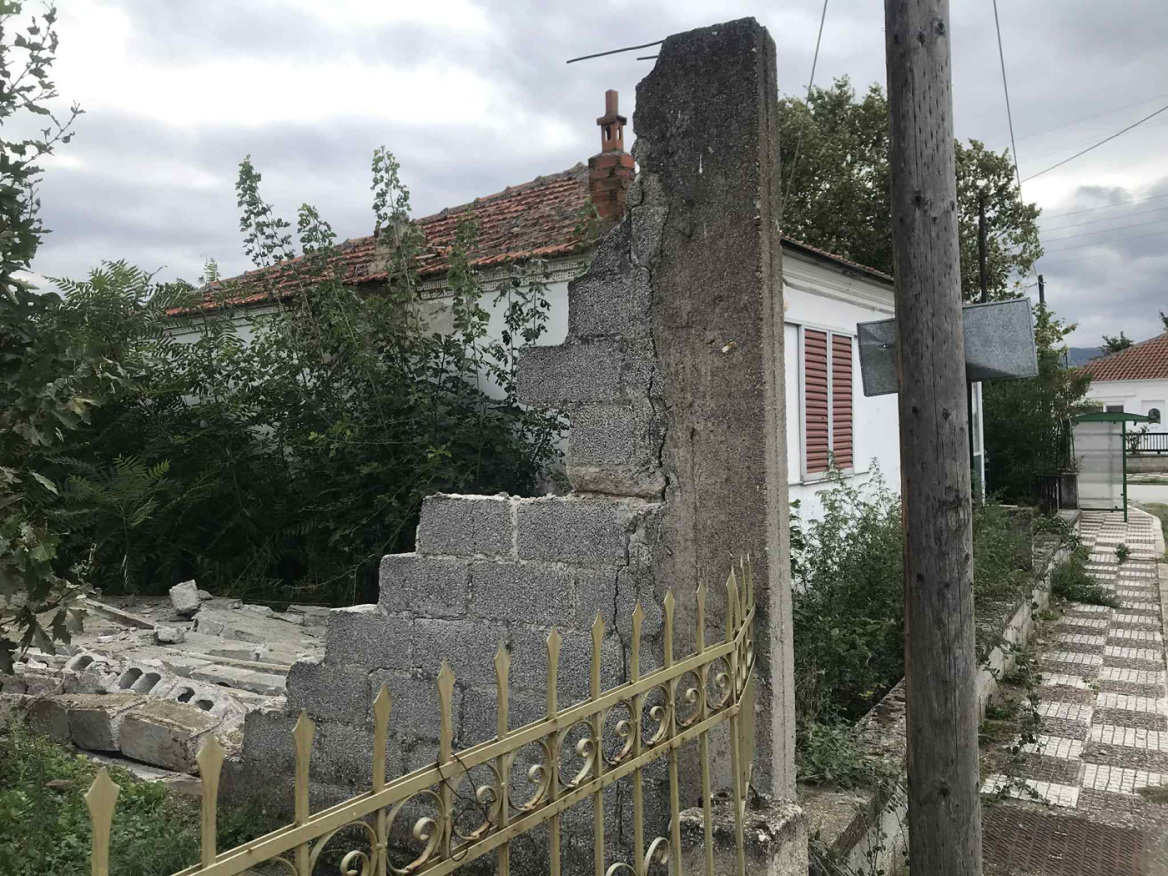
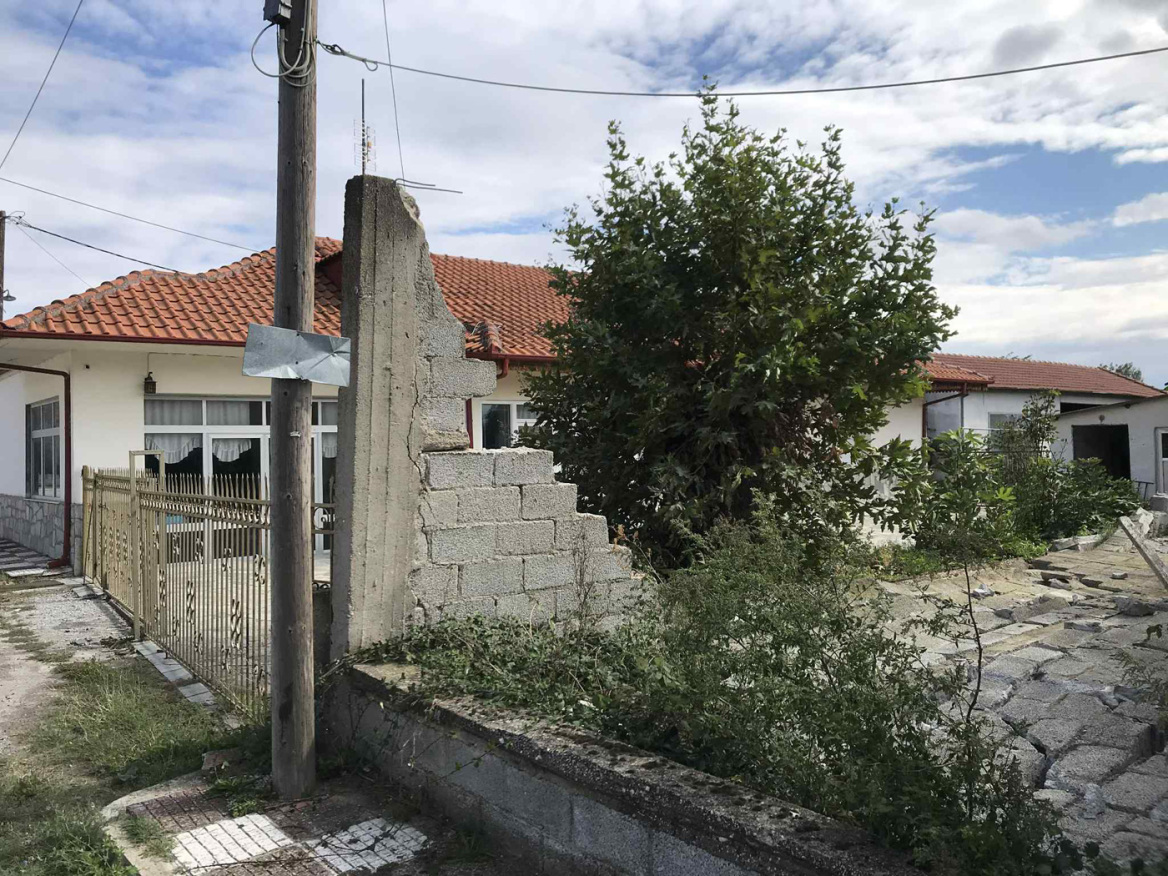
Their fears are not unfounded. A recent event proves it. As village resident Sofoklis Manos reports, after several days of heavy rain, on the morning of October 7, villagers woke to find a 13-meter-long, 3-meter-high retaining wall in the middle of the village had collapsed, just a breath away from the school bus stop. Two of the eight children still living in the village are Mr. Manos’ own.
Findings by Lekkas and Five Other Agencies
Many scientists agree with the villagers’ concerns. From the start, the scientific community’s mobilization was strong, but apparently not enough to shake the central government. On November 7, 2017, five months after the landslide, Professor Efthymios Lekkas, expert in Dynamic Tectonics, Applied Geology & Natural Disaster Management (now president of OASP), warned in writing that buildings in the area he designated as the “red zone” (nearly 1/3 of the village) should be gradually evacuated for safety reasons and residents immediately relocated.
By late August 2018, the Institute of Geology and Mineral Exploration (IGME) also deemed one-third of the settlement unfit for habitation. Six reports now point to the same conclusion: expropriation of land and relocation of residents. Yet, despite these recommendations, the central state remains inactive. Over eight years, local and national media occasionally highlight the issue, yet the prolonged inaction remains dangerous.
“We continuously warn them. We must leave; it’s dangerous to live here. There is even a risk of tragedy.” Words from S. Manos, echoing the “cry of anguish” for official inaction. Lawyer Ariadni Nouka adds: “The collapse of the retaining wall ten days ago confirms, in the clearest way, the ongoing and serious risk that persists in the Valtónera area. This underscores the need for immediate state intervention, especially within the designated ‘red zone,’ where the ground remains unstable and human lives exposed.”
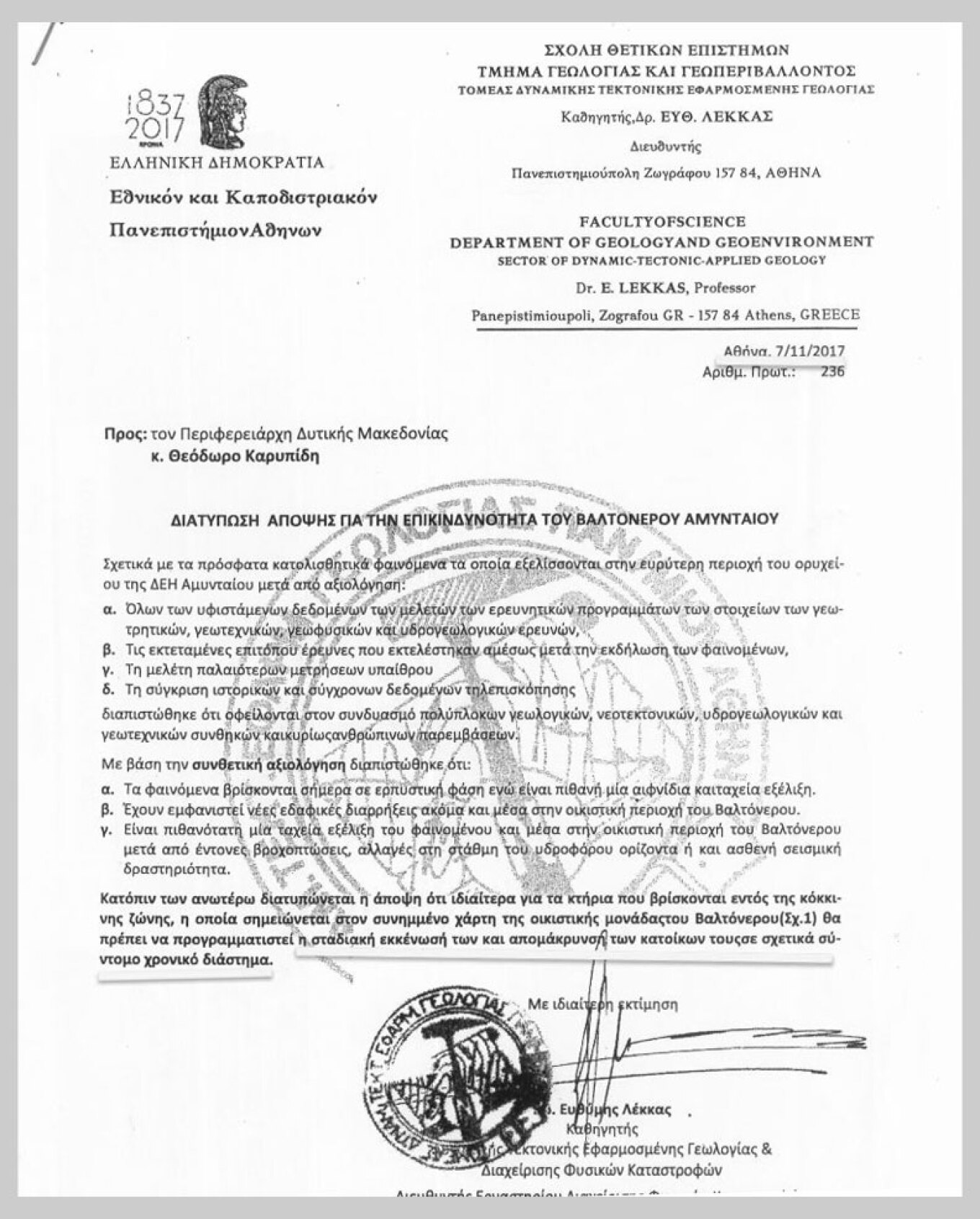
The warning from Professor Efthymios Lekkas since 2017
The Historic Judicial Decision
Some progress appeared earlier this year, when first the Amyntaio Municipal Council and then the Western Macedonia Regional Council unanimously voted for compulsory expropriation. The case was then transferred to Athens and the central administration, but no developments have occurred, not even after the recent wall collapse.
However, there were promising developments in the judicial domain. The Athens Court of First Instance, last April, recognized the danger of remaining in Valtónera, particularly within the “red zone.” It acknowledged that the fissures and land subsidence in the settlement were due to changes in the hydrogeological regime caused by over-extraction of groundwater by the PPC for mine safety. Compensation of €3.35 million was awarded to 31 residents who sued for moral and material damages.
Regarding geological and hydrogeological data, the Court accepted studies from Aristotle University of Thessaloniki and the University of Athens, proving four points:
A) Significant drop in groundwater levels (>50 m)
B) Formation of a “cone of depression” extending up to 2 km, including the settlement
C) Connection of fissures and subsidence to mining extraction
D) Exclusion of seismic or tectonic activity as the cause
Regarding social and residential impacts, the Court recognized that the entire settlement is in an unsafe living condition and noted the existence of a “red zone” requiring evacuation.
“…The Valtónera settlement is in immediate danger due to ground fissures. Given the condition of the soil and ongoing fissures and cracks, any additional events, such as a minor earthquake, could cause extensive damage or collapse to already stressed buildings, threatening ground stability. Therefore, residing in Valtónera and cultivating the fields is unsafe,” the decision states.
The properties of the plaintiffs have effectively lost their use and value due to these phenomena, with PPC held responsible as a source of elevated environmental risk. Compensation was awarded to the 31 plaintiffs for the moral and material harm suffered, making the decision one of the most well-documented and significant regarding environmental damage in Greece, setting a legal precedent for accountability of large agencies toward local communities.
Ariadni Nouka
Speaking about the decision, the lawyer representing the residents, Ariadni Nouka, told Proto Thema that it “already fully recognizes the responsibility of the parties at fault, the danger, and awarded compensation to the residents. The reality is now legally and scientifically acknowledged.
The question now is: will we wait for lives to be lost before authorities act? We expect the immediate activation of the competent authorities to implement the necessary protection, prevention, and restoration measures. Protecting human life and citizen safety is a primary duty of the State.”
The case now proceeds to a second instance.
Additionally, a lawsuit from 2021 by the Municipality of Amyntaio against all responsible parties is ongoing, leading to expert assessments and the consolidation of the six studies. After a postponement, the trial is set for March 2026, with the PPC administration held accountable.

On the left: Ariadni Nouka, lawyer representing the residents; on the right: Dimitra Katsouridou, a village child who lost her sight but, with immense strength and willpower, entered the Guinness Book of Records.
The Village’s History
Valtónera is a beautiful village, and its residents are proud of it, despite being forced to leave due to unavoidable circumstances. It lies in the center of a plain that was marshland until the late 1950s, hence the village’s name. The marsh was the remnant of an ancient lake, explaining the unstable soil. Prehistoric settlements developed along its banks, including one on the village outskirts dating to the Early Bronze Age.
In these harsh conditions, Pontic refugees settled in 1922, engaging in agriculture and livestock farming, especially after the marsh was drained and arable land revealed.
In 2003, Valtónera gained international fame thanks to Dimitra Katsouridou, a blind village child who, with extraordinary determination, entered the Guinness Book of Records with a collection of 8,514 pencil sharpeners gathered over 11 years, the largest collection in the world. Sadly, she passed away at 46 in February 2020. Today, Valtónera returns to public attention as a case study of state negligence and indifference toward the needs of remote communities.
See Photos:
Ask me anything
Explore related questions




