





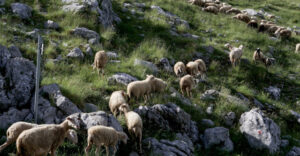
A total of 57,000 animals have been culled so far in Central Macedonia due to the outbreak of sheep pox, while cases have been confirmed in 250 farms across the region, according to data presented today by George Kefalas, Deputy Regional Governor for Agricultural Economy.
During a special session of the Central Macedonia Regional Council devoted to the administration’s accountability, Mr. Kefalas stated that “the scale of the epidemic was such that we could hardly keep up with events.” He described the situation as a health crisis comparable to COVID-19, adding:
“The sheep pox epidemic has taken on dramatic proportions and shows features previously unknown. One of them concerns its high contagiousness. According to veterinary literature, the degree of transmission is unusually high and cannot yet be fully explained. Possibly, we are dealing with aerosol-based transmission that has not been scientifically documented so far — or even transmission through insects, which also has not been previously recorded.”
Representatives of livestock farmers in Central Macedonia described the dire situation they are facing. Emotions ran high during the meeting as they accused the state and regional authorities of mismanaging the crisis — failing to follow protocols and delaying the culling and burial of infected herds, allowing the disease to continue spreading.
They called for immediate vaccination of herds, compensation for those who lost their flocks, financial support for those still keeping their animals alive, suspension of tax and social security obligations, and increased subsidies for animal feed.
Mr. Kefalas responded that the region did not delay its reaction, explaining that all seven regional units had pre-existing contracts for emergency measures — disinfection, sanitary burials, culling, and incinerations. He acknowledged, however, staff shortages, noting that new veterinary hires for two- and eight-month terms have been initiated.
He also revealed that 21 out of 37 municipalities failed to designate sanitary burial sites as requested — an omission that prompted him to refer the matter to the Thessaloniki Prosecutor’s Office.
“A preliminary investigation was launched. Mr. Tertivanidis, the General Director of Veterinary Services, has testified, and we await the outcome,” he added.
Mr. Kefalas also mentioned that police investigations had uncovered breaches of biosecurity measures, particularly violations of grazing bans. “Some farmers had sick animals and did not report them,” he said, noting that two seminars on biosecurity had been held — yet no farmers attended.
He announced that 35 new disinfection stations will be established, as the existing trenches proved inadequate, and that PCR testing kits will be available next week. Farmers will be able to collect saliva samples, receive results within 48 hours, and quickly send animals for slaughter to contain the spread.
Regarding compensation, he said that the region is pressing for “rational” payouts, as the current amounts are negligible compared to the scale of the losses.
The issue was raised in the council by regional councillors Kalliopi Valtadorou, Sotiris Avramopoulos, and Maria Papadimitriou, who requested updates on vaccination plans, compensation policies, and next steps.
Mr. Avramopoulos argued that a campaign against vaccination was promoted to avoid disrupting feta exports, controlled by a few major business groups. Meanwhile, Giannis Mylopoulos, head of the “Change in Central Macedonia” faction, criticized authorities for failing to act in time:
“Vaccination should have taken place in May, when officials didn’t realize the risk. The EU had vaccines available and told Greece to purchase them — but Greece refused.”
On the vaccination issue, Mr. Kefalas clarified:
“The decision rests with the General Directorate of Veterinary Services at the Ministry of Rural Development and Food — not with us. We have submitted the European Commission’s Health Directorate file to three veterinary professors for scientific evaluation. Currently available vaccines come from third countries — Turkey, Jordan, Pakistan — and just yesterday, a U.S. laboratory announced one. It is not for us to decide whether it should be used.”
Ask me anything
Explore related questions




