





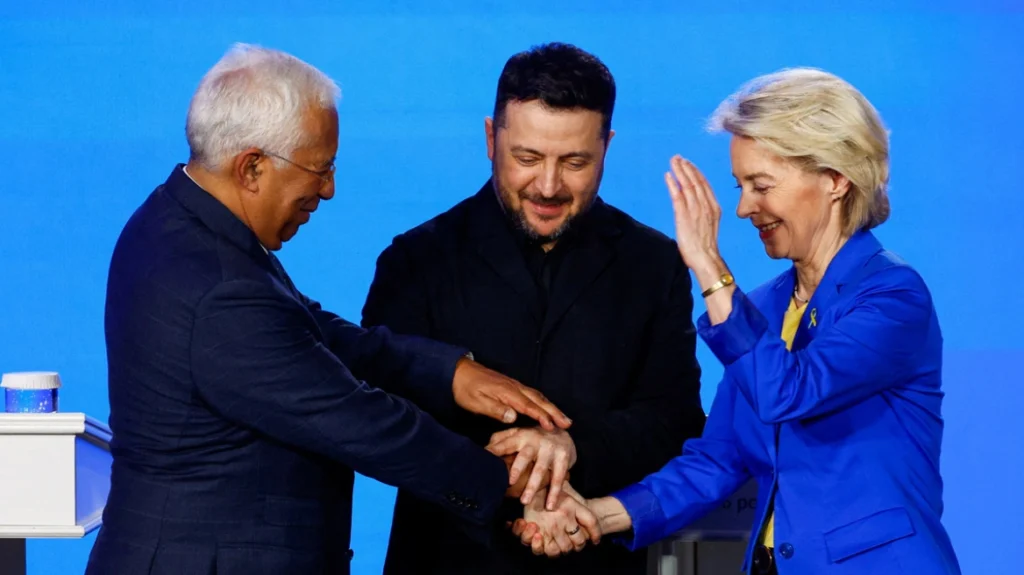
The new package from the European Union is, once again, not only an economic lifeline for Kyiv. It is a political admission that the war is entering a prolonged phase, that diplomacy has “frozen,” and that Europe is now being called upon to finance not only Ukraine’s survival, but also its military endurance.
For months, Europe insisted on keeping the “chapter” of peace open. Support for Kyiv, yes. Sanctions on Moscow, also. But always with the expectation—however rhetorical—that somewhere in the background a window for negotiation could reappear. The new loan of $106 billion (€90 billion) to Ukraine comes to dispel exactly that illusion.
The decision, which was unblocked today after Hungary lifted its veto, is not just another financial package. It is a strategic declaration. And that declaration says something very simple: the European Union does not believe the war will end soon. On the contrary, it is preparing for a long, costly, and deeply dangerous front in which Ukraine will need not only fiscal support, but also stable military financing over years.
This is already evident in the structure of the package itself. Unlike previous European commitments, the new funding is clearly oriented toward defense. Around $70 billion is allocated for military needs, for air defense systems, for drone production, and for strengthening a war effort that is no longer treated as a transitional phase, but as a new normal.
Europe fills the US gap
The EU is not simply financing Ukraine because it wants to support it. It is doing so because it understands that the American gap is neither temporary nor manageable. The fact that US aid has collapsed almost completely, with a 99% drop over the past year, changes the entire equation.
For years, Europe could present itself as the steady but not decisive partner, knowing that the strategic burden ultimately remained in Washington. Today, that is no longer the case.
The Trump administration not only failed to meaningfully strengthen Kyiv, but also did not apply the pressure on Moscow that many Europeans expected in order to achieve a serious compromise. Thus, Europe is confronted with a reality it long tried to postpone: if Ukraine is to continue resisting, it must pay the bill itself—on a much larger scale and for a much longer period.
It is no coincidence that alongside the €90 billion loan ($106 billion), there is already an expectation of an additional €117 billion from the Union’s long-term budget once the initial funds are exhausted. The message is clear: Brussels is not planning for months. It is planning until 2029.
Peace freezes, war becomes institutionalized
The second major truth behind the package is that peace talks, at least in their current form, are producing nothing at all. Russia has not accepted a ceasefire. US mediation has lost depth and political weight. And US involvement in a new war in the Middle East is shifting Washington’s attention, diplomatic capital, and strategic energy elsewhere.
Even more revealing is Moscow’s own stance. When Sergey Lavrov states that the resumption of talks is not a top priority for Russia, he effectively removes the last veneer of optimism. Berlin now says it openly: Russia, in the European reading, never took these talks seriously.
Thus, the discussion changes level. It is no longer about how the war will end. It is about how its duration will be financed. And this is an extremely harsh admission for a Europe that for years built its external identity on mediation, multilateralism, and economic power as a deterrent tool. Now, economic power remains a tool—but it is being used to sustain a war of attrition.
Kyiv also changes strategy
Ukraine’s own political system has adapted to this new reality. Volodymyr Zelensky did not simply carry out a technical reshuffle. By appointing Mykhailo Fedorov to the Ministry of Defense, he made a strategic choice with a clear message: Ukraine is not expecting a diplomatic solution in the near future and is investing in a war architecture increasingly based on technology, drones, air defense, and targeted attrition of the Russian war machine.
Fedorov’s logic is not one of ultimate victory in the classical sense. It is a logic of imposing costs: making the war so unprofitable for Moscow that at some point it will be forced to accept a settlement. It is a strategy of denial and exhaustion, not of dramatic reversal.
This matters. Because the European loan itself fits into this philosophy. The first disbursement wave—$33 billion for military needs and $20 billion for civilian expenses in the first year—is not aimed at “post-war reconstruction.” It is aimed at Ukraine’s ability to endure during the war.
The reference that the first funds could arrive in late May or early June to finance drone production is highly indicative. Europe is not investing in a post-war plan. It is investing in immediate war production.
Drones, air defense, and the new Ukrainian equation
Ukraine already claims it produces nearly 1,000 drones per day. If the new European funding allows this production to double, the assistance will not be merely accounting-based. It will translate directly into operational resilience.
Here, the technological logic of the new defense minister meets the EU’s strategic shift. Ukraine aims to close its skies, increase the cost of every Russian attack, absorb strikes more effectively, and simultaneously strike economic targets inside Russia—especially oil infrastructure that funds Moscow’s revenues.
This does not amount to a dramatic shift in the front line. But it does amount to a gradual shift in the balance of endurance. And in conflicts of this duration, endurance often matters more than momentary territorial gains.
The problem of the bill
However, there is also the more difficult side. The new loan, no matter how large, does not definitively solve the problem. It postpones it, manages it, stretches it over time—but does not eliminate it. The EU itself estimates the package will cover about two-thirds of Ukraine’s external financing needs over the next two years. The rest must come from other institutions such as the IMF.
And even so, there is a deep mismatch in the numbers. Ukraine’s official budget lists $66 billion in military spending this year. The Ministry of Defense, however, says that to truly implement its strategy of containing Russia, about $120 billion is needed. This gap shows that the current package, though decisive, is only one link in a much larger chain. In other words, Europe is buying time, not a solution.
Hungary, pipelines, and the geopolitics of vetoes
It is also worth noting what actually blocked this funding until now. Not a major ideological split within the Union, but a concrete national interest: the oil pipeline transporting Russian oil through Ukrainian territory to Hungary.
Budapest linked the funding approval to the continuation of oil flows. Once Kyiv completed repairs and the flow was restored, the veto was lifted. This illustrates a deeper truth of today’s Europe: strategic solidarity exists, but it always passes through the filter of national energy and political interests.
And precisely because this solidarity is not automatic, each new package becomes even more significant once approved. It is not only a product of political will, but also of overcoming internal European tensions.
The next phase of the war will not be decided only on the battlefield
The big picture is that the war in Ukraine is entering a new phase—not because the front line is changing radically today, but because its financial, political, and strategic foundations are changing.
Europe accepts that the conflict will not end soon. Kyiv is organizing itself as a wartime state. And Russia, as long as it is not decisively pressured into negotiations, retains the ability to continue a strategy of attrition, betting on the opponent’s fatigue.
The question, therefore, is not whether €106 billion is a lot. It is. The question is whether it is enough to change the political meaning of the war. For now, the answer is probably no.
It is enough to keep Ukraine standing and to allow it to fight better. But it is not enough to guarantee that Russia will soon be forced into retreat or serious compromise.
Europe is therefore doing what it can do most immediately: buying time, strengthening Ukraine’s endurance, and sending Moscow the message that Ukraine will not be left without oxygen. But it is also sending a second, perhaps heavier message to its own public: that peace is not around the corner, and that support for Ukraine will neither be short nor cheap.
This is the real content of the new loan: not only money—but the end of illusions.
Ask me anything
Explore related questions




