





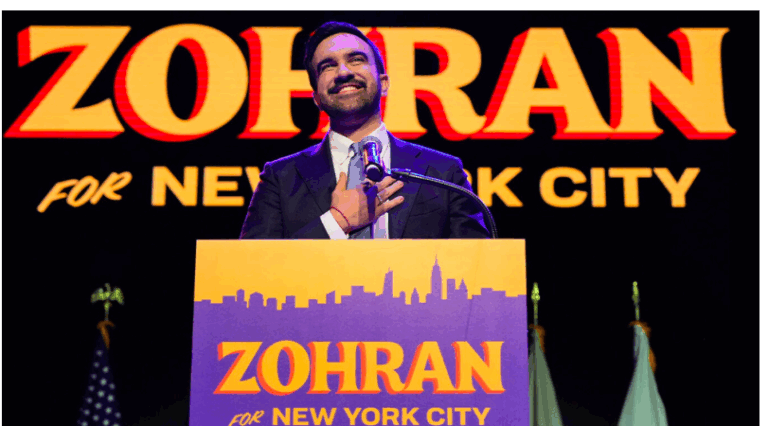
The election of Zohran Mamdani as mayor of New York City is more than just a local political event—it marks a rupture at the heart of the American urban establishment. For decades, New York has been the stage where Wall Street, real estate giants, and political machines have sought to shape the city’s destiny.
Mamdani captured the frustration of the middle class, young people, and immigrants burdened by skyrocketing living costs and the decline of the Democratic establishment. He didn’t win by inspiring hope as much as by capitalizing on the electorate’s exhaustion with the status quo.
A City on the Edge
New York is facing a deep structural crisis. Housing has become a luxury, public services are deteriorating, and the middle class is increasingly pushed to the suburbs or leaving the metropolitan area altogether.
Mamdani leveraged these realities with precision and persistence, advocating for a rent freeze, transportation improvements, and social welfare funded by taxing big businesses. While his platform resembled a movement manifesto more than a detailed governance plan, it was enough to unite a broad coalition of dissatisfied voters—an impressive majority.
Breaking with the Old Guard
Mamdani faced two powerful forces: Andrew Cuomo, representing the entrenched party apparatus, and the financial elites who view his victory as a threat to their investments. Despite limited administrative experience, Mamdani won by symbolizing a challenge to the arrogance that has long defined the mayor’s office. Voter turnout exceeded two million—a local record—reflecting a community voting less out of hope and more as a warning.
Early Market Reactions
Mamdani’s win immediately unsettled New York’s business landscape. Financial insiders report that major investment firms and tech companies are considering relocating their tax headquarters to New Jersey or Miami in anticipation of higher taxes and tighter real estate regulations. Investors see the new administration as unpredictable, focused on redistribution rather than growth. The New York Stock Exchange responded cautiously, signaling that uncertainty is now the norm.
The Federal Government’s Watchful Eye
Under Donald Trump, Washington is treating New York warily. The president has openly criticized “left-wing experimental administrations,” and his staff is reportedly exploring cuts to federal funding for cities pursuing policies “contrary to the national economic strategy.” If enacted, these measures would put New York under significant financial pressure, potentially amounting to political blackmail—a risky but highly charged scenario.
From Protest to Governance
The coming months will test whether Mamdani can transition from activism to effective administration. His agenda directly challenges developers’ interests, market orthodoxy, and federal policies under Trump.
Without pragmatism, Mamdani risks becoming locked in endless confrontation with little to show for it. But if he can balance his radical ideals with effective management, New York could become a global model for progressive governance. At this point, that potential seems more like an emerging reality than a distant goal.
Mamdani’s election is, above all, a stress test for the entire system. If markets retreat and Washington cuts funding, New York faces a tough road ahead. But if the city can maintain equilibrium, it may prove that even within America’s rigid capitalist framework, politics can once again speak the language of the people.
Ask me anything
Explore related questions




