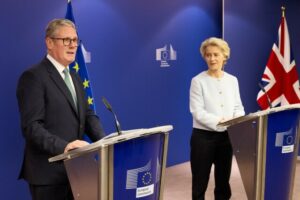
The British government appears to have been alarmed by the Commission’s demand for the UK’s participation in the European military programme SAFE.
According to information cited by the French Le Point, the European Commission, chaired by Ursula von der Leyen, has demanded from Prime Minister Kier Starmer a fair contribution, which is valued at a figure of between 4 and 6.5 billion euros.
This particular calculation, which takes into account the size of the UK defence industry, the country’s GDP, and, most importantly, the “substantial gains” expected from the programme, does not seem at all random. British BAE Systems, which is the sixth largest defence group in the world with an order book of €91 billion (at the end of 2024) and a turnover of £33.7 billion (€39.5 billion), will be the big beneficiary of access to the €150 billion package of concessional loans. The EU accounted for a third of British arms exports between 2019 and 2023, according to a House of Commons study.
Fair balance before joining the SAFE programme
For London, this equation is difficult. The Starmer government is, of course, keen to “reset” its relations with Brussels since the May 19 summit, which had led to the signing of a security and defence pact with the EU. However, the SAFE regulation, adopted on 27 May by the Council, explicitly provides in Article 17 that a fair balance must be struck between contributions and benefits and leaves no room for “stowaways” in the European military programme. The French were very insistent on this point during the development of the programme.
Without a predefined model for calculating the amount, the Commission has a lot of leeway – and the method of calculation is expected to be “complex”, according to a European source.
France and Italy back Brussels
To strengthen the Commission’s position vis-à-vis the British, an alliance has been formed around this financial requirement. France, of course, but also Italy, Spain, Lithuania and Luxembourg supported the Commission’s position. Paris, in particular, is careful not to offer the UK “discounted” access to the programme, while the rules already impose a 35% cap on arms manufactured outside EU countries and a limited list of partners (Norway, Switzerland, Iceland, Liechtenstein, Ukraine).
Time is not an ally, as member states must submit their national purchase plans before the end of November. If London wants to include its industrial players in these plans, the deal must be concluded quickly or reach a sufficiently advanced stage. At the end of October, the Commission said it was confident that within two to three weeks it would have“white smoke” but the amount required may make it difficult to gain political acceptance in Britain, where MPs will not fail to remind MPs that the UK will not benefit from the programme’s concessional loans – only from the right to participate in the common markets.
Strategic autonomy
The issue goes beyond the purely economic aspect. For Brussels, if it goes ahead, it is about confirming the framework of European strategic autonomy, keeping on board an indispensable ally – the UK remains the second military power in Europe. For London, on the other hand, it is an opportunity to keep its defence industry at the centre of Europe, nine years after the Brexit referendum, but it remains to be seen whether it is willing to pay that price to join the SAFE.
Ask me anything
Explore related questions