





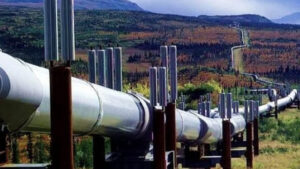
The Government of Northern Macedonia, at its last meeting, decided to pay a fee for the service of transporting oil derivatives through the VARDAX oil products pipeline.
With this decision of the Government of North Macedonia, all outstanding issues are effectively resolved and the way is now paved for the reopening of the Thessaloniki – Skopi oil pipeline, after 12 years of inactivity. The decision to pay the fee was the last pending issue. The decision was published on Friday (7/11) in the Government Gazette of North Macedonia.
The pipeline, after its radical upgrade, can transport 2.5 million tons of crude oil and petroleum products (diesel, kerosene and gasoline) per year. It is estimated that it will be used mainly for the transport of diesel.
Constructed in 2002
The pipeline was constructed in 2002 by VARDAX – in which HELLENiQ ENERGY owns 80% and the State of North Macedonia 20% – to connect the Thessaloniki refineries with the then refinery of OKTA (a subsidiary of HELLENiQ ENERGY), in Skopje.
As APE-MPE reports, in 2013, as was the case with several other relatively “simple” refineries in the region, which had been built according to other criteria during the Cold War era, it was deemed unprofitable to continue operating OKTA as a refinery. Instead, after careful study, it was decided to use OKTA’s facilities as a regional supply base in the Western Balkans, with a change of use of the pipeline to transport the latest and cleanest products instead of crude.
Although the pipeline and OKTA’s facilities were modified for the new operation and significant investments were made to modernize them, the pipeline remained dormant because of delays in the issuance of a relevant change in its licensing by the government of North Macedonia.
The pipeline has a total length of about 213 kilometers, of which 70 km are within Greek territory.
It is estimated that the reopening of the pipeline will also contribute greatly to the energy shielding of the Balkans, making North Macedonia an energy hub with HELLENiQ ENERGY expanding its economic footprint in the country.
The operation of the Greece-Northern Macedonia gas interconnector pipeline is also in the works
In addition to the Thessaloniki-Skopje oil pipeline, the operation of the Greece-Northern Macedonia gas interconnector is also in the works, the construction of which started a few months ago. This pipeline will have a total length of 123 kilometres and will interconnect the gas transmission systems of the two countries. The Greek section of the pipeline, 56 km long, will start in the area of Nea Mesimvria in Thessaloniki and will end in the area of Evzona – Gevgelis.
From there, the 67 km long section of the project within the territory of North Macedonia will start, ending in the area of Negotino. The initial capacity of the pipeline will be 1.5 billion cubic metres per year, with the possibility of expansion to 3 billion cubic metres per year, and studies have been carried out to ensure that the pipeline adopts the appropriate specifications for the transport of green hydrogen as well. The construction of the Greece-Northern Macedonia gas interconnector is expected to be completed in the first half of 2027.
Ask me anything
Explore related questions




