





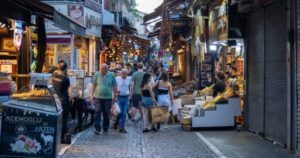
Every month, Cihan Çıtak — 48 years old, director of a food and beverage company — gets into his car in Istanbul, takes his passport, and heads to Alexandroupolis. The trip takes about four hours, but for him the journey is worth it. In the large supermarkets of the Greek city, he fills his cart with cheeses, wines and basic food items, paying up to one third of the price he would pay in Turkey.
“Olive oil that you find here for 10 euros per liter, in Turkey you pay double. The differences are huge,” he says. He is not simply looking for low prices, but better quality at a reasonable cost, according to Bloomberg.
Cross-border consumption becomes normality
The trend is not accidental. After the surge in high prices in Turkey, thousands of residents — especially of border regions — cross the border for their weekly shopping, the food they need. Data from the Turkish Statistics Agency shows that 6% of Turks who traveled to Greece in 2025 did so exclusively for shopping – the highest percentage since 2012.
In Alexandroupolis, the images are characteristic: full aisles, loaded carts, conversations in Turkish in the city’s restaurants.
On social media, dozens of videos present price comparisons of products like ground beef, sausages, gouda cheese and chocolates — all clearly cheaper compared to well-known chains in Turkey.
The shift in economic policy
Behind this shift lies the change in direction of Ankara’s economic policy. After Mehmet Şimşek’s return to the Ministry of Finance in 2023 and the abandonment of Recep Tayyip Erdogan’s unorthodox policies, the lira strengthened in real terms and food inflation retreated – but prices remained very high for households.
While the wealthy social groups benefit from the stock market and investor placements, middle and low incomes continue to live “month to month.”
Organized shopping trips
Travel agencies now offer day trips for shopping from Istanbul, Bursa and Çanakkale to Greece, with tickets around 50 euros. Participants fill bags with pasta, cheeses, yogurt, meat and vegetables and eat seafood at affordable prices in the seaside taverns of Alexandroupolis.
“Everyone leaves with full bags,” says a Turkish travel agent.
The only negative, according to Bloomberg: now there is a queue of hours at passport control when they return. “Last time we waited almost three hours,” Çıtak says.
And despite all that, he is already preparing the next trip.
And somehow, at the exit of the Egnatia, just before the view opens to the Thracian Sea, Alexandroupolis is no longer just a port, a border or a city living with its eyes turned to the wind and travel. It has gradually become a different destination: a place of “breath” for thousands of Turkish consumers who seek something simple and at the same time fundamental. Prices that can be endured…
Ask me anything
Explore related questions




