Inauguration of the international office of the University of Ioannina in New York – Archbishop Elpidophoros, see photos
The University of Ioannina is taking an important step towards extroversion and international presence, with the establishment and operation of an International Office in New York, in cooperation with the Greek Orthodox Archdiocese of America
Newsroom
Δείτε περισσότερα άρθρα μας στα αποτελέσματα αναζήτησης
In a significant move to expand its international outreach, the University of Ioannina has established an International Office in New York in partnership with the Greek Orthodox Archdiocese of America.
Located within the Archdiocese’s premises, the Office will serve as a vital link connecting the Greek community, U.S. academic institutions, and anyone interested in Greek language, education, and culture. Its mission is to promote the University’s Greek- and English-language programs, organize educational events, support conferences and symposia, provide scholarships and accredited courses to diaspora students and educators, and enhance Greek language teaching within the Archdiocese’s schools.
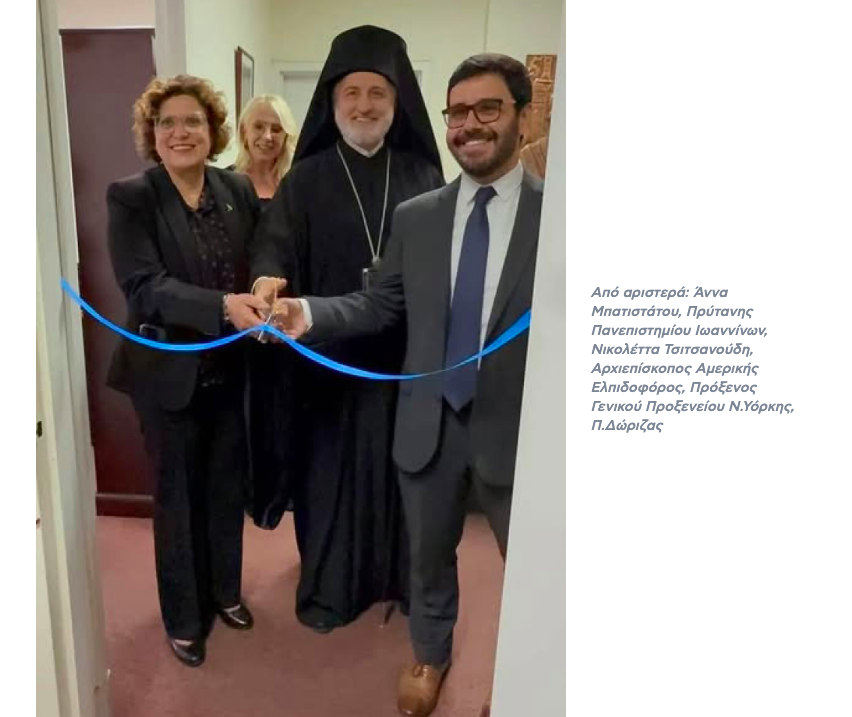
This collaboration was formalized with a Memorandum of Understanding signed on May 28, 2025, at the Museum of Fine Arts in Boston by Archbishop Elpidophoros of America and Professor Anna Batistatou, Rector of the University of Ioannina. The International Office was inaugurated at the Archdiocese’s New York City offices, with representatives from both institutions present, including Professor Nikoletta Tsitsanoudi-Mallidis, Dean of the School of Education, and Father Gregory Tilemachos Stamkopoulos, Associate Professor at Aristotle University of Thessaloniki and Head of the Archdiocese’s Greek Education Department.
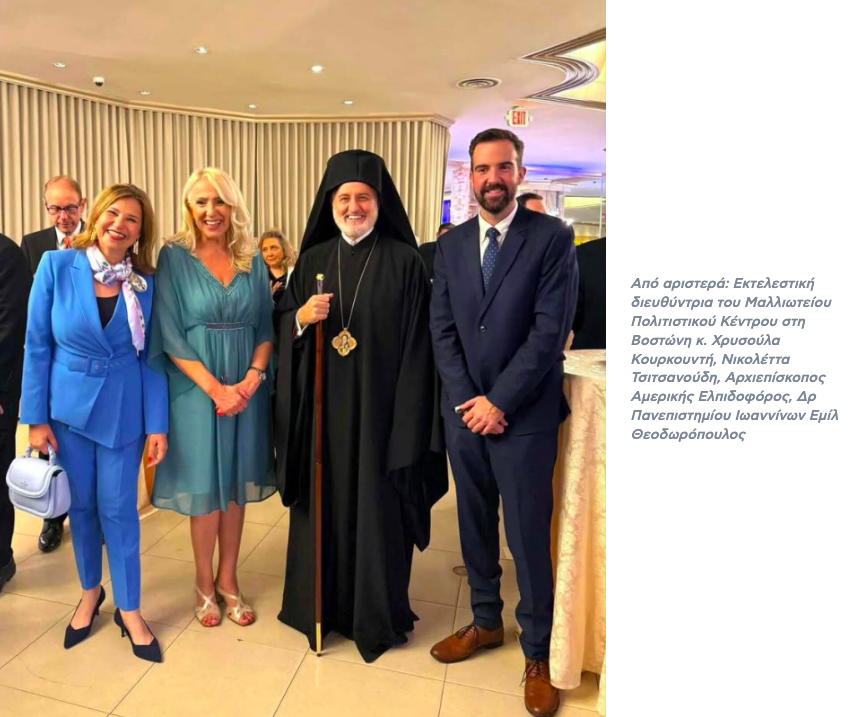
From left: Archbishop Elpidophoros of America, Anna Batistatou, Nikoletta Tsitsanoudi, Christos Michalakelis (President of Study in Greece), and Professor Anastasia Giannakidou (President of the Center for Hellenic Studies, University of Chicago)
During the event, the University presented a free training program for expatriate volunteers designed to support Greek language education abroad.
Professor Nikoletta Tsitsanoudi-Mallidis, who directs the program, told protothema.gr:
“Following a brief visit to New York, where we met academics from top U.S. universities including Harvard, Chicago, and Ohio, we held an international symposium marking the International Office’s launch. The theme was Greek education as a global, timeless, yet timely legacy. We announced a major educational initiative running from January to April 2026, featuring lectures by distinguished professors from Greek and international institutions. The program aims to train non-educator volunteers to teach Greek language and culture abroad, organized by the University’s Center for Continuing Education and Lifelong Learning in cooperation with the Archdiocese and the University’s Laboratory for the Study of Social Issues, Media and Education.”
She added:
“From January 17 to April 4, 2026, our Saturday evenings will be dedicated to the expatriate community. We will connect online with volunteers across the U.S., discussing language teaching with vision, inspiration, persistence, and passion.”
Regarding the program’s core principles, Tsitsanoudi explained:
“We view the Greek language not merely as a communication tool but as a carrier of cultural identity and a bridge between generations in the diaspora. The program combines theory and practice, aiming to equip volunteers without prior pedagogical training with knowledge and skills to support Greek language education and cultural heritage preservation.”
How will this be achieved?
“We will first analyze key challenges in teaching Greek as a heritage language, explore communicative approaches to handling language errors, and guide participants in designing creative teaching scenarios incorporating literature, music, and even mathematical concepts to develop language awareness.”
The program emphasizes active learner participation, autonomy, linguistic diversity, and the integration of digital technologies and artificial intelligence to enhance teaching and learning.
Tsitsanoudi highlights:
“Connecting language with cultural practices like poetry, music, and literature serves dual purposes: cultivating language skills and creativity, while strengthening cultural identity among expatriate children. The child is treated as an active learner, with goals to foster social skills, critical thinking, and linguistic sensitivity.”
A Pioneering Program
“The program’s innovation lies in its scientifically grounded blend of theory and practice, creative teaching tools, and focus on the Greek language as a vessel of cultural and historical continuity. Graduates will gain both theoretical insights and practical teaching tools that can be immediately applied, supporting the sustainability of Greek-language education in diaspora communities,” said the Dean of the School of Education at the University of Ioannina.
Open Call to Greek Academics
Many professors from Greek institutions will participate in the training program, contributing their expertise.
Tsitsanoudi encourages:
“We invite participants to actively engage, share experiences, ask questions, and experiment with teaching strategies. This program will become a platform for scientific and pedagogical exchange, enhancing the quality of Greek language education and cultural awareness in the diaspora.”
Training Program Content Overview
General Pedagogical and Linguistic Principles of Greek Language Teaching for Volunteers of the Expatriate Community (Non-Educators)
Saturday, January 17, 2026 20:00-20:15 — Greetings:
Anna Batistatou, Rector, University of Ioannina Father Telemachus Gregorios Stamkopoulos, Scientific Officer, Archdiocese of America, Aristotle University of Thessaloniki
20:15-22:00 — Introduction & Lecture by Nikoletta Tsitsanoudi-Mallidis: The great challenge of teaching: Negotiating error in language and communication.
Saturday, January 24, 2026 20:00-22:00 — Kostas Dinas, Professor Emeritus, University of Western Macedonia: Teaching Greek as a language of cultural heritage.
Saturday, January 31, 2026 20:00-22:00 — Zoe Gavriilidou, Professor, Democritus University of Thrace: Designing teaching scenarios for Greek as a Heritage Language in the Archdiocese.
Saturday, February 7, 2026 20:00-22:00 — Nikos Mathioudakis, Postdoctoral Fellow, Democritus University of Thrace: Creative activities inspired by Kazantzakis.
Saturday, February 14, 2026 20:00-22:00 — Athanasios Michalis, Associate Professor, National and Kapodistrian University of Athens: Methodological principles and practical applications in teaching Greek as a heritage language.
Saturday, February 21, 2026 20:00-22:00 — Emile Theodoropoulos, PhD, University of Ioannina: The teaching of Greek language in practice: Theoretical principles and practical ideas.
Saturday, February 28, 2026 20:00-22:00 — Marina Jakosta, Professor, University of Crete: Linguistic diversity as a facilitator of language development and teaching.
Saturday, March 7, 2026 20:00-22:00 — Penelope Vougioukli-Kabaki, Professor Emeritus, Democritus University of Thrace: Alternative approaches to teaching Greek through singing and mathematics.
Saturday, March 14, 2026 20:00-22:00 — Zoe Pavlopoulou, PhD, University of Ioannina: Teaching Elytis’ poetry in preschool and early school settings.
Saturday, March 21, 2026 20:00-22:00 — Themistoklis Gogkas, Associate Professor, University of Ioannina: Oral expression in the age of Artificial Intelligence.
Saturday, March 28, 2026 20:00-22:00 — Filippos Tentolouris, Assistant Professor, University of Thessaly: Digital ethnographic exploration of language and culture.
Saturday, April 4, 2026 20:00-22:00 — Despina Stefanou, PhD, Université de Montpellier Paul-Valéry: The expatriate child as an active learner of Greek: Teaching approaches and practices.