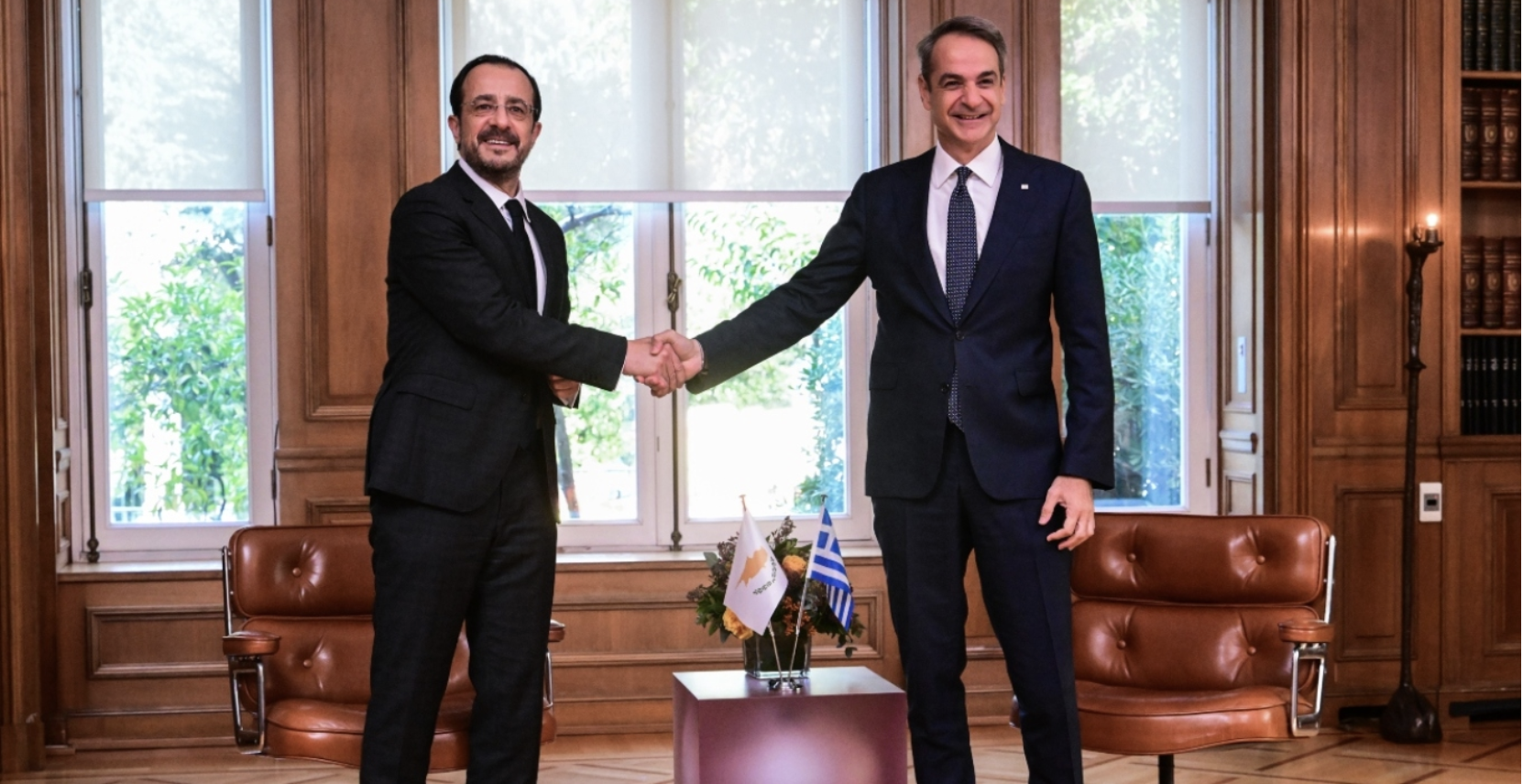
Prime Minister Kyriakos Mitsotakis and the President of the Republic of Cyprus, Nikos Christodoulides, are giving joint statements at the Maximos Mansion shortly after the conclusion of the 3rd Greece-Cyprus Intergovernmental Cooperation Summit.
Athens and Nicosia remain committed to international cooperation. The two countries serve as pillars of stability and reliability in the region, a fact confirmed by the agreements signed just two days ago. “At the same time, they carry a strong significance. We are following Cyprus on drilling issues, and a few days ago we opened a historic chapter,” stated the Greek Prime Minister. Mr. Mitsotakis clarified that Greece supports the green transition, but it would be wrong not to attempt to utilize its own resources—something Cyprus is already doing.
He also referred to the 3+1 framework, noting that it represents significant actions for substantial stability in our region. “We have decided to proceed with updating the technical parameters of the interconnection project between the two countries, so that it can be strengthened with the entry of new, strong investors, which benefits all of us,” he said.
Regarding the Cyprus issue, he reiterated that Greece is working toward the reunification of Cyprus. In closing, Mr. Mitsotakis mentioned that in one and a half months, Cyprus will assume the EU Council presidency for the first half of 2026. “All Greeks will stand by our Cypriot brothers. We will be by your side,” he said.
On his part, the President of Cyprus, Nikos Christodoulides, emphasized that the intergovernmental summit, held for the third time, carries both symbolic and substantive value, as befits Athens–Nicosia relations. “It strengthens our strategic cooperation across a wide range of issues,” he said.
Reiterating the ties between Greece and Cyprus, the Cypriot president noted that strategic cooperation is continuous, and he also announced the decision to update the financial and technical parameters for strategically important projects, such as the electricity interconnection project.
“The expansion of close and effective cooperation is a top priority and was a key component of the governmental discussions,” he said.
Mr. Christodoulides added that today the University of Nicosia operates in Greece under the law on non-profit universities. He also outlined areas of cooperation, including the environment and addressing water scarcity—a priority for the Cypriot presidency—civil protection, the protection of minors in the digital space, and foreign policy. “We continue to align our actions and policies,” he said, noting that coordination is underway for the full integration of Cyprus into the Schengen Area.
Greece and Cyprus agreed to maintain close coordination on a range of issues, particularly regarding Cyprus assuming the EU Council presidency and Greece in 2027. “Cyprus and Greece demonstrate in practice that together we achieve much more, primarily for our citizens, and this is one of our main objectives. At the center of our efforts is ending the occupation and the reunification of Cyprus,” based on UN resolutions and international law. “Greece is our most selfless ally and partner,” he concluded.
Ask me anything
Explore related questions