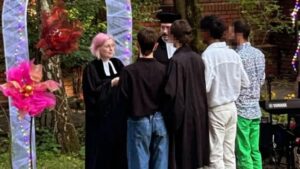
An unconventional “wedding ceremony” involving four men caused strong reactions in Germany in early November and reignited public debate about the limits of church practice, the legal framework of marriage, and social sensitivities.
According to a report by Berliner Zeitung on November 7, a 33-year-old pastor in Berlin held—by her own account—a “poly wedding” ceremony between four men, as part of a pop-up wedding festival in Kreuzberg.
In the intense backlash that followed, since polygamy is illegal under German civil law, the local Protestant structure expressed support for the pastor, while the Bishop of Berlin clarified that it was not an official church act with legal validity.
According to reports, the 33-year-old woke pastor Lena Müller—who describes herself on social media as a “feminist and pastor,” focusing on inclusion, feminism, queer-friendliness, and anti-racism—posted on Instagram that she had conducted her first “poly wedding” ceremony. The post, later deleted, showed Müller, the pink-haired pastor, together with four men, and read: “Four young men said ‘yes’ to each other, celebrated love with us, and placed themselves under the colorful blessing of God.”
The ceremony reportedly took place during a pop-up wedding festival in the summer—an open-air/temporary wedding festival set up in front of a Protestant church in Berlin’s Kreuzberg district, where couples could receive a blessing without prior registration.
Müller said that during the preparatory discussion it became clear the four deeply believed in their relationship. They even chose as their biblical verse “Love never ends.” She told Neue Osnabrücker Zeitung that “from the first moment you could see the great love between them,” and that the festival team quickly agreed to proceed with the blessing. “What could God have against there being four instead of two?” she reportedly said.
The term used in reports—“polycule”—was also explained: it refers to relationship networks resembling couples but involving more than two people, in the context of polyamorous relationships, where polyamory describes the practice or desire for romantic relationships with more than one partner at the same time, with everyone’s consent.
The revelation sparked strong reactions. The story was met with outrage in parts of the German press and social media, mainly referencing the incompatibility of such ceremonies with Germany’s legal framework for marriage: Article 1306 of the German Civil Code clearly states that “a marriage cannot be contracted if one of the persons wishing to marry is already married or in a civil partnership with a third person”—a provision that, in practice, prohibits polygamy.
Reports also reminded readers that the German state has in the past shown a degree of leniency in certain cases where religious or cultural contexts led to multiple marriages—such as in some Muslim immigrant communities where men already had more than one wife—but that, overall, the political stance remains a ban on polygamy.
The Church’s stance
The Church’s official reaction was twofold. On one hand, the Protestant Church of Berlin-Brandenburg expressed shock at the hate and attacks directed at Müller, posting on social media that they were “shocked by the hatred she is receiving” and that they “stand by her.”
On the other hand, Christian Stäblein, the Protestant Bishop of Berlin, clarified that the ceremony in question was not official or legally binding. According to reports, he emphasized that the ceremony did not constitute an official liturgical wedding within the church framework, noting that the four had previously held a civil marriage—a statement interpreted in reports as an attempt to separate the church blessing from a legally recognized marriage act.
Media that covered the story added details about the participants: Müller said the four men were two Latvians, one Thai citizen, and one whom she believed to be Spanish—the men reportedly spoke English among themselves. Their names were not disclosed by Müller, and photos circulating show the four men without providing further identifying details.
The case raises multiple questions: what a church blessing means in relation to the civil and legal concept of marriage and what boundaries religious communities set when their public practices clash with the legal framework.
Ask me anything
Explore related questions