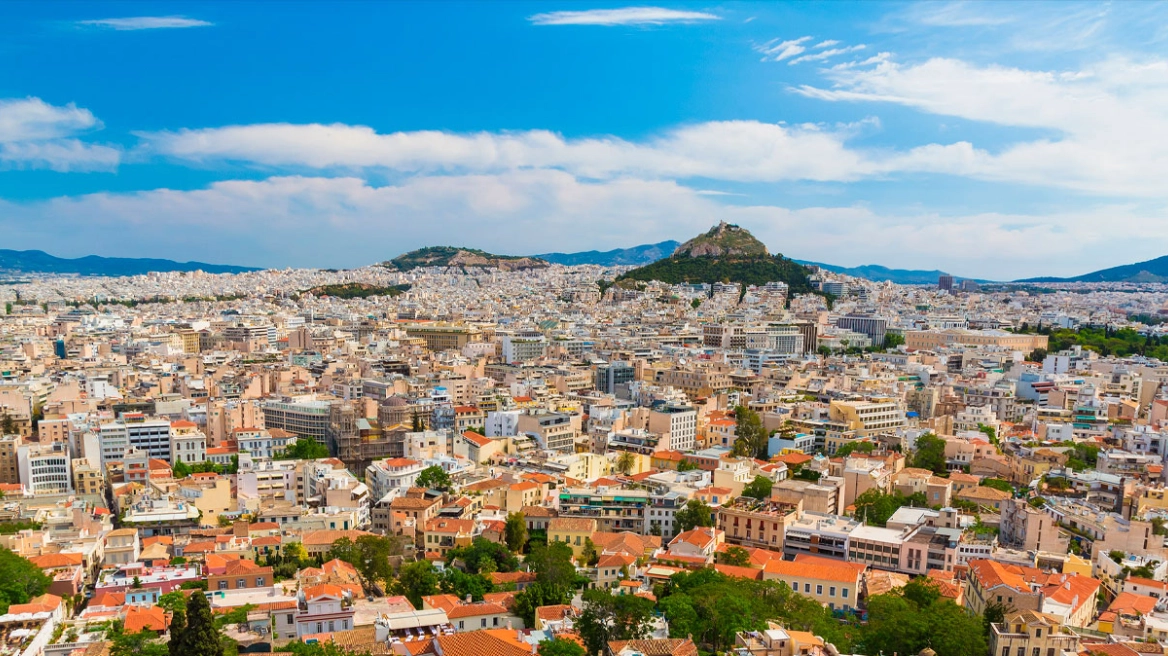
Those who live in Athens readily admit it. In this city, most residents feel suffocated. From daily commutes that have become unbearable—requiring hours of traffic for a trip that should take only minutes—to the overcrowding in public transport during rush hour. From the endless stretches of concrete, to people saying they cannot find housing, and experts warning that the capital’s infrastructure limits have been exceeded, and even to concerns that the water supply may not last much longer, everything points to the same suspicion: Have too many of us gathered in this city?
Athens is the definition of a metropolis—but also of over-centralization, in a country that chose to concentrate nearly half its population in a tiny area, just 2.9% of the country’s total land. Given that Athens, a truly ancient city, was built chaotically and without any planning to host such a large population, it is logical that the city seems close to reaching saturation. At this point—when life becomes unbearable—the idea of living somewhere outside the capital, especially when accompanied by incentives such as financial aid for young people, begins to seem more appealing than ever. But is this really the case? What are the signs that we are too many? Where are we feeling the squeeze, and what is missing? This report attempts to record the daily problems and shortages in Attica: from traffic, road lanes, and parking spaces, to the load on bridges, housing, office spaces, water, sewage, electricity, parks, squares, trees, groves, playgrounds, sports fields—everything that is insufficient or stretched to its limits because Athens hosts several million more people than this otherwise beautiful city can handle.
And what do we lack? The constantly increasing population brings more and more crowding and erases even the memory of the charms of old Athens. The empty lots and alleys where children once ran freely, the open spaces where worn-out balls nurtured legends of global basketball and football, the neighborhoods that once echoed with children’s voices, not horns and the curses of exhausted, noise-stricken, traffic-weary people.
50% of Greeks live on 2.9% of the country’s land
For someone to say they feel suffocated, they must truly be lacking space. To determine how much space we are missing, we need to see how many people occupy what is available. Here, we face an objective difficulty: recording the actual population of Athens. The latest official census (2021) found that 3.8 million people live in the basin (3,814,064 to be precise). This number is disputed, however, because various reasons prevented an accurate count. For example, due to COVID, many people refused to open their doors to census workers, while undocumented migrants chose not to “exist” for any official authority, and people registered in rural areas but living in Athens preferred to be counted in their hometowns for their own reasons.
The Municipality of Peristeri, for instance, which was recorded at about 133,000 residents, protests this figure, arguing that its real population is more than triple. Some municipal officials speak of 300,000 residents, others of 500,000 for the second-largest municipality in Greece after Athens (the 7 municipal units of the City of Athens have more than 700,000 residents, and if Peristeri has 300,000, it rivals Thessaloniki’s 317,778 residents and surpasses Patras with 211,593).
Something similar is happening with the total population of Athens. Unofficial measurements, such as those from commercial associations, estimate the real population as high as 5.2 million, with more conservative estimates placing it around 4.5 million.
Even based on the official figure of 3.8 million, Athenians have some of the least available space per person in Europe. The Region of Attica, considered part of Athens due to the city’s rapid expansion, occupies 2.9% of Greece’s land and has the eighth-largest population among EU metropolitan areas, according to the latest Eurostat data. But it has the second-highest population density in all of Europe.
After Paris, which has an average of 21,044 residents per square kilometer—the highest in the EU—Central Athens ranks second, with 10,436 residents per square kilometer. Also in the top ten are South Athens (7,498 residents per sq. km.) and West Athens (7,114 residents per sq. km.).
In practice, each Athenian has only 96 square meters of free space. This ratio is much better than in extremely dense megacities such as Kolkata, Manila, and Hong Kong—with 40,000 residents per square kilometer—but it is still inadequate by European standards. It indicates a high-density, heavily built-up urban area with limited open space and greenery per resident.
Noise levels above 75 dB
Calling Athens “noisy” is almost a cliché. The normal scene during rush hours—on central neighborhoods, major avenues, commercial streets, and lately even in small residential areas—is gridlocked cars, honking, revving motorbikes, shouting, jackhammers, drills, hammers, and barking dogs. Silence is a foreign concept to Athens. And this is no joke, as noise has been scientifically proven to dramatically harm the health of those who endure it.
Don’t take it lightly. A World Health Organization study concludes that daily exposure to sounds above 75 dB causes various health problems—from hearing damage to high blood pressure, heart palpitations, anxiety, psychosomatic illnesses, sleep disorders, brain dysfunctions, and even cancers. The study, which reports a reduction in healthy life expectancy due to traffic noise, ranks Athens among the noisiest cities in the world. Hardly an exaggeration when one considers that it is the “kingdom” of jackhammers, car horns, and faulty exhaust pipes. And this despite the fact that cars today produce 90% less noise than in 1970.
According to independent studies, the noisiest streets in Athens include Vouliagmenis Avenue, Alexandras Avenue, Katechaki Avenue, Vasilissis Sofias Avenue, Athinon Avenue, Mesogeion Avenue, Kifisou Avenue, Konstantinoupoleos Street, and Panepistimiou, Patission, Acharnon, Lenorman, Omirou, and Charilaou Trikoupi Streets.
The numbers
3.8 million is the population of Attica (according to the official 2021 census). However, estimates place it at 4.5 million.
9 million tourists are expected in Athens this year.
6 million cars are on the city’s roads.
2 million is the maximum capacity of the road network.
The… troubles of the Athenian
- Shares each square kilometer with 10,436 other residents
- Shares 2.9% of Greece’s territory with half the country’s population
- Has only 0.96 sq. m. of green space per person (while the “safe” level is 9 sq. m. per person)
- Loses 2 days stuck in traffic every year
- Gets stuck along with 8,000 others on Kifissos Avenue
- Searches for parking in the center, where 340,000 parking spaces are missing
- Is exposed to more than 75 decibels on average daily
- Must outrun 999 others for the newly built home that corresponds to them
- Must “compete” with 30,000 other renters looking for housing
200 metro stations are needed
Transport experts agree with Thanasis Tsianos’s statement that solving Athens’s mobility problem will come only through upgrading public transport (which stalled during the country’s crisis), especially the metro. “We need rapid expansion of the metro network (a total of 200 stations),” says Tsianos.
He explains that one metro line is equivalent to four urban avenues, and increasing train frequency to every three minutes on Lines 1, 2, and 3 is equivalent to adding a new avenue 110 kilometers long.
Today, in practice, trains often run every 6 minutes, serving a maximum of 10,000 passengers during peak hours per direction. The current plan, with a 4-minute frequency, foresees 15,000 passengers served per direction, while achieving a 3-minute frequency would serve up to 20,000 passengers per peak-hour direction.
30,000 rental homes are missing
If there is one issue that hurts Athenians more than any other, it is housing. The capital is experiencing an unprecedented housing crisis, as thousands of people desperately try to rent—and to a lesser extent buy—a home but cannot find one. And if they do, they must pay more than… renting Versailles. According to a Deloitte study, due to high demand, limited supply, and high rental prices, Athens is the second most unaffordable housing market in Europe, behind only Amsterdam, requiring 15.3 times a household’s annual income to buy an average apartment.
How many homes are missing from the market? The most recent available data from a Piraeus Bank study estimate the supply deficit relative to demand at around 212,000 homes nationwide. Real estate market experts tell “THEMA” that in the capital alone the deficit exceeds 30,000 homes. They explain that the deficit is not easy to measure because, for example, properties for sale are far more numerous than those available for rent, and those offered at triple the basic wage are far more numerous than those offered at humane prices. The available housing stock—or what appears to be—is in fact old, poorly maintained, and inadequate (e.g., without heating, without security doors, with drafty windows), and cannot meet citizens’ needs.
According to the Piraeus Bank study, this housing shortage has driven cumulative home prices 14% above what income growth would justify.
Is there salvation from this nightmare? With property prices having risen by more than 70% between 2017 and 2024, according to a BluPeak Estate Analytics study, Athens is building only one new residence per 1,000 residents—the lowest rate in the European Union.
Waiting lists for the few parking spaces
In Nea Smyrni, there is a waiting list at the municipal parking authority for anyone wanting to rent a permanent parking spot. In Kallithea, residents drive in endless loops searching for a space. In Kypseli, a resident recounts being forced to sleep in his double-parked car so he wouldn’t go to work sleepless the next day after searching for parking all night. In Athens, parking is the very definition of a nightmare, explaining why in neighborhoods with the worst traffic and weakest infrastructure for on-street and permanent parking—such as Kolonaki—a parking space can cost more than in Monte Carlo and more than a small apartment. Why?
This becomes clear once we consider how much smaller the supply of parking spaces is than the demand. According to an older study (for a period with lighter traffic), about 60,000 cars parked at night within the small ring of Athens, while during the morning peak (10 a.m.–1 p.m.), another 100,000 parked there, of which more than 35,000 “excess” vehicles parked illegally because supply was limited to 35,000 on-street spaces and 25,000 off-street spaces. According to current data from the Hellenic Institute of Transportation Engineers, more than 500,000 cars enter the small ring daily, only 30% of which is through-traffic. This means that about 350,000 cars park within the small ring alone.
Data from the Municipality of Athens now indicate that every day not 500,000 but 700,000 cars enter the city. Within its boundaries, the Controlled Parking System covers 5,177 resident parking spaces, 3,463 visitor spaces, 1,604 motorcycle spaces, and 1,000 special spots for people with disabilities. Up to 350,000 cars, there is a small… gap.
Traffic jams on roads built for… half the population
“The traffic capacity of our roads is three times smaller than the number of cars they serve. It’s like placing 30 people in a room meant for 10. No matter how well you distribute the space, you will still be cramped. The region was designed for 2 million residents, and today the population exceeds 4 million. During tourist season, that number can even double.” With these words, road safety advisor and transport engineer Kimon Logothetis explains the futility of trying to interpret Athens’ traffic problem.
Sitting in their immobilized car in endless traffic, the average Athenian is estimated to lose more than two full days of their life each year—time expected to increase rapidly in the coming years. Transport engineers say that more than 2.5 million cars circulate daily in the capital, out of the 6 million that exist, and congestion is inevitable as more and more people use the roads. This is also due to the rising number of total movements of people and goods, as tourism and commercial activity increase heavy vehicle traffic to and from the country’s main port—Piraeus—as well as Aspropyrgos and Elefsina.
The president of the Association of Hellenic Transport Engineers, Thanasis Tsianos, explains that Kifissos Avenue sees 260,000 daily crossings, while Attiki Odos handles 280,000 per day, an increase of 20% from 2022 to today. Traffic on Attiki Odos is estimated to rise by 55% by 2050, reaching 430,000 crossings. A key factor will be the increase in trucks (expected to grow by 16% by 2030), since if 9% of the traffic consists of trucks, their impact on congestion is equal to 22%. The Association of Transport Engineers estimates that future increases in traffic on critical road axes may exceed 16% by 2030. The fact that the city is spreading out does not solve the problem; on the contrary, it means longer trips for residents, and thus each private vehicle “loads” a greater length of the road network.
The paradox observed by experts, as Mr. Tsianos explains to THEMA, is that as congestion increases, the capacity of the road network decreases. In simple terms, when a road artery becomes clogged, fewer cars actually pass through it than during off-peak hours. For example, on one section of Kifissos Avenue (at the height of Athinon Avenue), during the non-peak hour of 12–1 p.m., it handles a traffic load of 9,300 vehicles. But when the peak hour comes (9–10 a.m.), only 8,000 vehicles pass through the same point—because it is blocked. Interchanges were designed and built for much lower traffic volumes, waiting areas are insufficient, and traffic lights in many cases operate with timing plans calculated decades ago. Even Attica’s bridges are now monitored by sensors, as current traffic is up to twenty times what they were originally designed to handle when they were built 20–25 years ago.
Tourist traffic at record levels
Athens is experiencing by far the best tourism year in its history in 2025, with the number of foreign visitors expected to break all previous records, likely surpassing 9 million for the first time. Already in the first nine months of this year, international air arrivals at the country’s largest airport reached 7 million—more precisely, 6.95 million—an increase of more than 600,000 visitors compared to the 6.34 million in the corresponding nine-month period of 2024, which had been the strongest tourism year for the Greek capital.
Last week, at the conference titled “Tourism: Real Problems and Myths,” the mayor of Athens, Haris Doukas, referred specifically to the sharp rise in foreign visitors, which will gradually reach 10 million, all the more so as the Greek capital becomes a year-round destination.
It is noted that in 2024 international arrivals at Athens International Airport “Eleftherios Venizelos” reached 7.92 million—another record—having increased by 12% compared with the next best year, the 7.07 million arrivals of 2023. In 2022, the figure was 5.55 million, and in 2021 it was 2.92 million. Before the pandemic, in 2019, the number of international arrivals in the Greek capital was 6.4 million.
The largest number of visitors comes from traditional markets (USA, UK, Germany, France, Italy), with the majority of European markets posting double-digit increases in visitors, and the Israeli market also showing very strong growth.
Significant upgrades have also taken place in hotel infrastructure, with more international brands (Marriott, Hilton, Accor, etc.) joining Athens’ hospitality market. According to official data from city hoteliers, between 2023–2024 the number of hotel rooms increased by 3% in Attica and 4% in central Athens, with growth mainly in 3- to 5-star hotels, while 1- and 2-star hotels continued to decline. Since 2017, 11 additional international hotel chains have entered Attica, raising the total to 23 chains operating 40 brands in 2024. Penetration of international brands remains strongest in the 5-star category, where 43% of hotels and 52% of rooms belong to international chains. In the 4-star category, the respective figures are 12% and 25%.
Ask me anything
Explore related questions