





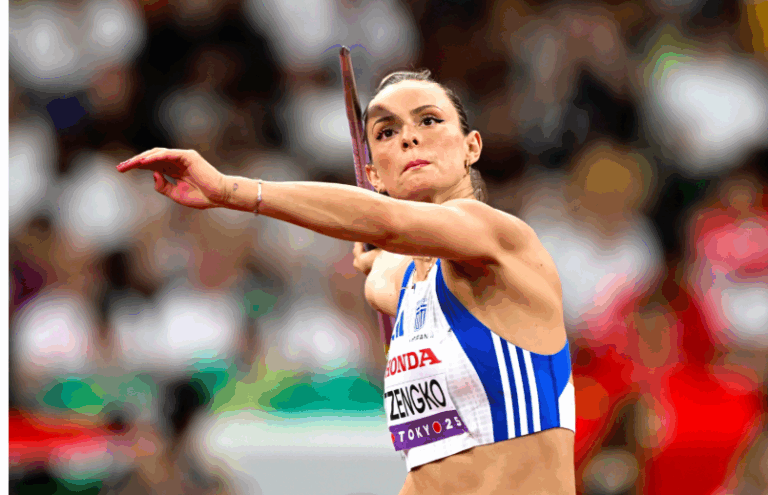
At just 23 years old, Elina Tzengko has already established herself as one of Greece’s most important athletes.
Her records in youth categories, her victory in 2022 at the European Championships in Munich—where she became the youngest European javelin champion—her fifth place at this year’s World Championships, and winning the Diamond Trophy in the Diamond League series are just a few highlights that have defined Elina’s impressive journey so far.
Coached by Giorgos Botskariov, Elina possesses the talent, personality, and confidence to be one of the top javelin throwers of the next decade.
The year 2025 marked a fresh start for the Greek champion. Not only because she combined great performances with important achievements, but mainly because she found the balance that allows her to enjoy what she does, manage pressure, and present her best self in major competitions.
What are your goals and ambitions for 2026?
“Definitely, I want to stay focused and relaxed. The competition schedule is set, and now the key is proper training and selecting the right events, with the European Championships in Birmingham next August as the absolute target. The throwing stadium in Nea Iraklia is also being prepared, which is very positive for our training since it will reduce our travels to Thessaloniki. The weather so far has been good, which helps us a lot. In January, we will move to Cyprus for the main phase of our preparation.”
Do you have any routines before your competitions?
“I stopped having specific routines because they made me overthink. When my mind is relaxed, everything comes out perfectly. Following a strict schedule stresses me out. On competition day, I set my own limits and act as I feel. For example, if I normally wake up at 8:00 a.m. but on the competition day I feel like sleeping more, I will do that.”
How heavy is the pressure when competing for the national team?
“When you compete for the national team, the pressure is greater. Your country expects you to win a medal. In other competitions, you compete just for yourself. With the national team, you compete both for yourself and for everyone else.”
What is harder to manage: physical preparation or psychological pressure?
“Definitely the psychological management of pressure. The body is always ready—we train all year for these events. But if the mind isn’t right, it affects the body. Anxiety can ‘freeze’ you; you can’t even find your footing.”
Your event requires you to spend a lot of time on the field. What do you think about during those moments?
“When I stay too long, I feel my energy dropping, so I like to move around and do things to distract myself. This year, I was very focused on what I had to do. But there were years when I was thinking about unrelated things during the competition, and I paid for it. I’d go to compete, but my mind was elsewhere. My coach was talking to me, but I was thinking about what I would eat after or what I’d do when I got home. That happened because I didn’t believe enough in myself. That was a big mistake. In those years, I’d go to the competition thinking, ‘One athlete threw 66.00m, another 64.00m, I don’t have those distances, so I’ll fight for third place.’ I basically started with a lower goal. I looked at the other athletes and thought, ‘I’m not cut out for that.’”
In 2022, at such a young age, you achieved a remarkable distinction. How did you handle the pressure?
“2022 was very stressful. All athletes go through that when they start to stand out. It took me some time to ‘wake up.’ It was a phase. I took everything too personally. The truth is, you should only focus on yourself. I knew I could throw the distances—I saw it in training; I was consistent. But in competition, I didn’t perform as I should because of anxiety. Then I’d say, ‘I have to throw this far…’ and that put even more pressure on me. Over time, I changed my philosophy, handled others’ pressure differently, and worked more for myself and less for others.”
You had a great performance in Tokyo, yet you wanted more. After the final, did you have doubts about yourself?
“I can’t say I failed in Tokyo. It’s just that I didn’t perform as well as I believed I could. I was upset because I was in great form and could have been on the podium. There was tension but also great relief because at the last competition of the year all the pressure lifts off your shoulders. It was a medal that slipped through my fingers—the same thing happened at the Olympics. Still, I was and am proud of myself for this year because I won the Diamond Trophy in the Diamond League and achieved several great performances. The World Championship competition was the most stressful for me. You never know what can happen. In the qualifying round, many athletes threw big distances but didn’t continue at the same level. One athlete came out of nowhere and had her best year ever. In the final, everything resets; we all start from the same line.”
Winning the Diamond League was one of the greatest achievements of your career. How important was that moment for you?
“It was a perfect feeling. The whole year had gone so well, and I expected a big throw from myself. But I had to stay very focused. There were good performances before that. I kind of ‘unlocked’ myself. I started the season strong, went to China and had two good competitions. At some point, I got tired of always being anxious—I wasn’t enjoying what I was doing. I even reached the point of saying, ‘I don’t want to do what I love anymore.’ Then I took it easier: if something doesn’t go well, there’s always the next competition.”
Ask me anything
Explore related questions




