

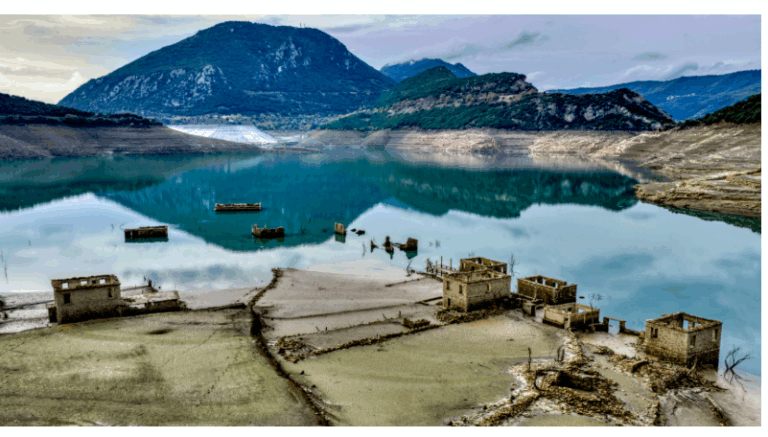
Attica is now confronted with the greatest water-scarcity crisis of the last 30 years, as the dramatic drop in reserves at the two main reservoirs supplying the capital — Mornos and Yliki — has reached alarming levels.
According to available data, water levels have fallen to their lowest point in a decade, forcing the state to initiate an emergency plan to safeguard water adequacy for the Athens basin, home to nearly half the population of Greece.
Recent measurements paint a bleak picture of rapid deterioration. At Mornos, the primary reservoir covering a large share of Attica’s needs, more than 40% of reserves have been lost within just two years, with the lake’s surface area nearly halved. At Yliki, the situation is equally troubling: water volume has dropped 40% in only the past year, highlighting how abruptly the hydrological balance has worsened.
Given these conditions, the government has already set in motion a state of emergency specifically for water consumption in Attica. The aim is twofold: to save critical quantities of water and to accelerate major infrastructure projects that will secure the region’s water supply for decades. The strategic target is to ensure the Athens basin can meet demand for at least the next 30 years through a combination of new works, infrastructure upgrades, and changes in consumer behavior.
A central pillar of the government’s long-studied plan is the “Evrytos” project. It involves redirecting surplus water from regions with higher rainfall — particularly from the Kremasta lake, where the Krikeliotis and Karpenisiotis rivers flow. At the same time, a series of smaller projects are being designed and implemented to improve water-management efficiency and strengthen the resilience of the water-supply system.
Within this framework, EYDAP is developing a major €2.5-billion investment program aimed at enhancing the resilience and modernization of water infrastructure. Investments include “smart” networks with telemetry and continuous leak-detection systems to reduce water losses, along with water-reuse projects for specific types of consumption, thereby easing pressure on drinking-water reservoirs. The goal is a more efficient, digitally monitored, and far less wasteful water-supply network.
Equally crucial, however, will be the behavior of citizens. Authorities emphasize that even with major projects underway, reckless or excessive consumption can worsen the situation — especially during prolonged dry spells.
Experts and EYDAP officials note that the capital is going through a period of “persistent drought,” comparable only to the crisis from 1988 to 1994. They stress that today’s problem is more complex because it is directly linked to the climate crisis. Across the Mediterranean, the number of rainy days per year has decreased, while mountain snow — which naturally feeds streams and rivers — has declined sharply. This leads to a steady reduction in natural inflow to reservoirs, making it much harder to replenish water reserves.
Despite recent heavy rainfall, specialists explain that the overall situation has not fundamentally improved. In intense downpours, most water rushes quickly to the sea instead of being stored in reservoirs, meaning such storms cannot compensate for the losses caused by long-term drought.
They also point to international examples showing how critical timely, coordinated action and responsible consumer behavior are. In 2008, Cyprus had to ship about 8 million cubic meters of water from Greece to meet its needs. Today, after learning from that crisis, Cyprus has significantly boosted its resilience through new desalination plants and stricter conservation measures — steps that Greece has yet to adopt on a similar scale.
Southern France, Spain, and Italy are facing similar pressures, with governments declaring “water-alert” conditions and implementing measures like those Greece is now planning — from consumption limits to major investments in new infrastructure and technologies.
In contrast, Iran serves as a negative example: delayed responses to a severe water-shortage crisis have led officials there to consider extreme measures, from water rationing to the possible long-term relocation of the capital, Tehran.
Ask me anything
Explore related questions