
The Cabinet has given the green light to the innovative modernisation provisions of the “Floridis Bill” concerning inheritance law, 80 years after their first implementation. On Tuesday, the political leadership of the Ministry of Justice will present the bill’s provisions, which adapt to the transformations of the family institution and contemporary social changes, such as civil partnerships, same-sex marriage, etc.
At the latest Cabinet meeting, Prime Minister Kyriakos Mitsotakis, during Justice Minister Giorgos Floridis’ presentation of the bill’s provisions introducing radical changes to inheritance law, highlighted that the current legal framework contains “provisions which have remained unchanged for 80 years, belonging to a legal environment suited perhaps to the country as it once was, but certainly not to the country we are now or aspire to become.”
Referring to the content of the “Floridis Bill,” the Prime Minister noted that inheritance law is undergoing a series of important and innovative reforms, such as “the introduction of the inheritance contract, changes to the shares when there is no will, strengthening the position of the spouse, recognising rights for partners, and procedures that will now be carried out digitally to eliminate delays.”
Mr. Mitsotakis also stressed that “the reform of inheritance law has a very significant developmental dimension regarding how assets are inherited today, which often results in heirs being unable to utilise property for reasons that can now be addressed through legislative changes.”
As “THEMA” revealed last Sunday (23.11.2025), a series of reforms is coming to inheritance law, including the establishment of inheritance contracts, changes to the legal share regime, protecting wills from forgery, etc.
Additionally, on Tuesday—after a one-week postponement—Mr. Floridis and Deputy Minister of Justice Giannis Bougas, together with Emeritus Professor of Law at the University of Athens Apostolos Georgiadis, who chaired the committee responsible for the reform, will present the innovative provisions of the bill that will be submitted to Parliament.
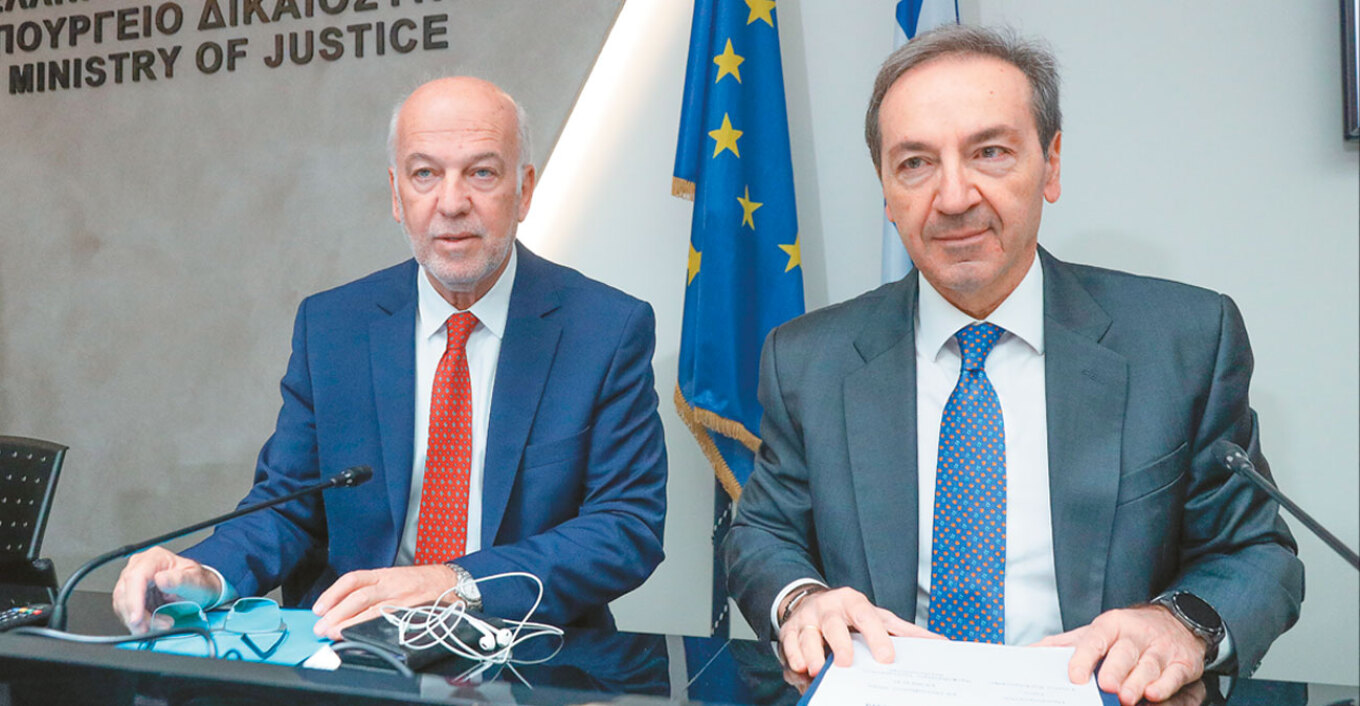
Justice Minister Giorgos Floridis and Deputy Minister Giannis Bougas present the new bill’s provisions on Tuesday.
Among the main changes introduced to inheritance law is that the testator can now ensure while alive that their wishes regarding their estate—whether movable, immovable, or other rights such as intellectual property—will pass to the persons they choose to protect. In other words, while still alive, they can regulate the assets they will leave to their heirs.
At the same time, the 80-year-old regime of the legal share for spouses and children changes. The surviving spouse’s legal share increases to 33.3%, leaving two-thirds (66.7%) to the children—an increase of 8.3%.
Additionally, the new provisions resolve the issue of the deceased’s debts. Under the new rules, heirs will not need to renounce an inheritance to avoid taking on debts owed to banks, the tax authority, etc., and abandoned properties will no longer deteriorate due to lack of upkeep.
The regime for wills also changes, introducing safeguards against forged wills—common in situations where elderly individuals are exploited in care homes or by relatives.
Public and secret wills will be drafted before a notary with only two witnesses, eliminating the option of a second notary.
To address the problem of forged handwritten wills, the bill provides that “a handwritten will will have no legal effect until declared valid by a court if the heirs are exclusively relatives or if the will is published more than two years after the testator’s death, regardless of who inherits.”

Examples from everyday inheritance cases
Validity of a handwritten will
- K. wrote a valid handwritten will naming his brother A. as sole heir. At the time of K.’s death, his son G. was alive. Is the handwritten will valid?
• Current law: Since G., a forced heir, was left nothing, the will is invalid as to the portion of the legal share (½).
• Proposed law: Because the sole heir is not a first-class heir, the will has no effect unless declared valid by a court. If validated, it is substantively valid, but G. gains only a monetary claim for his legal share.
Are the deceased’s debts inherited?
2. K. dies intestate with only debts. His son A. fails to renounce the inheritance on time. Does his personal property risk seizure?
• Current law: Yes—A. is liable with his personal assets.
• Proposed law: No—A. is liable only with the inherited estate.
Seizure of heir’s personal assets for the deceased’s debts
3. K. dies intestate with an apartment worth €100,000 and an equal tax debt. If A. accepts the inheritance, can the tax authority seize A.’s personal apartment?
• Current law: Yes.
• Proposed law: No—only the inherited apartment may be seized.
Creating an inheritance contract during life
4. Complex case involving a family business and children from two marriages.
• Current law: Only a will is possible, but it is revocable and insecure.
• Proposed law: An inheritance contract can secure the business for child A., while B. and S1 can waive their legal share for compensation.
Mutual inheritance contract between spouses
5. A. and B. want: each spouse inherits the other, and after both die, the entire estate passes to son G.
• Current law: Only separate wills; insecure and may violate legal shares.
• Proposed law: A binding inheritance contract is permitted.
How an unmarried long-term partner inherits
6. K., unmarried and childless, dies intestate, with no surviving relatives. He lived with A. for 10 years.
• Current law: The State inherits.
• Proposed law: A. may apply within 4 months; if the court confirms at least 3 years of cohabitation, she becomes the sole heir.
Ask me anything
Explore related questions