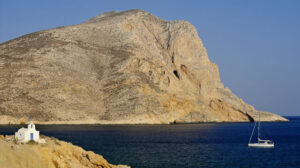
In the Aegean Sea, in the Cyclades, lies one of the most striking and fearsome rock formations in the world—often referred to as the “second Gibraltar.” It is Mount Kalamos on the island of Anafi, the second-largest monolith in the Mediterranean after the Rock of Gibraltar.
The shape of the rock speaks for itself. According to legend, it rose from the sea to help the Argonauts find a safe harbor.
Both rocks share the same sense of absolute dominance over the landscape. Like Gibraltar, Kalamos rises abruptly and in isolation, giving the impression of a natural, impregnable fortress.
Although Kalamos does not share Gibraltar’s military history, its position on the edge of Anafi—offering visibility across a large expanse of the Aegean—made it an important landmark and a spiritual stronghold, largely due to the monastery built upon it.
Monastery of Panagia Kalamiotissa
At the top of Kalamos stands the monastery of Panagia Kalamiotissa. Perched at an altitude of 460 meters, the ruined monastery is a single-nave domed chapel that hangs over the sea. Inside, it preserves an 18th-century carved wooden iconostasis, along with a few cells and a small cistern.
The monastery dates back to 1715, as indicated by an inscription on a stone plaque in the façade of a cell. It was abandoned during the 19th century, and its icons were transferred to the church of Zoodochos Pigi at the foot of the mountain, which subsequently took the same name, Kalamiotissa.
According to oral tradition, the icon of the Virgin was found near the monastery hanging from a reed—hence the name Kalamiotissa (“of the reed”). Another version attributes the name to the mountain itself, Kalamos.
The Island
The main settlement of Anafi is its Chora, the island’s only village, currently home to around 270 residents and located 1.5 km from the port.
Narrow stone-paved alleys, reminiscent of the Anafiotika district beneath the Acropolis in Athens, lead up to the primary school.
There are no tourist shops, and from the few tavernas you walk upward to the central square and the church of Agios Nikolaos, which overlooks the island’s western side toward Vagia and Santorini.
Monastery of Zoodochos Pigi
At the foot of Mount Kalamos, on the eastern end of Anafi at the end of the main road, stands the monastery of Zoodochos Pigi. It is built within the precinct of the ancient Temple of Apollo (the statue of Aigletes Apollo is housed in the British Museum).
The ancient temple was the center of religious life for the island’s early inhabitants and was connected to the political center at Kastelli by a 3-km paved sacred road.
The Monastery of Zoodochos Pigi (also called the Lower Kalamiotissa Monastery) is surrounded by a high wall made of carved stones taken from the ancient temple. To the right of the entrance lies the remains of the ancient Temple of Apollo.
The climb from the lower monastery at 200 meters altitude to the upper monastery at 460 meters involves a significant elevation gain.
The courtyard contains monks’ cells, storerooms, and at its center the small church of Zoodochos Pigi.
Ancient marble or local stone building materials were reused throughout the monastery’s structures, with several inscriptions embedded into the walls.
The refectory, on the right side near the entrance, incorporates parts of an ancient structure. Across the courtyard are scattered architectural fragments, including column drums.
The church was built in 1887, when the icon of Panagia Kalamiotissa was transferred from the upper monastery. It was damaged by the 1956 earthquake.
Ask me anything
Explore related questions