





An unconventional architectural practice of the Minoans—unusual given the meticulous attention they typically paid to their constructions, yet ultimately proof of their technical brilliance—came to light during the excavation conducted at the Palace of Archanes in Crete for the 2025 season.
Under the direction of Dr. Efi Sapouna-Sakellarakis, the archaeological research, which began—more accurately, resumed—in 2023, aimed to complete the picture of the three-story building of the Archanes palace, which flourished in the form we now uncover until 1450 BC.
The “Inclined Wall”
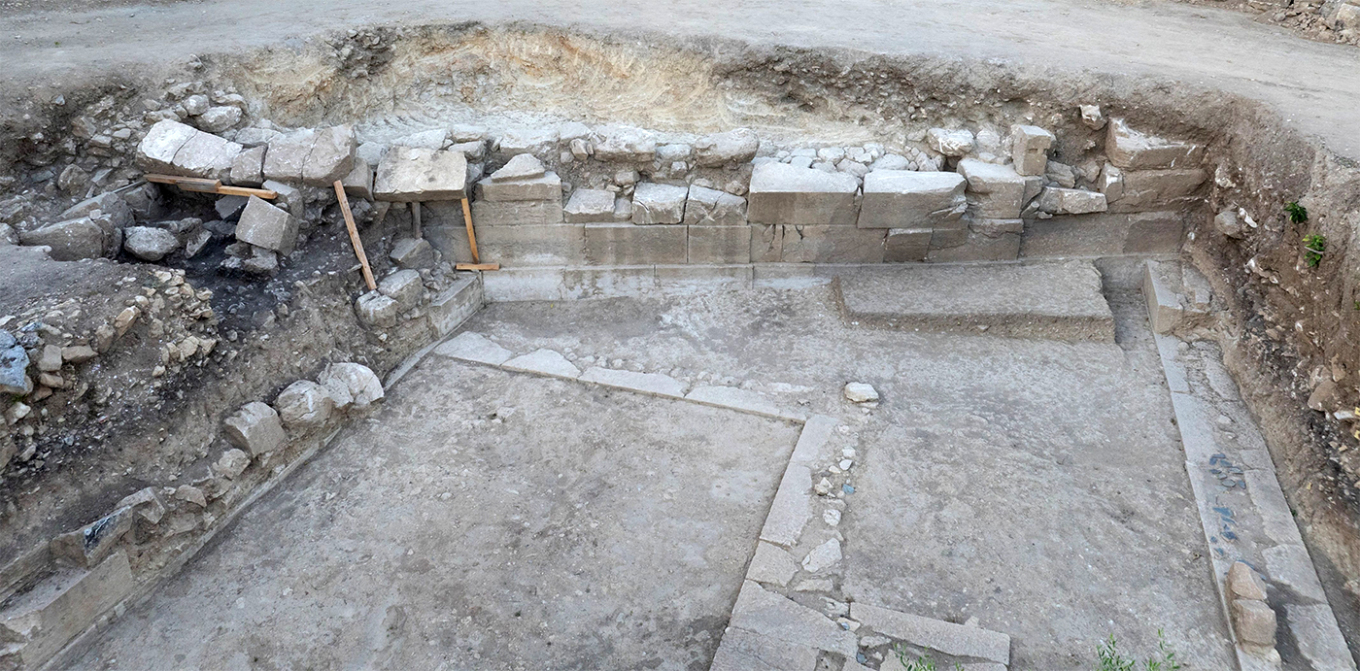
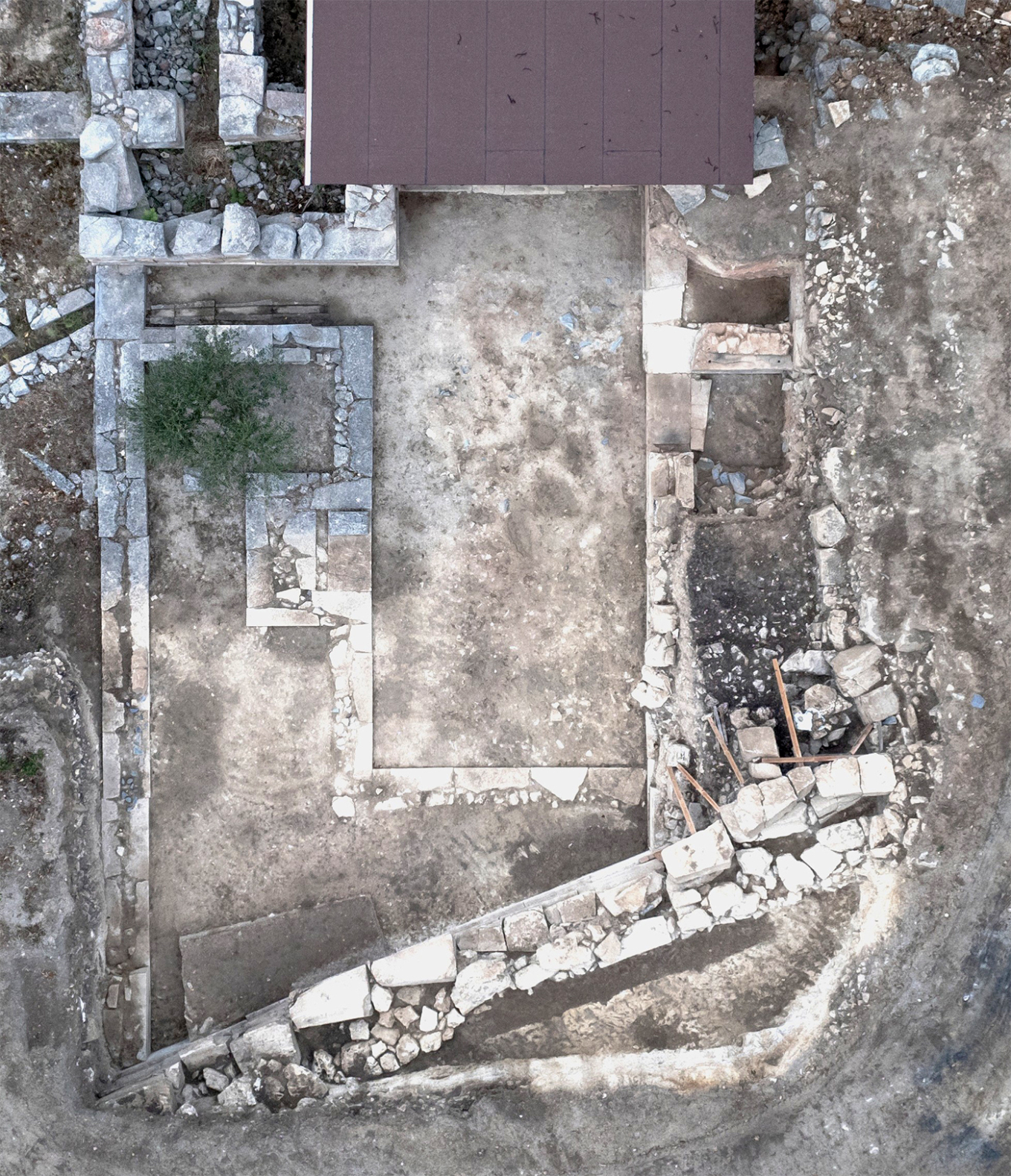
The 2025 excavation focused on studying an inclined, double wall that had peculiarly enclosed a large part of the palace courtyard. The wall was also constructed without care—built from unworked stones—raising many questions.
Systematic archaeological investigation, along with input from specialized scientists, ultimately showed that this wall played a crucial role: it protected the building from natural disasters, specifically from the possible landslide of the overlying rock. This is also why the southern part of the wall was not crafted carefully—it was not visible.
However, the Minoan architects’ intelligence, experience, and aesthetic sensitivity would not allow such an eyesore to remain visible. Thus, they constructed a second wall, attached to the first, so that the courtyard-facing side appeared well-built.
This second wall is meticulously crafted, made of beautifully carved poros stones, similar to those used in the rest of the palace.
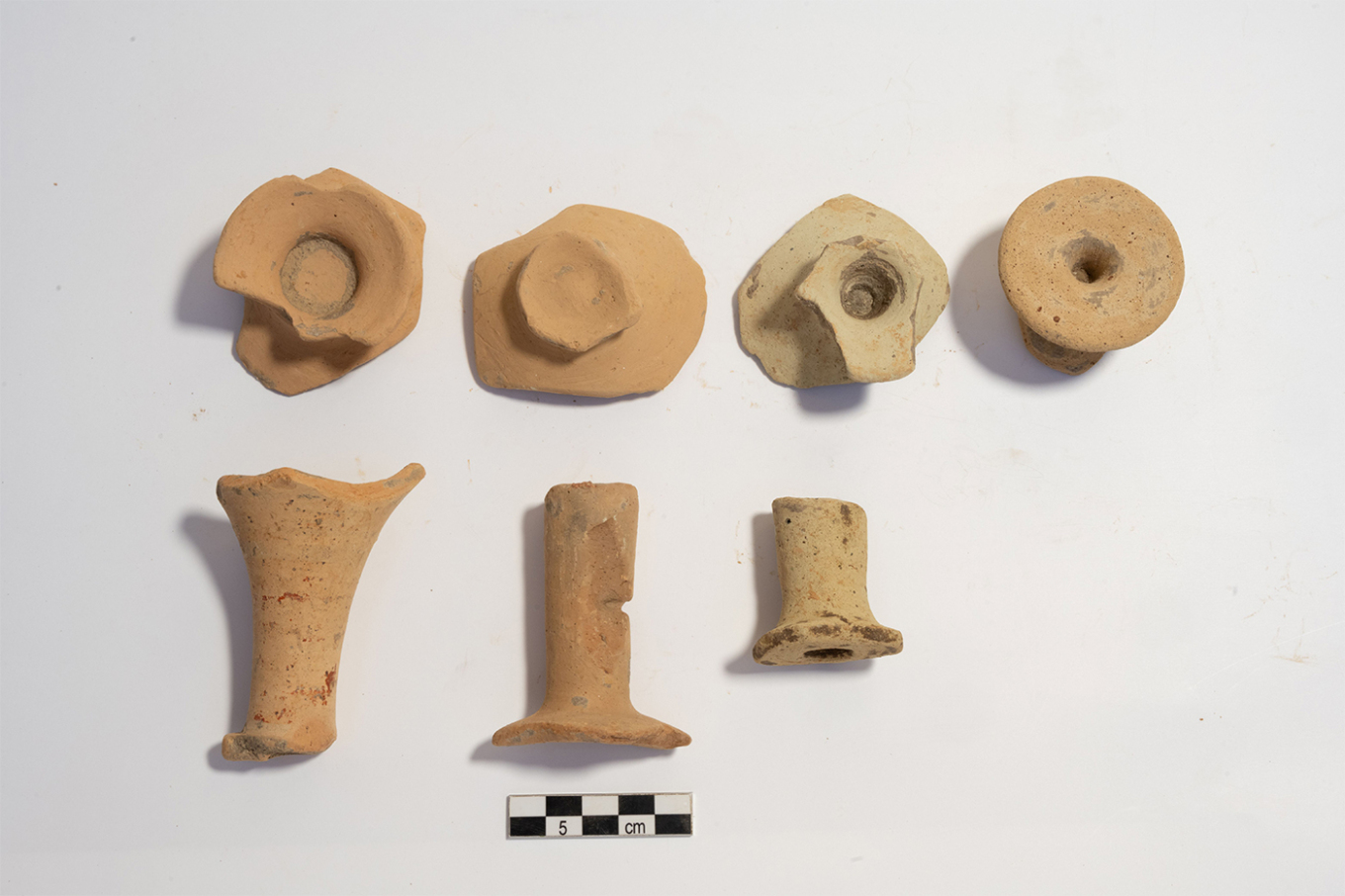
Above this wall, archaeologists found the usual layers of the Mycenaean period, with many kylikes, as well as finds from historical times. Indicative of the site’s long-term use are Hellenistic-era objects, such as a trefoil-mouthed oenochoe with two relief heads (3rd century BC) and a clay head that was likely attached to another object.
New Discoveries in the Southeast Area
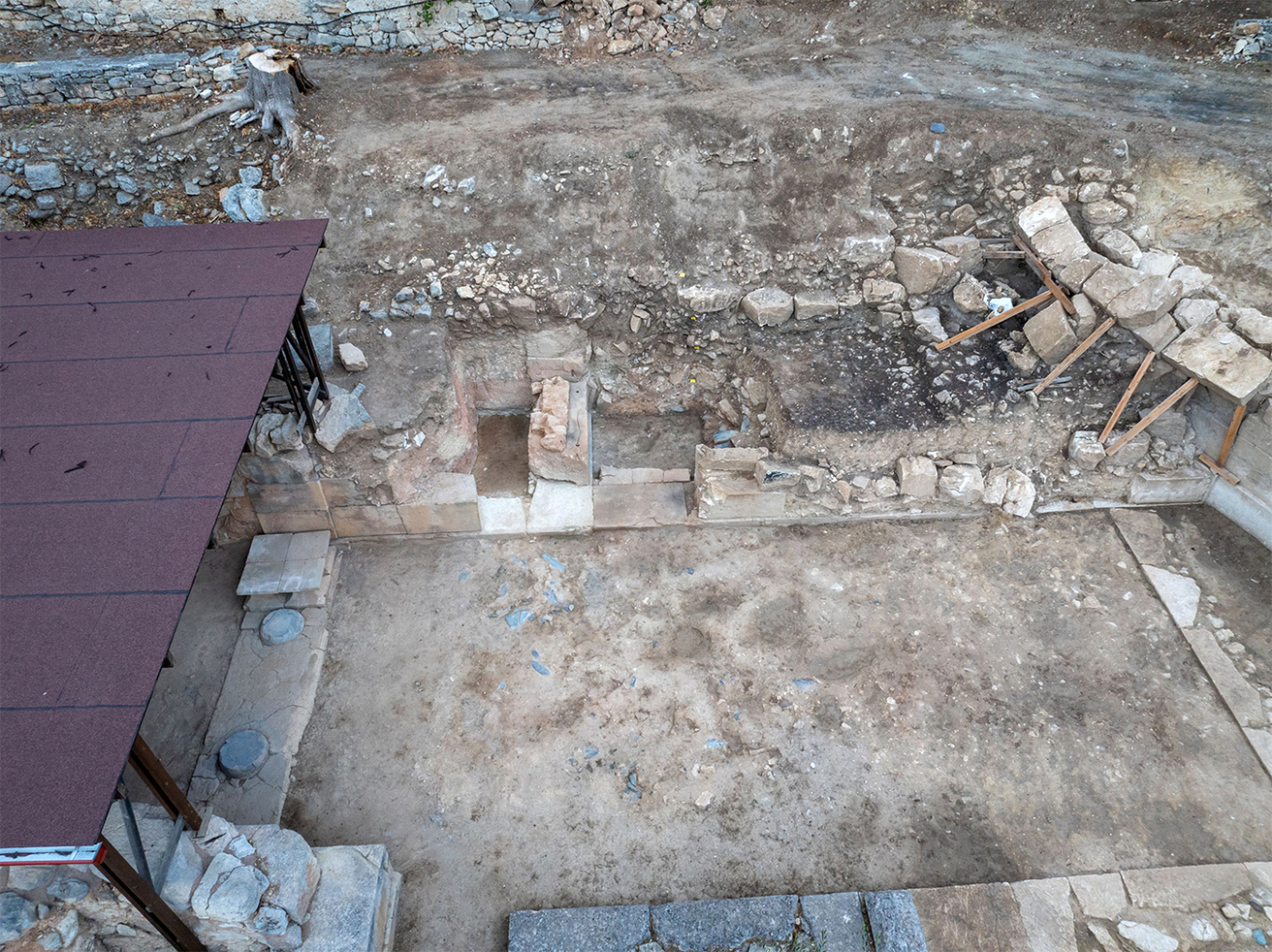
Important discoveries were also made in the southeastern part of the excavation. In one area (Room 28), researchers uncovered an opening from the Central Court leading to the easternmost section of the palace, while stone slabs divided the space into two parts.
A large trapezoidal stone with cuttings indicating the presence of a parapet—destroyed by a later Mycenaean wall—had been added atop these slabs.
A natural stone with faint anthropomorphic features is one of the most intriguing finds from this area. It had fallen from an upper floor and was likely related to the existence of a “fetish shrine,” similar to that known from Knossos.
Architecture of the Elite Wing
During the 2023–2024 seasons, significant new information emerged regarding the function of the palace. In the northernmost area excavated so far, two- and three-story spaces were uncovered—an elite wing of the palace:
Luxurious rooms connected by corridors, abundant gypsum half-columns, fragments of frescoes, walls covered with plaster, schist floors, and, in situ, the typical plaster divider strips that surrounded floor slabs in nearly every palace room.
A Landmark in the Modern Town
The Palace of Archanes lies in the center of the modern town, in the Turkogeitonia district. It was destroyed by an earthquake around 1700 BC but rebuilt and flourished until its final destruction in 1450 BC. Excavations, however, showed that habitation continued throughout.
Sir Arthur Evans was the first to mention Archanes due to significant finds (now in the Ashmolean Museum), likely from the Minoan cemetery at Fourni Hill. This cemetery was later excavated by Yannis and Efi Sakellarakis and yielded five tholos tombs, numerous burial buildings, and Mycenaean cist graves.
In the town itself, Evans had noted large wall surfaces and excavated a circular aqueduct belonging to the palace.
Later, Yannis Sakellarakis, through surface surveying and exploration of house basements, discovered that many modern homes were built directly atop strong Minoan walls—something earlier researchers (such as Marinatos and Platon) had not identified.
Mapping all these remains allowed Sakellarakis to pinpoint the palace center, which yielded rich architectural features and luxurious portable finds. In an adjacent area, the palace’s archive and theater space were found.
The 2025 Excavation Team
The 2025 excavation was carried out by the Archaeological Society, with the same excellent scientific team as previous years: archaeologists Dr. Polina Sapouna-Ellis, Dimitris Kokkinakos (MA), Persephone Xylouri, designer Agapi Ladianou, conservator Veta Kalyvianaki, and photographer Kostas Maris. Dr. Charalambos Fasoulas made a significant contribution regarding the role of the “inclined wall.”
UNESCO Recognition
The inclusion of Zominthos—discovered on Mount Psiloritis by Yannis Sakellarakis and excavated with Efi Sapouna-Sakellarakis—on the UNESCO World Heritage List recognizes not only the uniqueness of this site but also the broader value and Minoan identity of Crete.
At the archaeological site and surrounding area, improvements were made, such as creating a parking area, guardhouse, restrooms, and informational signs. Zominthos was inscribed together with five other Minoan palaces: Knossos, Phaistos, Zakros, Malia, and Kydonia.
It should be noted that both in Archanes and in Anogeia, small museums/information centers have been created exclusively for finds from the excavations of Archanes, Zominthos, and the Idaean Cave.
Ask me anything
Explore related questions




