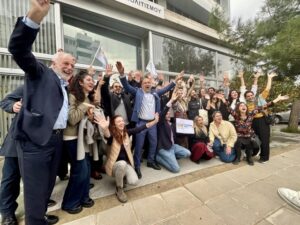
Larnaca is the Cypriot city that will hold the title of European Capital of Culture in 2030, as announced today at the Deputy Ministry of Culture in Nicosia, during the final round of the competition where it “competed” against Limassol. Larnaca will share the European title with Leuven in Belgium and Nikšić in Montenegro, which have already been selected for their respective countries.
The announcement by the president of the Expert Committee, Toni Attard, was received with strong enthusiasm by the Larnaca delegation, who saw a long-term collective effort come to fruition.
How the decision was “locked in”
Speaking at the press conference, Cyprus’ Deputy Minister of Culture, Vasiliki Kassianidou, emphasized that all EU regulations were followed in the procedure and that absolutely transparent and equal treatment of the candidate cities was ensured. She reminded that in the initial phase of the competition, five municipalities were in the running: Ayia Napa, Larnaca, Limassol, Nicosia, and West Limassol, before the shortlist was narrowed down to Larnaca and Limassol.
The final recommendation was made by a 12-member Expert Committee, consisting of ten specialists appointed by the European Commission and two Cypriot experts selected by the Deputy Ministry of Culture.
Toni Attard noted that the Committee “really struggled” to choose, as both cities presented mature, ambitious, and well-prepared proposals, developed through intensive preparation and consultation with local communities.
More funding, bigger expectations
A key element of the decision was the increase in state funding. Vasiliki Kassianidou announced that the government raised its financial support for Cyprus’ European Capital of Culture from €6.5 million to €10 million, aiming to give a “strong boost” to the city that will undertake the institution. Funding will begin in 2026 and extend until 2031, to cover both preparation and the legacy of the event.
In addition to funding from the Cypriot state, European Capitals of Culture can also compete for the “Melina Mercouri Prize” of €1.5 million from the Creative Europe program, provided their preparation is deemed exemplary by EU bodies.
The institution and Cyprus’ position
The European Capital of Culture program began in 1985 and is considered one of the EU’s most successful cultural initiatives. More than 60 cities have held the title so far, including Paphos in 2017, the first Cypriot city to earn the honor.
Richard Kühnel, Director for Representations and Communication in the EU Member States at the European Commission, stressed that the Capitals of Culture serve as “carriers of fundamental European values,” such as democracy, freedom of expression, and the fight against discrimination. He noted that the institution allows citizens to discover Europe’s cultural diversity and view their shared history from a fresh perspective.
In the same spirit, Cyprus’ Deputy Minister of Culture noted that for Cyprus the title carries additional political significance. It offers an opportunity to showcase the island’s millennia-old cultural heritage and its contemporary creative dynamism as an integral part of the European family. It is also connected with Cyprus’ upcoming Presidency of the Council of the EU, as the selection process concludes shortly before Nicosia assumes the Presidency, during which the post-2033 future of the institution will also be discussed.
Larnaca as a “gateway” of culture
The government sees the title as a tool to position Cyprus as Europe’s gateway to the East and as a bridge to Asia and Africa. Kassianidou spoke of the goal of highlighting the country as a “cultural hub,” leveraging relationships with neighboring states to open new markets for Cyprus’ cultural and creative industries.
Now that Larnaca has secured the title, the focus shifts from planning to implementation. The city must transform its bid proposal into concrete projects, infrastructure, and initiatives that will leave a lasting mark not only on its waterfront and historic center but also on neighborhoods that have until now remained outside the spotlight when discussing culture.
Winners beyond the title
Despite the inevitable disappointment in Limassol, both the Deputy Minister and European officials stressed that all participating cities gained something substantial. They built collaborations, mobilized institutions, businesses, artists, and citizens, and invested in strategic cultural planning.
Richard Kühnel reminded that cities participating in the process continue to benefit from the work carried out, regardless of the competition’s outcome. They create, he said, “laboratories for strategic and sustainable cultural investment,” as they are required to consider how culture connects with urban development, tourism, social inclusion, and residents’ everyday lives.
From anticipation to implementation
For Larnaca, the anxiety of waiting now gives way to a different kind of pressure — a far more creative one. The city must now set up an implementation mechanism strong enough to carry the project through to 2030, ensuring the program does not remain superficial but genuinely transforms how residents live and produce culture.
Cyprus’ Deputy Minister pledged that the Deputy Ministry of Culture will support Larnaca at every stage, offering assistance, expertise, and cooperation to successfully complete “this major mission.”
Ask me anything
Explore related questions