





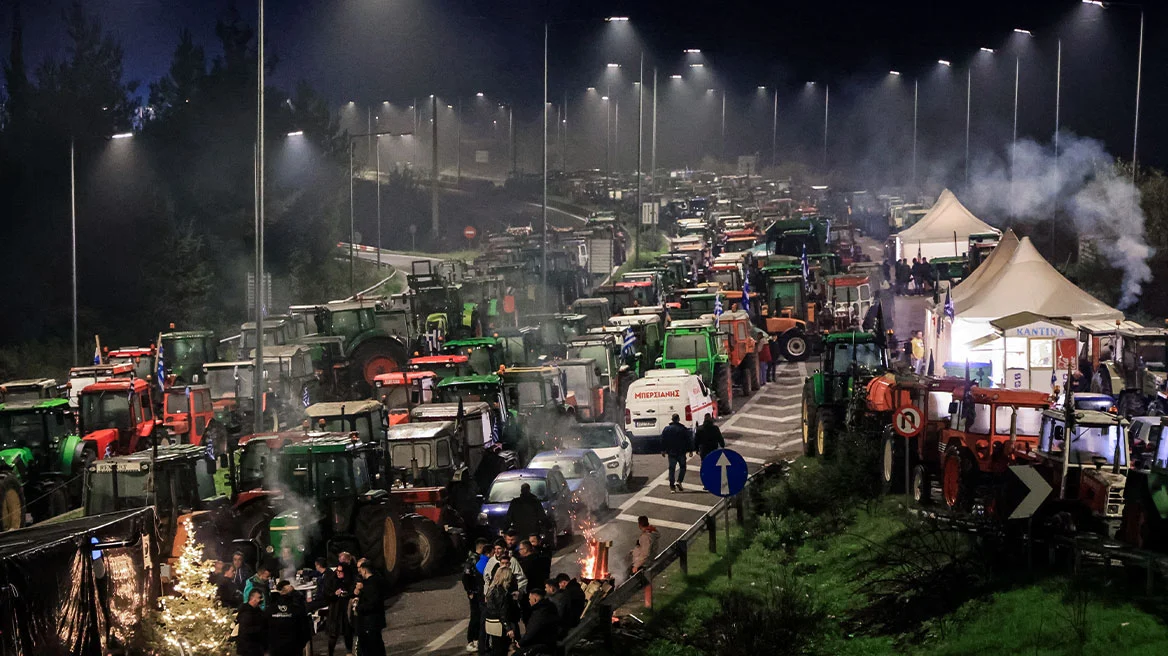
This afternoon, farmers who took part in the nationwide meeting in Nikaia sent their list of demands to the government and Prime Minister Kyriakos Mitsotakis.
It is noteworthy that, although the “sin-ridden” OPEKEPE is at the center of the major scandal involving the theft of subsidies and despite the fact that felony charges have already been brought against 15 people involved, the farmers are highlighting as a central demand that the management and control of subsidies not be transferred to AADE, as the government has already decided in order to achieve cleanup.
Among other things, they are demanding minimum guaranteed prices, electricity at 7 cents per kilowatt-hour, and they reject the integration of OPEKEPE into AADE. As has become known, the demands were received and will be examined by the Prime Minister’s Office, with government sources referring to what the prime minister stated in his Sunday review on Facebook. Among other things, Mr. Mitsotakis had made it clear that his position on the cleanup of OPEKEPE through its integration into AADE remains non-negotiable.
The farmers’ demands also include a broader political reference to the war in Ukraine, as they express their opposition to the redistribution of resources from the Common Agricultural Policy for the benefit of “war preparations.”
It is recalled that, despite appeals from the government, the farmers rejected the prime minister’s invitation for dialogue with their representatives at the Maximos Mansion on Monday afternoon. They also declare that they are determined to spend the holidays at the roadblocks, pressing for the satisfaction of their demands, and they announce an escalation of mobilizations.
The demands are:
“- An end to state repression, authoritarianism, and farm courts – dismissal of all case files related to mobilizations against protesting farmers by decision of Parliament.
- We demand here and now the payment of all amounts owed by the government.
- Minimum guaranteed prices that cover production costs and leave a viable income to meet subsistence needs and cultivation expenses.
- Reduction of production costs. Tax-free diesel at the pump and redefinition of liters per crop, a cap on the price of agricultural electricity at 7 cents/kWh and abolition of the Energy Exchange, subsidies for means and inputs and abolition of VAT.
- Compensation for lost income for 2025 for all products whose prices have collapsed below production costs.
- Implementation of the necessary infrastructure projects that the agricultural movement claims in each region (e.g., irrigation and flood/fire protection, rural roadworks, etc.).
- Change to the ELGA regulation so that it insures and compensates production and capital at 100% against all natural risks and diseases at all stages of production, with adequate state funding.
- Linking subsidies to production in agriculture and to livestock capital in livestock farming. Those who produce and are real farmers and breeders should receive the subsidies, and they should be non-seizable.
- Abolition of ATAK–KAEK for plots under 20 stremmas due to fragmentation and multiple ownership. Legislative establishment of land exchange due to lack of land consolidation and fragmentation. Immediate checks and payment of all blocked tax IDs (AFM). Payment of Measure 23. Proper functioning of Monitoring.
- An end to mass imports and “Hellenizations” of similar products without tariffs, e.g., Mercosur and other EU agreements.
- Freezing of debts to insurance organizations, KEAO, tax offices, banks, PPC (DEI), and settlement of debts in interest-free installments without down payment.
- No reduction of CAP resources for war preparation, as they are already preparing to proceed with cuts.
- Abolition of the electronic delivery note sent by the producer from the field.
- Immediate doubling of agricultural pensions.
- We single out two burning issues:
Foot-and-mouth disease in livestock farming: vaccination of animals, full compensation for slaughtered animals, replacement of lost income, free reconstitution of herds. Compensation for bluetongue disease.
OPEKEPE scandal: the money that was stolen must be returned and distributed to the real beneficiaries; we will not pay the fines; political and criminal responsibilities must be assigned and the names made public. Cleanup of OPEKEPE, an oversight mechanism, and it must not be integrated into AADE.”
Detailed demands of livestock breeders
- Vaccination
a. Change in disease management with vaccination and immediate cessation of culling.
b. Reopening of units after 6 to 8 months and within a distance of up to 5 kilometers from the unit. - Full compensation for the real value of animals
Updating compensation amounts to reflect the real cost of purchase and production.
Differentiation by species, age, productivity, purebred (indigenous breeds). - Compensation for lost income
a. Coverage of production losses (milk, meat, reproduction) for at least 12–24 months or as long as needed, until full reconstitution of the herd, at 30% of turnover based on calculations of meat and milk sales.
b. During force majeure, rights and improvement plans to be maintained until herd reconstitution. - “Hellenization”
One of the most serious causes of the spread of animal diseases is mass imports of milk and live animals that arrive and are slaughtered in Greece and then exported, thus transferring diseases to Greece. - Compensation for destruction of products by volume measurement
Compensation for alfalfa, hay, feed, or other raw materials that are necessarily destroyed due to measures. - Support for herd reconstitution
a. Subsidies for the purchase of new animals and support for breed improvement.
Provision for high-value genetic material that is lost.
b. Measure 5.2 lost income for all natural disasters (Daniel, Ilias, fires) and for animal diseases for all livestock capital.
c. Herd reconstitution to be granted even if slaughter compensation has been paid. - Extraordinary European Support
Utilization of special EU funds to relieve livestock breeders, as applied in Spain and Portugal for similar animal diseases. - Freezing of payments for the duration of force majeure to PPC (DEI), AADE, EFKA, water utilities, and banks.
- Energy cost – Net metering through a program or improvement plan.
- Abolition of administrative fines.
What beekeepers are asking for, specifically
- Unhindered and unconditional work in forests. Freedom of entry and placement of beehives.
- Extension of permitted hours for using smokers.
- Inclusion of island beekeepers in island policy – revision for all islands.
- Electronic registry based on EU regulation. No encroachment on rights and competencies.
- Sectoral program: drafting of actions by the Federation. Support to producers through actions benefiting producers.
- CAP: equal and equitable inclusion of beekeeping in investment programs (e.g., improvement plans). Adaptation of eco-schemes for pollination.
- Side roads: solution for beekeepers’ movement on the auxiliary road network.
- Tax incentives and financial facilities for purchasing new-technology trucks.
- A set of measures to combat “Hellenizations” in cooperation with the Federation.
- A set of measures to combat profiteering in cooperation with the Federation.
- Stable and intensive checks for honey quality.
- Counting and determination of specific honey analyses.
- Adoption of the Federation’s proposals for restructuring the ELGA regulation regarding beekeeping.
- Income replacement of €20 per hive (total request €30 million).
“Hold dialogue, not market hostage,” message from the business community
Earlier, a few hours after the prime minister’s new invitation for dialogue via his Sunday post and the message that “dialogue cannot be conducted with ultimatums,” and the farmers’ renewed negative reaction from the roadblocks, first the president of the Athens Chamber of Commerce and Industry (EBEA), Giannis Bratakos, and then the associations of craftsmen and industries from Thessaloniki issued statements.
The president of EBEA stressed that “problems are not solved by refusal, nor by holding society hostage,” while the presidents of EBETh Ioannis Masoutis, BETh Makarios Papadopoulos, SBE Loukia Saranti, and SEVE Symeon Diamantidis note that “when the State calls for dialogue at the highest institutional level and the invitation is rejected, responsibility ceases to be unilateral.”
Mitsotakis’ new invitation and the message “dialogue does not take place with ultimatums”
On Sunday morning, in his regular post, the prime minister initially stated that “dialogue does not take place with ultimatums,” also noting that “roadblocks which in practice turn against other social groups do not serve farmers’ demands. On the contrary, they undermine them. And road closures and occupations of roads and other public infrastructure that belong to everyone are not responsible actions, but moves that harm the country and, of course, local economies in the regions.”
Expressing surprise at the farmers’ refusal, he states that “solutions arise only through discussion. Whoever rejects these principles of reason and democracy assumes a heavy burden toward the rest of society.”
“For my part, I repeat that the government’s door remains open to those farmers and livestock breeders who wish to meet either with me, or with the Deputy Prime Minister Kostis Hatzidakis and the Minister of Rural Development Kostas Tsiaras. Something that the farmers and livestock breeders of Crete recently did,” the prime minister adds, announcing a new package of support measures.
As he writes characteristically: “the government takes into account every fair request. Thus, it is already studying a set of additional support measures—always, however, within the capabilities of the national economy and in accordance with European rules. Measures that will mainly be based on resources from the reallocation of unused amounts arising from the new framework for agricultural subsidies. It is obvious, moreover, that a positive response to the request of a specific social group could not derail the positive economic course of the entire country. Just as it is obvious that no measure outside the framework of the Common Agricultural Policy could stand in Brussels.”
Mr. Mitsotakis also clarifies that “non-negotiable, in any case, remains my position on the cleanup of OPEKEPE through its integration into AADE. This is because it constitutes the catalyst that will modernize the primary sector in the country overall—so that, on the one hand, EU funds finally strengthen national production, and on the other, honest farmers receive more money every year.”
He comments further in this context that “it seems, however, that this bold decision of ours inconvenienced quite a few who had grown accustomed to operating by exploiting the gaps and dysfunctions of the old system. I am sorry, but this pathology of 40 years and cross-party responsibilities must end. After all, no one wants some opportunists to live at the expense of honest professionals and at the expense of the State itself.”
The farmers’ new “no”
On their side, union representatives responded with threats to escalate road closures in the coming days.
Sokratis Aleiftiras, vice president of the farmers of Larissa, described the prime minister’s statements as “incendiary” and warned that the roadblocks—now 57 across the country—will intensify in the coming days.
Ask me anything
Explore related questions




