A simple piece of chalk became the symbol of protest for an entire generation in Slovakia. Soon, anti-government messages turned into a movement, sparking intense debate about the future of democracy in the country.
Messages written in chalk on sidewalks near a high school in eastern Slovakia, addressed to Prime Minister Robert Fico, have become the talk of the country. “Enough already, Fico,” read one, while another mocked Robert Fico’s relationship with Vladimir Putin.
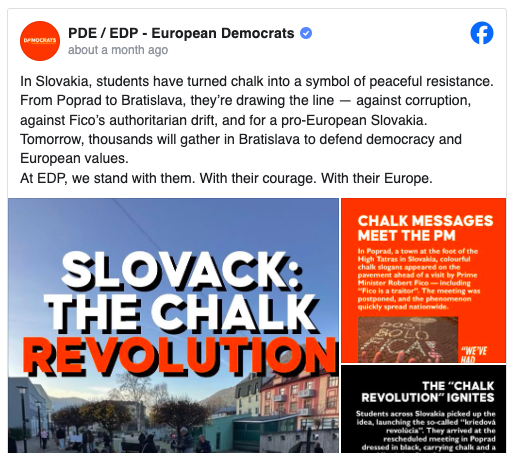
The messages appeared just a few hours before the prime minister was scheduled to visit the school.
Similar slogans soon began appearing on sidewalks across the country, giving rise to an initiative that became known as the “Chalk Revolution.”
The 19-year-old Michal, known as Muro, who wrote the first messages, admits to the Guardian that he did not expect the movement to grow as large as it did. “It seems I’m not the only one who holds this view,” he says.
When he learned that the prime minister would be visiting his school in Poprad to give a lecture, he decided to act. For years, he had watched the prime minister adopt a pro-Russian stance and question the EU’s policy on Ukraine. Writing with chalk was, for him, a harmless way to express his frustration with a government that fails to tackle corruption, drives up the cost of living, and invests very little in education and healthcare, contributing to the emigration of young people.
The response was immediate: Robert Fico postponed his visit, and the police summoned Muro for questioning, though no charges were ultimately filed. Within just a few hours, the movement had already begun. “Social media did their job, and the messages started flooding in,” Muro says.
In Slovakia, chalk was transformed into a symbol of protest against a government accused of undermining human rights and dismantling the rule of law. From students posting photos of their chalk messages to events in town squares and schools, the initiative evolved into a broader social movement.
The movement peaked in November, during the anniversary of the 1989 Velvet Revolution, which put an end to decades of communist rule. Thousands of citizens took part in rallies against the erosion of democracy. “Fico is attacking independent institutions, culture, the media… exactly as the communists did,” said opposition leader Jaroslav Naď.
Muro spoke at a rally in Bratislava, reminding citizens that they must be aware of what they are voting for. “You are voting for the return of what you fought for decades to avoid. And now it’s here, and you welcome it with open arms,” he stressed.
Members of the government accused the young man of acting as a pawn of political opponents, and in extreme cases even compared him to the man accused last year of attempting to assassinate Fico. He categorically rejects these accusations and states that he has no affiliation with any political party.
In recent weeks, the intensity of the chalk slogans has declined, partly due to weather conditions. However, mobilizations continue in other forms, from student walkouts to protests against institutional changes being pushed by the government.
Ask me anything
Explore related questions