





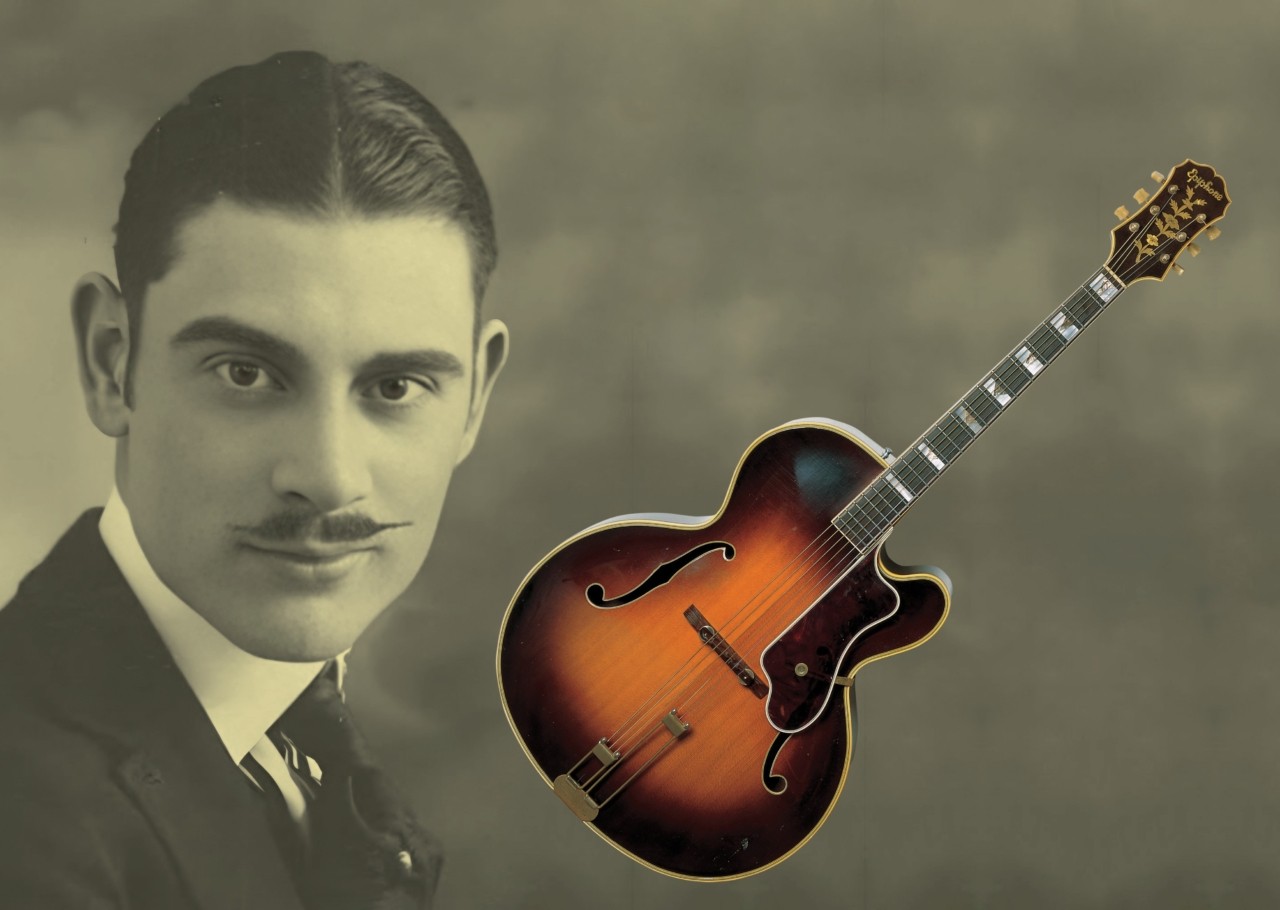
What connects the Beatles, Noel Gallagher, and Lenny Kravitz? They used—and continue to use—Epiphone guitars. What is rarely mentioned is that one of the most important brands in the world of stringed sound was created by a Greek luthier, and that his nickname was engraved on his instruments as a personal signature.
Epiphone was born in early-20th-century New York, founded by a Greek immigrant, Epaminondas Stathopoulos, known among musicians as “Epi.” Stathopoulos was not merely a successful instrument maker. He was a man who realized early on that the guitar would not remain an acoustic instrument forever. He believed—and was proven right—that electric sound belonged to the future of the era in which he worked professionally. His faith in progress did not negate a core principle: electric guitars had to serve music without altering its character. The fact that his name became a commercial brand and was engraved on the unique instruments he built was not a marketing move, but a conscious act of identity.
The History of Epiphone
Epaminondas’ father, Anastasios Stathopoulos, was born in 1863 in Kastania, Laconia. From a young age he showed an aptitude for instrument making. In 1873 his family migrated to Smyrna, a multicultural port city where music was an integral part of daily life. There, Anastasios worked alongside Italian craftsmen who built mandolins and guitars, acquiring technical precision and deep knowledge of wood, metal, and the exact measurements required for a stringed instrument. After marrying Marianthi Vamva, he founded his first workshop, producing instruments known for their durability and clarity of construction.
Political instability and the persecution of the Greek population in Smyrna forced Anastasios to make a critical decision. In 1903, at the age of 43, he moved his family to New York. In Queens he established a new workshop and began building instruments signed “A. Stathopoulo,” even adapting his surname so it would be easier for Americans to pronounce. His instruments quickly gained a reputation among the city’s musicians.
After Anastasios’ death in 1915, Epaminondas took over the business. Unlike his father, “Epi” possessed strong entrepreneurial instincts and a clear understanding of the changes taking place in the music industry. In 1917 the name “House of Stathopoulo” was adopted, but he was searching for a name that would function as a creator’s seal. In the mid-1920s, Epiphone was established, derived from “Epi” and the word phone, referring to voice and sound. From that moment on, the name appeared on guitars not simply as a brand, but as a declaration of origin.
During the 1930s and 1940s, Epiphone evolved into one of the greatest competitors of the leading brand Gibson. The company invested heavily in technological development. Experiments carried out in its factory contributed to the transition toward the electric guitar. In this environment, Les Paul also tested ideas, at a time when nothing was taken for granted. Epaminondas Stathopoulos died in 1943 from leukemia. After his death, the company struggled to cope with the conditions of World War II. In 1957, the historic Epiphone was acquired by Gibson for just $20,000. Despite the changes that followed, the name and legacy of “Epi” did not disappear.
Giants of the Music Scene & Collectors
In the 1960s, the Beatles used Epiphone guitars in historic recordings. Later, Noel Gallagher and Lenny Kravitz, along with many other significant artists, kept that same lineage alive on stage. Different eras, different genres, one common starting point: a company founded by a Greek, still bearing his name engraved on the headstock of the guitar.
Authentic Epiphone guitars built during the lifetime of Epaminondas “Epi” Stathopoulos—from the mid-1910s until his death in 1943—are today considered objects of high collectible and historical value. Pre-war acoustic Epiphones rarely appear on the market, and their prices typically range between €20,000 and €40,000.
Epiphone instruments in excellent condition, with full documentation and original components, have exceeded €60,000, while some auctions have recorded sales above €70,000. A special category includes early electric or experimental models from the early 1940s, where valuations start at €40,000 and, in rare cases, reach or exceed €100,000. An Epiphone from the era of Epi is not regarded as a working instrument, but as a testament to the history of the guitar.
Ask me anything
Explore related questions




