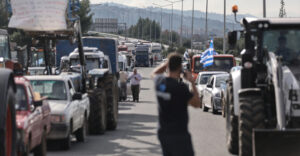
Yesterday’s closure of the Tempi tunnels marked, for farmers, the conclusion of another phase of their mobilization, which included the blocking of side roads and the temporary closure of the highway. At this stage, farmers appear inclined to scale back their actions to facilitate holiday travel.
Traffic lanes and restrictions
Within this framework, they proposed positioning tractors at the blockades in a way that would allow one additional lane in each direction to remain open, enabling excursionists to pass without disruption. However, the final decision rests with the Road Authority, which so far has not approved the passage of vehicles through the blockades, citing safety concerns. As a result, from today, travelers are expected to use alternative routes, leading to significantly longer travel times.
Throughout the festive period, farmers intend to ease their mobilization to accommodate holiday traffic. However, after 24 days of tractors on the roads, the government and farmers have yet to reach an agreement to begin substantive discussions on issues affecting the primary sector. Some observers note that, following two refusals by farmers to engage in dialogue, the opportunity for a timely meeting may have passed.
Prospects for dialogue
Government officials, including the prime minister, continue to call for dialogue with farmers. Farmers, for their part, argue that the conditions for meaningful talks are not currently in place, particularly during the holiday period. While channels of communication remain open, they are described as limited and insufficient to build trust.
According to government sources, electricity prices for agricultural use could reach 8.3 cents per kilowatt-hour over the next two years. Farmers view this prospect positively but are seeking longer-term guarantees. The government maintains that energy prices are expected to decline further after two years, potentially allowing for more favorable terms. Officials note that two years ago the rate stood at 9.2 cents, while current estimates approach 8 cents per kilowatt-hour.
>Related articles
Regarding agricultural diesel, farmers argue that the government is allocating €100 million at the pump, an amount they had previously received through billing arrangements. The government responds that subsidy tables by crop will be revised, which could result in increased support. Officials also point out that while €100 million had initially been budgeted this year, €150 million was ultimately disbursed after additional resources were identified. They add that further funds could be made available through budget surpluses, to be distributed via a dedicated application already prepared by the ADC.
In parallel, €160 million has been allocated from unused subsidies and tax audits conducted by AADE. Of this amount, €80 million is earmarked for wheat, cotton, and alfalfa, with the remaining €80 million designated for the livestock sector. Farmers are requesting an increase in these allocations to improve per-acre compensation. Within this framework, officials indicate that additional farmer demands could be examined.
The Christmas period may offer an opportunity for both sides to identify a path toward dialogue, as a continuation of mobilizations after the holidays would likely carry costs for all involved.
Ask me anything
Explore related questions