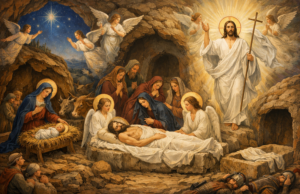
The Mystery of the Incarnation of the Son and Word of God is not an isolated event within the history of the Divine Economia/Dispensation. The Nativity of Christ is inseparably linked with His Passion, His Burial, and His Resurrection. All of these constitute a single path of salvation, an indivisible mystery of God’s love for humankind.
The Nativity of Christ is not merely the beginning of His earthly presence, but already the commencement of His voluntary journey toward death and the victory over death. For this reason, Orthodox iconography, Patristic theology, and above all the Church’s hymnography perceive in the Manger the shadow of the Tomb, and in the Nativity the proclamation in advance of the Resurrection.
The Fathers of the Church, with their theological insight, highlight this inner unity not only on the dogmatic level, but also on the iconographic one.
The iconography of the Nativity is not simply a tender depiction of an infant in a manger; it is profoundly cruciform and resurrectional. The icon of the Nativity already foretells the Burial and the Resurrection of Christ.
Both in the Nativity and in the Resurrection, the presence of the angels is dominant. On the night of the Nativity, the angels glorify God and announce His entry into history:
“Today the Virgin gives birth to the Transcendent One… Angels with shepherds glorify Him” (Kontakion of Christmas, Tone 3).
“Glory to God in the highest, and on earth peace,” the Church chants at the Orthros of Christmas, while the Doxastikon of the Αίνοι/Praises adds: “Today Bethlehem receives Him who sits upon the Cherubim.”
The same angelic presence is repeated at the Tomb. There, the angels no longer praise the Nativity, but proclaim the victory over death when they say: “Why do you seek the living among the dead?”
The angels function as witnesses sent by God of the decisive moments of salvation, when God enters the world and when death is destroyed from within.
Saint John Chrysostom points out that the angels appear “where God renews nature” (Homily II on Matthew), that is, when God enters the world and when the world is delivered from corruption. These are not two different events, but one and the same work of salvation.
The Fathers of the Church assign particular theological weight to the swaddling clothes of the Divine Infant. The Word of God condescends to be born in a manger. Christ is born “wrapped in swaddling clothes” and placed in a manger; at His Burial, He is wrapped in a burial shroud and laid in a tomb.
Saint Gregory the Theologian expresses this truth in a striking manner: “The Word is wrapped in swaddling clothes, that He may loosen the bonds of sin” (Oration 38, On Theophany). The Fathers see in the swaddling clothes a prefiguration of the burial linens.
The Church chants: “The Uncontainable One—how was He contained in a womb? He who is in the bosom of the Father—how is He held in the arms of His Mother? In every way as He knew, as He willed, and as He was pleased” (Canon of Christmas, Ode 9).
This wonder finds its answer on Great Friday, when the Church beholds Christ wrapped no longer in swaddling clothes, but in a burial shroud: “He who suspended the earth upon the waters is seen wrapped in a shroud” (Doxastikon of the Aposticha of Great Friday Vespers).
The swaddling clothes of the Nativity and the burial shroud of the Burial are two expressions of the same Kenosis. God accepts limitation in order to free humanity from the bonds of death.
At the Nativity, light illumines the cave of Bethlehem, a dark and humble place. The people “who sat in darkness” saw a “great light.” At the Resurrection, the same light shines forth from the Tomb, dispersing the darkness of Hades.
Saint Maximus the Confessor emphasizes that “Christ is the true Light, which no shadow can contain” (Theological Chapters, I). The “true Light” does not depend on the conditions of the world, space, or time. Whether in the cave or in the Tomb, His light remains unsetting, conquering the darkness of corruption.
The same light that illumines the night of Bethlehem shines forth brilliantly from the Tomb of the Resurrection; therefore, on the night of Pascha the Church proclaims: “Come, receive light from the unwaning Light, and glorify Christ who has risen from the dead.”
The Patristic Tradition insists on the fact that both the Nativity and the Burial take place in a cave. The cave of Bethlehem and the hewn Tomb constitute iconographic and theological correspondences.
“Your Tomb, O Lord, has been revealed as a fountain of resurrection” (Canon of Holy Saturday, Ode 6). The Church uses the same language: cave equals paradise; tomb equals source of life.
“He who lay in a manger is laid in a tomb; and He who rose from the tomb raises Adam,” states the Sticheron of the Αίνοι/Praises of Holy Saturday. This hymnographic structure is characteristic of the poetic and theological synthesis of Holy Saturday, where seemingly contradictory events (death–life, burial–resurrection) coexist within a single salvific perspective.
This sticheron is formed as a condensed Christological summary of the Divine Economy. “He who lay in a manger” refers to the mystery of the Incarnation. The manger signifies the extreme Kenosis of the Word: the pre-eternal God assumes human nature without glory, power, or honor.
Hymnography does not present three fragmented events, but a single salvific arc: what begins in the Manger is fulfilled in the Tomb and overturned in the Resurrection!
The paradox is not a rhetorical device, but theological language. Only in this way can the Mystery of Divine Condescension be expressed.
The second part of the sticheron shifts the focus: “He who rose from the tomb.” The Resurrection is not merely a victory over death as a natural event, but an ontological rupture in the history of humanity.
“He raises Adam.” “Adam” here does not signify merely the historical person, but the entirety of humankind. The Resurrection of Christ possesses a universal anthropological character. Christ rises as the new Adam and raises the whole human race.
Christ lies in the Tomb, yet already acts salvifically: He descends into Hades and raises Adam. The sticheron expresses precisely this dual reality: apparent stillness—real salvation.
The sticheron teaches that the Incarnation is from the outset cruciform, that the death of Christ is salvific, and that the Resurrection is not an individual event, but the universal resurrection of human nature.
Saint Ephrem the Syrian poetically summarizes this theology: “The cave gave birth to Life, and the Tomb proclaimed Immortality” (Hymns on the Nativity, 11). Wherever Christ enters, space itself is transformed: the cave becomes a womb of life, a new Eden, and the Tomb a source of incorruption.
The empty Tomb is the final confirmation that He who was born in humility is the Lord of life and death.
The Tomb is not a place of absence, but a place of the presence of life; therefore, on Holy Saturday the Church chants: “Your Tomb, O Lord, has been revealed as a fountain of resurrection.”
The manger, the burial shroud, and the empty Tomb are not three images; they are one truth, one unified salvific journey. Christ is born in order to die voluntarily, and He dies in order to raise humanity.
As Saint Athanasius the Great summarizes: “He became man, that we might be deified” (On the Incarnation, 54).
The icon of the Nativity is already an icon of the Resurrection, because it reveals God’s entry into the world with the purpose of conquering death.
Let us therefore celebrate the Nativity of Christ with resurrectional faith, and let us experience the Resurrection as the fruit of the Incarnation, for He who was laid in a manger destroyed the Tomb and granted the world eternal life.
Ask me anything
Explore related questions