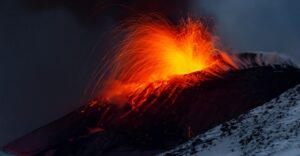
Mount Etna has entered a new phase of volcanic activity, as a new lava outflow has been observed in recent hours inside the Valle del Bove.
According to the Italian National Institute of Geophysics and Volcanology, the activity began in the afternoon of January 1, 2026, when a fissure at an altitude of approximately 2,000 to 2,100 meters started releasing lava.
#Italy: Mount Etna volcano erupts again, lava reaches 400 meters high pic.twitter.com/wpRlNiyOLT
— Jack Straw (@JackStr42679640) January 1, 2026
The flow slowly advanced toward the lower sections of the valley, reaching around 1,500 meters above sea level, following the natural path of the Valle del Bove, which acts as a natural “barrier” and limits the spread of the phenomenon.
Videos circulating on social media, including footage by Emilio Messina, show the slow but steady movement of the lava within the natural basin, without exceeding its boundaries.
Authorities assure that, for the time being, no residential areas are under threat, while scientific teams are closely monitoring the evolution of the activity. So far, no damage or infrastructure problems have been reported.
Mount Etna, Europe’s most active volcano, frequently displays similar phenomena, with local authorities remaining on constant alert and providing updates on any new developments.
Ask me anything
Explore related questions