





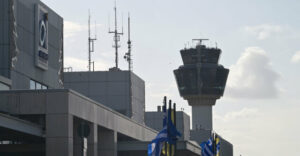
The Athens Public Prosecutor’s Office has intervened following the total blackout at the Athens FIR, which caused chaos at airports on Monday.
Specifically, Aristeidis Koreas, head of the Athens Prosecutor’s Office, ordered an urgent preliminary investigation. The Cyber Crime Unit will conduct the probe.
The investigation will examine whether the offense of dangerous interference with aircraft transportation was committed and will seek to determine the source of the disruptions across nearly all Athens FIR frequencies.
Dimas: “Heads Will Roll”
Transport and Infrastructure Minister Christos Dimas spoke to state broadcaster ERT on Monday morning.
“This does not appear to be a cyberattack,” he said. “The root cause has not yet been clarified. That is why I ordered an internal administrative investigation, to determine who is responsible, why this happened, and to ensure it does not happen again.”
Asked whether accountability would be assigned, Dimas replied:
“Absolutely. That is precisely why the investigation is under way.”
The minister acknowledged that air traffic control systems are outdated, though still compliant with European standards.
“Our goal is to replace them by 2028,” he said.
European Law Violations and Delayed Upgrades
Dimas also explained that three violations of EU law are currently pending.
One case has already been referred to authorities, while two others are progressing. These concern:
- Data link services, stalled at the Court of Auditors
- PBL systems, where a recent administrative court ruling allows progress with the lowest bidder
- S-mode radar systems, involving the purchase and installation of eight new radars, with locations selected and studies completed
Over the past eight months, the ministry has coordinated with all relevant European bodies to resolve these issues by 2028.
“No Risk to Flight Safety”
According to the minister, flight safety was never compromised.
“A NOTAM was issued immediately,” he said.
Based on reports from the Civil Aviation Authority (CAA) and air traffic controllers, a strong noise interference affected radio frequencies, making communication between pilots and control towers impossible.
The interference impacted all operational and backup frequencies nationwide. This prompted the decision to restrict or suspend flights.
The CAA, OTE, and the National Telecommunications Commission carried out on-site inspections and aerial frequency checks. The findings indicate that the issue did not originate from CAA infrastructure.
Dimas added that investigators will assign responsibility and may involve European Commission experts or other EU agencies if necessary.
“We expect clear answers in the coming days,” he said.
No Evidence of External Interference
So far, authorities believe the incident resulted from a technical malfunction, not an external threat.
Although initial reports mentioned “interference,” raising concerns about possible cyberattacks, current evidence rules out external or asymmetric threats.
Frequency surveillance flights and system log analysis found no signs of outside interference.
Controllers reported hearing interference, but the main problem was their inability to transmit messages, suggesting a failure within the system itself.
The Two Most Likely Scenarios
1. Telecommunications Infrastructure Failure
The CAA uses leased telecommunications circuits to transmit audio and data between antennas, radars, and control centers.
Recent technical work on a specific data link may have caused a malfunction or compatibility issue. This could explain internal interference without external involvement.
Officials stress that these critical systems lack sufficient backup redundancy, raising serious concerns.
The malfunction also affected the CAA’s central telecommunications network, with reports of no phone service and no internet access throughout the day.
2. Obsolete Equipment with Limited Backup
Much of the CAA’s equipment is severely outdated, with systems that have not been modernized for decades.
Officials emphasize that partial upgrades are impossible for systems of this critical nature. Full modernization requires at least two years.
Why the Air Force Was Not Affected
Greece operates two entirely separate air traffic management systems.
- The civil system, run by the CAA, manages civilian flights within the Athens FIR
- The military system, operated by the Hellenic Air Force under the Ministry of Defense, uses independent infrastructure
The military system has its own radars, transmitters, air defense controllers, and an autonomous operations center in Larissa.
Because the two systems are not interconnected, failures in the civilian system do not affect military operations.
Investigation Continues
Government sources note that while the incident was serious, similar disruptions have occurred elsewhere in Europe. London experienced a comparable shutdown lasting two days just months ago.
This does not diminish the severity of what happened in Greece.
Authorities stress that the priority is not only identifying the cause but also implementing safeguards to prevent recurrence. Otherwise, the impact on air transport and Greece’s international image could be significant.
Ask me anything
Explore related questions




