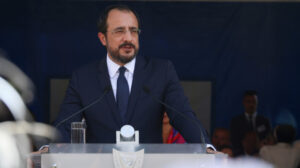
The Kronos gas field in Block 6 of Cyprus’s Exclusive Economic Zone (EEZ) is entering its final stage of development, with the objective of delivering the first volumes of Cypriot natural gas to Europe via Egypt. This was stated by Cypriot President Nicos Christodoulides during a meeting with Guido Brusco, Chief Operating Officer for Global Natural Resources at the Italian energy company ENI.
President Christodoulides identified the end of March as a key milestone, also referring to an invitation from Egyptian President Abdel Fattah al-Sisi to attend the Cairo Energy Forum, scheduled for 30 March–1 April. He noted that he has also invited European Commission President Ursula von der Leyen to participate, as Cyprus seeks a strong and visible European presence in what is being presented as the first commercial development of a gas field in the Cypriot EEZ.
March milestone
Christodoulides stressed that this is the first gas field to be developed in Cyprus’s EEZ, highlighting its importance not only for the national economy and public revenues, but also for the geopolitical dimension of the European Union’s energy security.
While the export route via Egypt is not a new concept, it now has a concrete framework following the agreement signed by Cyprus, Egypt, and the Block 6 partners—ENI and TotalEnergies. Under this arrangement, gas from the Kronos field will be transported to existing offshore processing facilities in Egypt, before being liquefied at the Damietta LNG terminal and shipped to European markets.
ENI: “Strong commitment” and $1.2 billion investment
Guido Brusco described his discussions with Cypriot Energy Minister Michael Damianou as constructive and reaffirmed ENI’s long-term commitment to Cyprus, noting that the consortium has already invested approximately $1.2 billion. He added that the Cyprus–Egypt–ENI–TotalEnergies agreement “paves the way” for the project to move from formal agreements to concrete technical and commercial decisions.
Kronos of strategic interest to the EU
The Kronos-1 discovery was announced in the summer of 2022 in Block 6, approximately 160 kilometers off the Cypriot coast. Preliminary estimates at the time placed recoverable reserves at around 2.5 trillion cubic feet of natural gas (roughly 70 billion cubic meters).
Block 6 also has a broader exploration history, with additional indications and discoveries reported in previous years. This strengthens the case for a more integrated development approach, allowing for economies of scale.
From the EU’s perspective, the project’s significance is clear: any new, reliable gas source that can supply LNG to European terminals contributes to diversifying supply, reducing dependence on Russian energy, and stabilising gas flows. Egypt, with its existing LNG infrastructure, is emerging as a practical energy corridor at a time when the EU is deepening its strategic partnership with Cairo.
Nicosia’s political message is that the project must be technically and organisationally secured by the end of March, ensuring that the anticipated visit to Cairo by Christodoulides and von der Leyen marks a tangible step forward—signalling Cyprus’s transition from exploration to commercial production.
In practical terms, the coming period will hinge on whether the project partners proceed swiftly with development and production planning following the February 2025 agreement, in close coordination with the Cypriot authorities, as already announced.
Ask me anything
Explore related questions