When California-educated David Hohnen returned to Western Australia and took over the well-known Cape Mentelle winery, the wine scene in neighbouring New Zealand was almost non-existent, and the Sauvignon Blanc variety was barely – and only experimentally – planted. But a trip by some island oenologists to Cape Mentelle to taste Cabernet Sauvignon was destined to change the course of not only its history but that of the entire world wine scene. On their departure, they left Hohnen a few bottles of the white Sauvignon they had made, bottles that may have been filled with unpleasant herbaceousness, yet capable of shocking the anxious winemaker.
Within no time, David Hohnen was ploughing from coast to coast across Kiwi country in search of the perfect place for the varietal and found it on the northern tip of the southern island, which at the time measured just a few hundred acres of vineyards. Within a few short years, the unheralded Marlborough and particularly the Wairau Valley with its dry climate, wide day and night temperature differences, and pebble-laden drainage soils would be on the lips of every wine lover on the planet. But in addition to an ideal terroir, Hohnen also found an ideal oenologist in Kevin Judd, with the tasting of their first wine from the 1983 vintage confirming that something great was about to happen in this far-flung part of the world.
Of course, there were many issues to be resolved, as there were no vines or a winery. The first problem was initially solved by purchasing grapes from the Corbins Co-op, grapes which Hohnen transported to the northern part of the North Island, where Judd was making wine. The second was more complicated, as it took the capture of a huge trout in the local waters by avid fisherman and prospective financier Simon Fraser to get him to say “yes” to a loan of A$1,000,000 at 23.% interest!
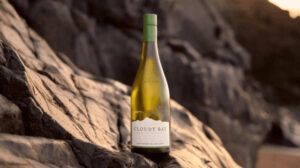
Without exaggeration, it could be said that one trout set the wine course of an entire country, as Cloudy Bay 1985 created a hurricane that shattered the existing status quo overnight. With its name borrowed not from its creators (as was customary at the time) but from the bay first discovered by Captain Hook in 1770, and with the distinctive, faint mountain peaks adorning its label, Cloudy Bay left the world speechless with its explosive and intense aromas and cool crispness.
Cloudy Bay has never been expensive, yet it has always been a hit, especially in the early years when production was limited. But neither this frenzy to acquire a bottle of it nor the fact that it is essentially a “simple”, fruity white made the creators put water in their wine: the yields of the vineyard are kept about 30% below the average for the region, and in difficult years – like 1995 – they did not hesitate to sell half of the total quantity because they did not consider it of sufficient quality.
Initially, Cloudy Bay included a small percentage of Riesling and Chardonnay in its composition, but the subsequent release brought Sauvignon Blanc alone into the bottle, defining a style that was to find countless imitators at home and abroad. Okay, this Sauvignon has a brackish, dried-out taste and aromas of lemongrass, unripe rabbit’s foot, and citrus that lend it a certain rigor. But Marlborough’s playfulness is present in every sip, upping the wow factor to such an extent that it prompted the great oenographer Oz Clarke to declare “Cloudy Bay has forever changed our perspective on what a white wine can and should taste like.”
Apparently, its huge commercial success did not leave major wine players indifferent, with Cliquot acquiring a majority stake as early as 1991 and the LVMH group becoming the sole owner of Cloudy Bay in 2003. Forty years have passed since the first vintage of this great wine, which costs around 35€, less than many of the world’s great wines.
But its importance is infinitely greater than its price, as this iconic Sauvignon Blanc has managed to create a wine cluster on its own, making New Zealand one of the most commercially successful wine-producing countries on the planet and elevating Marlborough as one of the world’s most renowned but large (27000ha) vineyards.
.
Ask me anything
Explore related questions