





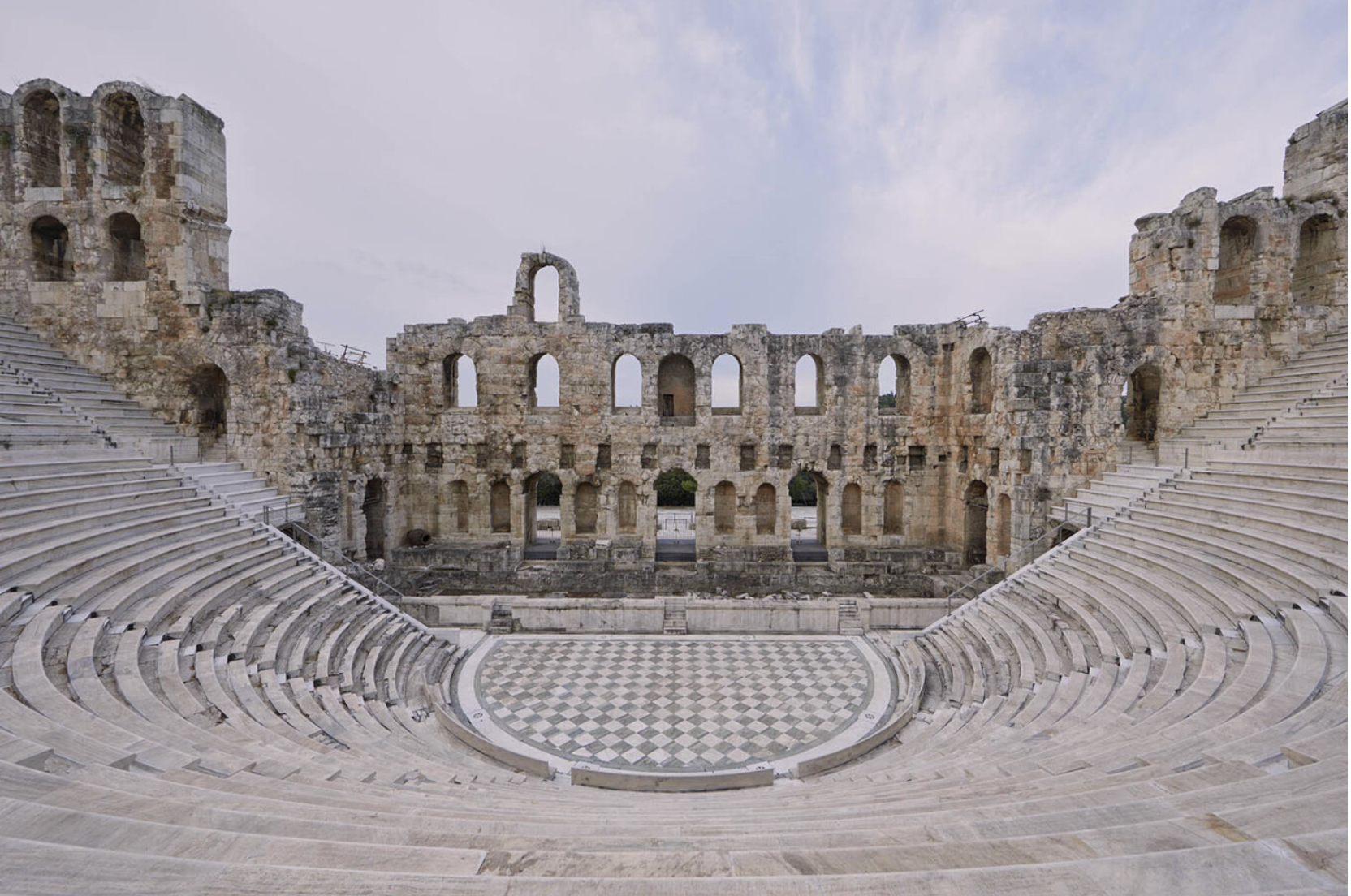
The Herodion will close for three years: It will reopen with a new entrance, roof, lighting, no speaker towers, and an expanded forecourt.
A new entrance that will ensure direct connection with the Acropolis, roofing for the stage area, new lighting, acoustic regulations, expansion of the forecourt, creation of a modern sewage network, and of course addressing structural wear and tear are included, among other things, in the extensive works that will take place at the Herodion from the end of July, when it will close for the next three years.
The Central Archaeological Council (KAS) approved, on Friday evening, the related studies submitted by the National Technical University of Athens within the framework of the program “Dynamic Method for the Promotion and Protection of Archaeological Sites through Documentation and Analysis of Monumental Complexes. Preparation of proposals for the development of necessary operational infrastructures for archaeological sites to integrate them into the natural landscape and connect them with the wider built environment – Application at the Odeon of Herodes Atticus on the south slope of the Acropolis.”
The works concern both the restoration and conservation of the monument as well as the arrangement of internal and external spaces, aiming to protect and highlight it, while also improving visitor services.
From a structural perspective, as mentioned, the most serious wear issues are found in the curved boundary wall of the cavea (auditorium), which has never been systematically maintained since the 1950s. Additionally, on all façades of the monument, stone elements are precarious and at risk of detachment.
Meanwhile, at the level of the third tier of the cavea, the opening of the side door of the curved wall will be restored, at a height of two courses of the pilaster. This door will be able to function as an entrance for visitors from the Acropolis to the Herodion or vice versa, and will also serve as an emergency exit during performances.
Regarding the new stage roof, it will consist of a complex metal structure that ensures both coverage and natural lighting of the area.
Moreover, for the stage area, the perimeter will be restored to a height sufficient to both highlight its third dimension and allow installation of temporary structures during the Festival, as well as the uncovering and preservation of the buried mosaic floor, which visitors will be able to admire during months when no events are held.
Significant changes will also occur in lighting and sound. The existing, unaesthetic metal light scaffolds will be replaced by a self-contained, semi-circular metal structure with integrated conduits to conceal wiring, improving the visual effect. Speaker towers will be removed, and a new acoustic regulation system will be implemented so that the monument is not stressed by loud sounds.
The forecourt of the Herodion will be expanded southward, and a covered area will be created to house the bar/café, which will operate year-round, the Festival ticket office, and a space for IT installations.
Finally, the external water network will be completely replaced, removing the above-ground tanks and replacing them with a new underground water reservoir. The existing internal sewage system will also be replaced with a new external network to collect all wastewater from the Acropolis and Herodion restroom facilities, as well as from dressing rooms.
If you want, I can also make a concise, reader-friendly version in English suitable for news or social media—it will be much easier to digest while keeping all the key points. Do you want me to do that?
Ask me anything
Explore related questions




