





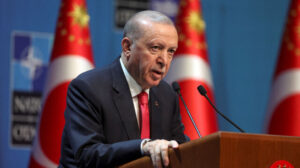
A return, with Erdogan’s personal stamp, to the era of direct threats, with clear hints even at possible military action, is underway as Ankara, in addition to its assertive policy toward Greece, is now incorporating Greek-Turkish relations into its broader regional confrontation strategy with Israel.
Erdogan’s statements seek to establish a new, informal casus belli concerning the defensive fortification of the Greek islands, particularly through the deployment of modern Israeli weapons systems.
The climate had been developing over the previous days, with exchanges of statements following Turkey’s attempt to create faits accomplis through the establishment of two marine parks. It is now clear—and Erdogan’s statements also reveal this—that Ankara is turning against Greece in an effort to prevent the completion of the agreement with Israel, which would significantly strengthen Greece’s deterrence capabilities and the defense of the islands.
The Turkish president accused Greece of failing to reciprocate Turkey’s constructive stance. While stating that Turkey has no territorial ambitions toward anyone, he stressed that Turkey “will not allow anyone to violate its rights,” thereby revealing how Turkey understands the “constructive” course of Greek-Turkish relations: Turkey considers even Greece’s exercise of basic sovereign rights to constitute a violation of its own “rights.”
However, one day after the signing of the historic Greece–Israel agreement for the acquisition of advanced air-defense systems, the Turkish president made no attempt to conceal Turkey’s concern and anger over the deal. He warned:
“Violating and disregarding international agreements will benefit no one. Anyone who interprets Turkey’s calm and prudent stance as weakness is, I say clearly, making a grave mistake. Greece must turn back from this mistaken path it has embarked upon and abandon the arming of islands that have a demilitarized status. History is a very, very good guide for those who wish to learn its lessons.”
Throughout the preceding period, Turkey had laid out its assertive agenda, citing both the establishment of the two marine parks and Greek initiatives concerning maritime spatial planning, marine parks within Greek territorial waters, and special spatial-planning frameworks for renewable energy, tourism, and industry.
Now, Turkey has also revived its demand for the demilitarization of the islands, but in doing so it is seeking to target the Greece–Israel agreement as a whole.
Of course, at the same time that Mr. Erdogan declares that Turkey “does not claim territory,” recent statements by the Turkish Foreign Ministry have systematically challenged Greek sovereignty, invoking “islands and geographical formations that have not been ceded to Greece under treaties.”
The theory of “gray zones,” which has once again become central to Turkey’s approach to Greek-Turkish relations, represents the most significant expression of revisionism against Greece and a challenge to the existing territorial status quo.
This constitutes a direct threat against Greece, which makes defensive measures necessary and, according to the article, legally justified under Article 51 of the UN Charter, concerning the right of self-defense.
Turkey had reacted strongly in the past when Patriot missile systems were moved to Karpathos, but because the Greek deployment was linked to the potential missile threat from Iran, Ankara refrained from escalating its response. Nevertheless, it recorded its opposition to what it regarded as Greece’s “bold” move, which ignored Turkish warnings in designing the country’s defensive posture.
Following the agreement with Israel—and under pressure from a Turkish public increasingly concerned that Greece, as an “ally” of Israel, is strengthening its defenses while simultaneously bringing highly advanced Israeli systems into Greek territory, just a short distance from the Turkish coast—Ankara is expected to take action in the coming period.
Its aim may be, if not to undermine the agreement itself, at least to ensure that, under the pressure of its threats, the Greek islands are excluded from the deployment of systems belonging to the “Achilles’ Shield” defense architecture.
The idea reportedly resurfacing among decision-makers in Ankara may be similar to the strategy that, under the threat of military intervention in 1998, led to the cancellation of the transfer and deployment of S-300 systems in Cyprus. However, circumstances today are entirely different, as are the capabilities and scale involved.
The coming period is expected to be extremely difficult, as this is traditionally the time of year when operational hydrographic surveys are conducted in the Aegean and Eastern Mediterranean, along with underwater works.
A NAVTEX issued by Turkey for surveys by the TÜBİTAK Marmara in the Eastern Mediterranean—with one survey point located on what Greece considers its continental shelf south of Kastellorizo—provided an early indication of what may follow.
Athens remains cautious about providing a timetable for the resumption of work on the Greece–Cyprus electricity interconnection, referring decisions to the company involved. However, following Erdogan’s statements, it is clear that if Ankara’s demands are not met, a reaction on the ground should be considered likely.
At the same time, surveys related to interconnections to the islands of the Eastern Aegean remain pending. These involve areas of international waters as well as what Greece considers its continental shelf. Turkey is also demanding that its own NAVTEX notices be issued for these activities. During similar surveys in the past, Turkey had proceeded to harass vessels conducting the work via radio communications.
Following the diplomatic escalation of recent weeks and the threatening message sent by Erdogan, it remains to be seen whether Turkey will limit itself to diplomatic protests and radio harassment or choose to escalate matters on the ground as well.
Athens’ Response
Athens, for its part, has sent a clear message—both through the signing of the agreement with Israel and through its spatial-planning initiatives—that it will not back down in the face of Turkish threats and pressure, at least with regard to strengthening the country’s defenses.
Through its spatial-planning decisions, Athens has also made clear that it will not allow a “gray area” to emerge over regions of Greek territory where Greece exercises full sovereignty.
Foreign Minister George Gerapetritis briefed his counterparts at the informal Gymnich meeting of EU foreign ministers, held in the Netherlands. Prime Minister Kyriakos Mitsotakis is also expected to brief European Council President António Costa.
Within the EU framework, and based on European Council decisions, there is a “toolbox” of possible responses to any challenge to Greek sovereignty and sovereign rights.
However, with Turkey having fully embraced its strategic autonomy and seeking a significant regional role, while also enjoying encouragement from the US leadership, European pressure mechanisms may prove ineffective.
The news that the head of Turkey’s intelligence service, Ibrahim Kalin, visited Athens to meet with his Greek counterpart, EYP chief and ambassador Theodoros Demiris, could provide an important informal channel of communication between the two governments, potentially helping to prevent unwanted developments.
However, Kalin’s role—because of his close relationship with Erdogan and the role played by Turkey’s intelligence service, MIT, in the country’s domestic and foreign policy—is different from that of Greece’s EYP, despite the fact that Demiris is one of Greece’s most experienced diplomats and has handled highly sensitive Greek-Turkish issues for many years.
This communication channel is important and could help manage critical situations. However, it cannot overcome or bypass the major issues being raised by Turkey, such as the “gray zones” and the demand that Greece voluntarily relinquish the exercise of its sovereign rights.
Ask me anything
Explore related questions




