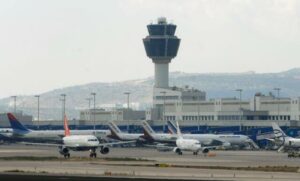
Authorities have restored the radar fault at Eleftherios Venizelos International Airport, after nearly two hours of disruption caused by a malfunction in an air-surveillance system. The issue led to delays in both departures and arrivals at Athens’ main airport.
The malfunction restricted air traffic, as fewer aircraft could land at the airport and departures were also reduced. Officials traced the problem to a radar operated by the Hellenic Civil Aviation Authority (HCAA), located on Merenda hill in eastern Attica, near Markopoulo Mesogaias.
According to information available at the time, arrivals fell from 22 to 17 per hour, while departures dropped from 25 to 20 per hour.
During the disruption, Air Traffic Controllers issued a statement stressing that this was not the first time the specific problem had occurred.
Statement by Air Traffic Controllers
“Once again, we found ourselves reliving the same situation this morning, as communication with Merenda hill was lost—just as it was last August—when a spare part failed. The HCAA had been ‘assessing’ since May 2024 whether to procure this part, yet it has still not been delivered.
Athens Approach, which serves the country’s largest airport, once again operated with only one radar instead of the three that should normally be in service, and without backup frequencies, after data transmission to and from Merenda hill was interrupted.
On 4 January 2026, we faced the unacceptable incident of a total loss of communications at the Athens Area Control Center (KEPATHM). To this day, we have not been informed of its causes. Meanwhile, the Administration has neither carried out a safety assessment nor issued operational instructions for traffic management, despite the risk that the fault may recur at any moment. Sector capacities remain at 100%, as if nothing has happened.
Today’s data-link failure with Merenda hill is not unprecedented. It further exposes the HCAA Administration and the responsible Directors, as it repeats the same problem that occurred months ago—despite assurances that it would not happen again.
Unfortunately, although the previous Governor was removed, his close associates—who share responsibility for the current state of the HCAA—remain in place for inexplicable reasons. It is therefore no surprise that nothing changes.
No responsible authority seems moved by the humiliation of the HCAA, which was forced to seek a donation to acquire a voice-communications system for KEPATHM—not due to lack of funds, but because years were wasted pursuing the revival of a contract that everyone knew was impossible, leading to a critical loss of time.
At the same time, the HCAA continues to pursue a contract for a new radar system (D.P.S.), whose budget has now reached €160 million (up from €76 million in 2024 and €150 million just weeks ago), without presenting technical specifications—a global anomaly, as a vast sum is set to be spent without clearly defining the system to be delivered. Meanwhile, the contract for the relocation of Athens Approach, after a 13-month delay in signing due to administrative indifference toward timely funding renewal, has already suffered a further three-month delay in execution, because the competent directorate has failed to appoint a committee to define detailed functional specifications (D.F.S.). This mirrors the situation that led to the expiration of the KEPATHM voice-communications contract without the system ever being delivered.
It is now evident that the long-standing pattern that deprived the HCAA of critical safety systems continues unchanged today—despite the scale of recent failures and the nationwide awareness of the problem. Those responsible for acquiring these systems appear to proceed undeterred. The key question is why they continue to act the same way and why they remain in their positions. At this point, the Minister and the Justice system must intervene.
What is certain is that the situation has long exceeded the limits of acceptability. As long as this state persists—and as long as no meaningful measures are taken to renew equipment and upgrade the reliability of existing systems—Air Traffic Controllers, in full respect of our duty to flight safety, will take all necessary actions, including capacity reductions, to protect passengers.
Once again, the only safety net that functioned was the Air Traffic Controllers themselves, who managed repeated equipment failures and successfully guided aircraft to safe landings. This, however, cannot continue.
Under the current conditions, we reiterate that no overtime will be provided during the upcoming summer season. We owe it to passengers and to the country not to serve as an alibi for the HCAA leadership and responsible directors to continue operating in the same way that led the Authority to its current, dire state.
We are determined to take any necessary action to end the prevailing mindset within the HCAA and reverse its decline, so that the country can finally secure an air-navigation service provider worthy of European standards.”
Ask me anything
Explore related questions