Two parallel negotiation tracks appear to have emerged over the past year regarding the war in Ukraine. On one hand, the United States has initiated talks with Russia aimed at ending the conflict. Despite repeated proposals, these discussions have so far failed to produce an agreement on territorial issues or security guarantees. On the other hand, reports suggest that representatives of the Kremlin and the White House have also been exploring potential bilateral economic agreements.
Ukrainian President Volodymyr Zelensky, citing Ukrainian intelligence, claimed that Moscow has offered the United States deals worth up to $12 trillion in exchange for lifting sanctions. A source quoted by The Economist indicated that a broad framework for such agreements may already have been informally outlined.
Meanwhile, concerns are growing in Europe that Donald Trump could pressure Kyiv into making significant concessions by June—a deadline he has reportedly set for progress on a peace deal—in order to secure economic benefits from Russia.
“The Greatest Deal” and What It Includes
According to the same publication, ahead of a reported meeting between Vladimir Putin and Donald Trump in August in Alaska, a memorandum was allegedly prepared on behalf of the Russian Security Council to present the US president with what was described as “the greatest deal.”
Since April, Kirill Dmitriev, head of the Russian Direct Investment Fund, has reportedly held repeated meetings with Trump’s special envoy, Steve Witkoff. At the same time, individuals said to be connected to Trump’s inner circle have been examining potential investment opportunities in Russian energy assets.
Among the proposals reportedly discussed are investments in Arctic oil and gas projects, rare earth mineral mines, a nuclear-powered data center, and even the construction of a tunnel beneath the Bering Strait. Russia faces pressure from low oil prices and tightening sanctions, while Trump is said to be seeking tangible achievements ahead of the November midterm elections.
The “Excessive” $12 Trillion Figure
The notion that the United States could secure $12 trillion in gains—roughly six times Russia’s annual GDP—has been described by some analysts as hyperbole intended to appeal to Trump. What, then, could be the realistic economic reward of peace in Ukraine?
Optimists argue that Russia’s inexpensive energy resources, critical minerals, and market of 145 million consumers could offer substantial opportunities for Western companies. However, analysts caution that the actual benefits may be far more limited, particularly given that China has already strengthened its position in Russian energy and raw materials projects.
Despite the sanctions regime, Western interest in Russia’s energy sector appears to persist. According to reports, executives from major oil companies met former Moscow partners at the ADIPEC energy conference in Abu Dhabi, while US law firms have been assessing potential scenarios for sanctions relief. At least five American companies that previously exited Russia, including Apple and McDonald’s, have reportedly re-registered trademarks in the country.
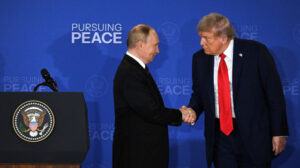
Additionally, The Economist reported that during a meeting between Putin and Trump in Anchorage, the Russian president offered to return $5 billion in assets seized from ExxonMobil in 2022.
In 2021, prior to the invasion of Ukraine, European Union exports to Russia totaled €90 billion. These included €40 billion in machinery and transport equipment—much of it destined for Russia’s mining and oil and gas sectors—along with €20 billion in chemicals and €9 billion in industrial goods such as household appliances and scientific instruments. By contrast, US exports to Russia amounted to just $6 billion, suggesting potential room for expansion in the event of a deal.
How Feasible Is Sanctions Relief?
In practice, lifting sanctions on the Russian economy would be far more complicated than it may appear. Western governments have imposed nearly 23,000 restrictive measures on Russia in recent years, creating a dense and multilayered sanctions regime.
While a US president could revoke certain sanctions through executive orders, lifting others—particularly those targeting major Russian banks and energy projects—would require congressional approval, where opposition to Moscow remains strong.
At the same time, diplomatic and intelligence sources suggest that European governments would be highly cautious about easing their own sanctions. Experience indicates that prolonged uncertainty deters multinational companies. Few firms returned to Iran after key sanctions were lifted in 2016, despite encouragement from European governments.
Even if Trump were able to persuade allies to offer Russia a “second chance,” he would have limited control over the internal dynamics of the Russian economy. Even before the war, foreign companies operated in an environment where politically sensitive missteps could trigger targeted sanctions or administrative obstacles. Today, that environment is widely regarded as even more unpredictable.
Denials from Moscow
On the Russian side, Kirill Dmitriev has firmly denied that Moscow is offering $12 trillion in projects “in exchange” for sanctions relief. In a public statement, he argued that decisions regarding sanctions would ultimately be guided by US interests and claimed that American companies have lost more than $300 billion as a result of withdrawing from the Russian market.
Ask me anything
Explore related questions