





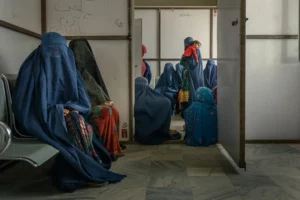
A new penal code adopted by the Taliban regime in Afghanistan has sparked strong reactions from human rights organizations, as it includes provisions that, according to reports, equate women with “slaves” and allow husbands or “masters” to impose physical punishment.
The newspaper The Independent has obtained a copy of the code, titled De Mahakumu Jazaai Osulnama, which has been distributed to courts across Afghanistan.
According to the report, certain provisions appear to allow husbands, as well as those described as “guardians” of women and children, to impose “discretionary punishment” in the form of beatings on women or subordinates. Of particular concern is that these regulations effectively place women in a position equivalent to that of “slaves,” as noted in the analysis of the text.
Even referring to the law is reportedly illegal
Many people avoid speaking publicly about the new code, fearing retaliation from the authorities. According to rights organizations, after criticism spread online, the Taliban allegedly issued a separate directive making even public discussion of the new framework a punishable offense.
The code provides that corporal punishments for serious crimes will not be carried out by prison officials but by Islamic clerics. For lesser offenses, the so-called ta’zir (discretionary punishment) applies, which, in cases where the “offender” is a wife, may translate into beatings carried out by the husband himself.
Although the law theoretically provides a legal process for women who suffer abuse to seek justice, the procedure is described as extremely difficult. Women are required to prove that they have suffered serious bodily harm by presenting their injuries before a judge while remaining fully covered. In addition, they must be accompanied by their husband or a male relative (mahram), even when the alleged perpetrator is the husband himself.
A legal adviser working in Kabul, speaking anonymously to The Independent, said that women face an “extremely time-consuming and difficult” process in order to obtain justice in abuse cases. In one of the cases she described, a woman was reportedly beaten by a Taliban guard while visiting her imprisoned husband. When she reported the incident, she was told she had to appear with a male guardian — namely her own husband, who was in prison.
Women exposed to ongoing violence
The human rights organization Rawadari, which monitors developments from exile, points out that certain provisions of the code do not allow women to safely seek refuge in their parental home. According to Article 34, if a woman repeatedly visits her father’s or relatives’ home without her husband’s permission and does not return despite his demand, both she and any family member who shelters her may face up to three months’ imprisonment.
As the organization stresses, this provision leaves women exposed to continued domestic violence, effectively depriving them of their only safe haven in a context where institutional protections are limited.
Rawadari and other experts also argue that the new code assigns religious officials the authority to impose restrictions on the rights of women, girls, and minorities, while granting them broad immunity from legal consequences.
A hierarchy of punishment
At the same time, the system appears to introduce a hierarchy of punishment based on a person’s social status rather than solely on the nature of the offense. At the top are religious scholars, followed by elites, then the “middle class,” and at the lowest level the “lower class.”
If a religious figure commits an offense, they may simply receive “advice.” A member of the elite may face the highest level of “advisory” intervention and a court summons. For individuals from the “middle class,” imprisonment is предусмотрed, while for the “lower class,” punishment may combine imprisonment and corporal punishment.
As Shaharzad Akbar, Executive Director of Rawadari, notes, the new framework makes religious officials responsible for enforcing systemic restrictions on the rights of women and minorities, while at the same time granting them extensive protection from legal consequences.
“The mullah is now at the top,” she states. “He sets the rules and enjoys privileges that do not apply to ordinary citizens, because he is placed even above the elites.”
Ask me anything
Explore related questions




