The Total Energy Corridor is emerging as a key tool in the new transatlantic strategy to enhance Europe’s energy security and secure supply in the post-Russian gas era.
The clear willingness of the United States to actively support the formation of a unified energy axis in Central and Eastern Europe was demonstrated by yesterday’s Energy Ministers’ meeting in Washington, D.C., which followed the P-TEC energy conference held in Athens last November, confirming the transatlantic focus on widening the routes of the U.S. LNG to the European market.
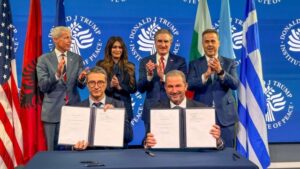
The summit, hosted by the White House and the National Energy Dominance Council (NEDC), brought together representatives from more than 20 countries, senior U.S. government officials and more than 50 energy and investment companies from 13 countries.
From the Greek side, Aktor, DESFA, Atlantic See LNG Trade S.A., Metlen, Gastrade, PPC and ONEX Shipyards & Technologies Group participated. On the US side, energy and investment giants such as Berkshire Hathaway, Cheniere Energy, Chevron, ConocoPhillips, ExxonMobil, Glencore, S&P Global, Shell USA, Siemens Energy and Woodside Energy Group participated.
The strong corporate presence demonstrates that the Vertical Corridor is not only a transnational policy initiative, but also an area of intense business interest, with the aim of securing long-term LNG contracts and financing new energy infrastructure.
New deal with Metlen
.
The signing of a Memorandum of Understanding (MoU) between Metlen and Shell, signed yesterday in Washington, D.C., is part of this, according to reliable sources. The agreement is for the supply of 0.5 to 1 billion cubic meters of natural gas per year. With the new deal, Metlen – which until now has been among the main importers of Russian gas through Gazprom – is accelerating its strategy of diversifying its supplies in line with the new European and transatlantic energy reality.
Atlantic See’s new agreements
Also of particular importance were the signings by Atlantic See LNG Trade S.A., the joint company of Aktor Group and DEPA Emporia, of multi-year contracts for the supply of US LNG with four countries in the region. These agreements involve commercial cooperation and gas supply, enhancing Greece’s footprint on the regional energy map.
Specifically, agreements were signed with Albania’s Ministry of Infrastructure and Energy, Bulgaria’s public gas company Bulgargaz, Aluminij Industries and M.T. Abraham Group from Bosnia and Herzegovina, and Ukraine’s Naftogaz.
Reports suggest that this is a first “batch” of deals, with similar deals with other countries in the pipeline, while more details on financials and volumes are expected to be announced today.
The joint communiqué
At the core of yesterday’s meeting is the Joint Statement of 13 countries on Enhancing Security of Gas Supply in Central and Eastern Europe, through which cooperation on regulatory, financial and commercial levels is sought, which until now has not been a given.
With these agreements, the goal is to move the Vertical Corridor from planning to implementation, enhancing two-way gas flows from Southeast to Central Europe and upgrading Greece’s role as a key LNG gateway.
According to the communiqué, the participating countries:
-Enhance the resilience of the gas markets by making full use of existing infrastructure and making new investments where needed.
-Ensure transparent and non-discriminatory access to energy infrastructure in Central and Eastern Europe.
-Promote the harmonisation of gas exchanges and the improvement of regulatory pricing frameworks.
-Commit to remove regulatory barriers that could restrict LNG imports, new infrastructure or the long-term stability of gas trade.
-Attract public and private capital, including export credit agencies and multilateral financial institutions.
-Reaffirm strategic cooperation with the United States to enhance energy security and prevent manipulation or coercion through energy.
The text was signed by the Ministers of Energy and representatives of: the Hellenic Republic, Bulgaria, Bulgaria, Hungary, Poland, Romania, Slovakia, Moldova, Moldova, Ukraine, Croatia, Lithuania, Serbia, Bosnia and Herzegovina, Serbia and the United States of America.
Corridor competition
However, despite the clear political will reflected in the Washington Joint Statement for a unified line on energy security, within the Central and Eastern European axis strong pockets of differentiation are already forming.
Poland and Lithuania are moving with a strategy that is not limited to compliance with the transatlantic framework, but aims to make them autonomous and competitive gas hubs for the next day of the European market.
On the sidelines of events marking ten years of US LNG exports to Europe, the day before yesterday Poland’s Deputy Minister of Climate and Environment Miłosz Motyka and Lithuania’s Energy Minister Žygimantas Vaičiūnas sent a clear message of readiness. They stressed that their countries have not only secured competitive LNG prices, but have also made systematic investments that allow for an immediate increase in capacity and transport routes to Central Europe.
At the heart of this strategy is the so-called Amber Gas Corridor, which was inaugurated on 27 November 2025.
At the beginning of 2035, this is the first step towards the creation of the new gas pipeline network.
This is a regional initiative to interconnect the gas markets of Finland, the Baltic States and Poland, with the prospect of expansion to Central and Eastern Europe. The corridor builds on already developed infrastructure, utilising the Klaipėda LNG Terminal, the Inkoo LNG Terminal, the Balticconnector interconnector and the Polish GAZ-SYSTEM transmission system, allowing two-way flows and flexibility in load sharing.
The Lithuanian minister’s suggestion that the Amber Corridor should be a key route for the “second decade” of US LNG in Europe is significant. It was a political signal that the Baltic is seeking a leading role, forming a northern axis that competes with the southern and vertical corridor, where Greece aspires to serve as the main gateway to the Balkans and Ukraine.
Ask me anything
Explore related questions