





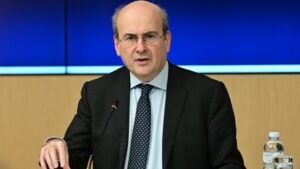
Before Easter, in early April, the next increase in the minimum wage will be announced, Deputy Prime Minister Kostis Hatzidakis said in an interview today.
Speaking on SKAI television, he said that “this increase follows those that preceded it in recent years, in which the minimum wage was increased from 650 to 880 euros per month and it is in 11th place among EU countries with a minimum wage.”
At the same time, he recalled that in the past few days, wage and pensioners’ pockets have seen increases in earnings due to the reduction in income tax, i.e. monthly tax withholding. “We are exhausting the budget margins,” Hatzidakis said.
“Unlike the opposition, the New Democracy government does not have magic recipes for increasing incomes, because such recipes do not exist. But it proceeds with pro-growth policies, with support for healthy entrepreneurship, tax cuts, improvement of the environment and wage and pension increases at the limit of what is feasible.”
About the Recovery Fund
Asked about the expiration of the Recovery Fund and the possibility of a reduction of financial support from the EU, the deputy prime minister said that it is wrong to think that Greece will not have substantial support from the EU in the next period (2028-2034).
“The support will be of almost the same intensity as at present. In the current period the available funds from NSRF, agricultural subsidies, loans and the Recovery Fund are in the range of 75-77 billion euros. Based on the EU proposal for the next period it is around €50 billion, to which are added loans and the Competitiveness Fund funds which total for EU countries €400 billion. So even if Greece gets a small part of that, it will be a big contribution. The support will be there, what we have to do is to combine fiscal seriousness with pro-development policies that take the country forward.
With regard to the political scene that is taking shape ahead of the 2027 elections, Hatzidakis noted that the way things have evolved, the choice is not between the right and the left but between rationalism and irrationalism.
“Whatever one may attribute to ND, it is a government that tries to work systematically, with results and following European practices. On the other hand, we have demagoguery, exaggerations, toxicity, conspiracy theories, perceptions that reflect ‘spurious’ theories. On the rationalism front, I would partly add PASOK, but it has a tendency to abandon itself and tend towards exaggeration,” he said.
“The point is not to give ND a third four-year term, but to think about how not to go back three four-year terms. The opposition parties do not want to work with the Southwest, but neither do they want to work with each other. And from this their irrationality is demonstrated. How do they want to appear as an alternative when all they practice is stone-walling?”
Finally, on Zoe Konstantopoulou and her interventions in Parliament, he said:
“There are always some graphic people who allow themselves such extremes. When someone attacks, constantly interrupts and uses sharp and insulting expressions, from a certain point onwards you cannot demand from the opposite person to restrain themselves and always give way to anger. It is our duty, because politics also has an educational role, to remain as much as possible at a high level. But it is also the obligation of all those who engage in such practices to take a break at some point and see if this is going anywhere. Because, this politics of sensationalism goes a few months, it goes maybe a few years, but no one has stayed in politics because they’ve been cursing at the other side and interrupting all the time in the House.”
Ask me anything
Explore related questions




