Last 10 days A generalized rise in sea levels across the Aegean Sea, from the coast of Crete to the Thracian Sea was recorded in the last 10 days.
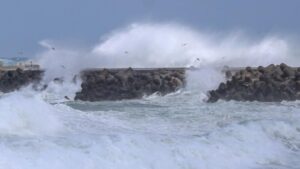
The phenomenon became particularly visible through images of flooding of specific beaches due to intense waves, as shown by media. However, this is a wider rather than local process, affecting the Aegean as a whole and the Southeastern Mediterranean in general.
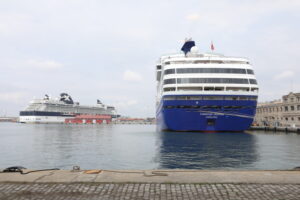
This observation mobilized the Coastal Research Laboratory, which, utilizing the equipment installed at the port of Heraklion in cooperation with the Organization of Heraklion Port (OLI), proceeded to the analytical processing of the measured data.
The contribution of OΛΗ was decisive as through the continuous support of the research infrastructure and the provision of operational data, it was possible to directly and reliably record the evolution of the phenomenon. The modern barometric pressure level recording equipment operating in the port of Heraklion allowed the precise correlation of the level changes with the atmospheric conditions.
According to the researchers, the generalised rise in levels is primarily linked to a decrease in atmospheric pressure in the area. When air pressure decreases, the sea surface “decompresses” and the sea level rises; conversely, when pressure increases, the level recedes.
Sensors in the port of Heraklion recorded a marked drop in barometric pressure in February, which explains the rise in levels observed during the same period. A similar trend was observed overall for the two months of January-February, with a gradual decrease in pressure and a parallel increase in level.
At the same time, successive episodes of bad weather in recent weeks contributed to short-term but pronounced changes. Strong southwesterly winds caused large water masses to be transported north and northwest through a process known as Eckman transport.
In areas where water accumulated, additional elevation of water levels was observed.
Indicatively, in the Thracian Sea the rise exceeded 50 cm in some cases, while in southern regions and in some places in Crete changes of 30-35 cm were recorded. These variations are related to the direction and intensity of the winds as well as to the geomorphology of the coast.
The presence of extensive low barometric systems in the Aegean Sea, which allowed the sea to maintain the increased sea level due to reduced atmospheric pressure, also played a decisive role. The persistent wave action temporarily increased the flooding phenomena on the coasts.
Scientists point out that this is a combination of meteorological and oceanographic factors and not an isolated or purely local incident. Systematic monitoring of sea levels and atmospheric conditions is essential, as such phenomena can recur when low pressures, strong winds and prolonged wave action coexist.
The Coastal Research Laboratory will continue to analyse the data and inform the relevant agencies and the local community, with the aim of early understanding and management of similar phenomena in the future.
The CEO of OLI, Menas Papadakis, said:
“The close cooperation of the Heraklion Port Authority with the scientific community is proving to be particularly important in practice. Through the continuous operation and support of the measuring stations in the port, we can have a timely and reliable picture of phenomena that affect both the port facilities and the coastal zones in general. Investing in knowledge and prevention is our strategic priority.”
The Research Director of the Coastal and Marine Research Laboratory, Nikos Kambanis, underlined:
“The phenomenon recorded is not local, but the result of a combination of meteorological and oceanographic factors on an Aegean and Southeastern Mediterranean scale. Our systematic high-resolution monitoring, supported by OLE, allows us to analyse in real time the level changes and contribute to both scientific understanding and operational preparedness.”
The Laboratory and OLE will continue their close cooperation and monitoring of marine and atmospheric parameters, with the aim of providing timely information to the relevant authorities and society on phenomena related to the dynamics of the coastal environment.
Ask me anything
Explore related questions