Nicosia is strengthening its defenses against the drone threat while at the same time raising its diplomatic and strategic profile with Monday’s trilateral meeting in Cyprus.
The Republic of Cyprus is moving forward with the acquisition of four “Kentavros” (Centaur) anti-drone systems in a move aimed at filling a critical gap in the island’s defense following the attacks and threats of recent days in the Eastern Mediterranean.
At the same time, Paphos will become a location of high political and strategic symbolism on Monday, March 9, as President Nikos Christodoulides, French President Emmanuel Macron, and Prime Minister Kyriakos Mitsotakis will meet there.
A defensive move with a Greek signature
The decision to procure the four “Kentavros” systems is part of Nicosia’s effort to gain more substantial protection against unmanned aerial vehicles, which have evolved into the most immediate and cheapest threat to critical infrastructure, military installations, and strategically important sites.
A government source confirmed to protothema.gr that the purchase of the “Kentavros” systems did not arise because of the U.S.–Israel conflict with Iran; rather, the intention had already been recorded months earlier in the procurement program proposed by Nicosia and approved by Brussels with funding linked to support through the SAFE mechanism.
It is a drone-countermeasure system developed by the Hellenic Aerospace Industry and based on electronic countermeasures designed to jam, disrupt, and neutralize the threat before it reaches its target.
The company itself states that the system has been operationally tested and is intended for anti-drone defense missions.
From frigate to land
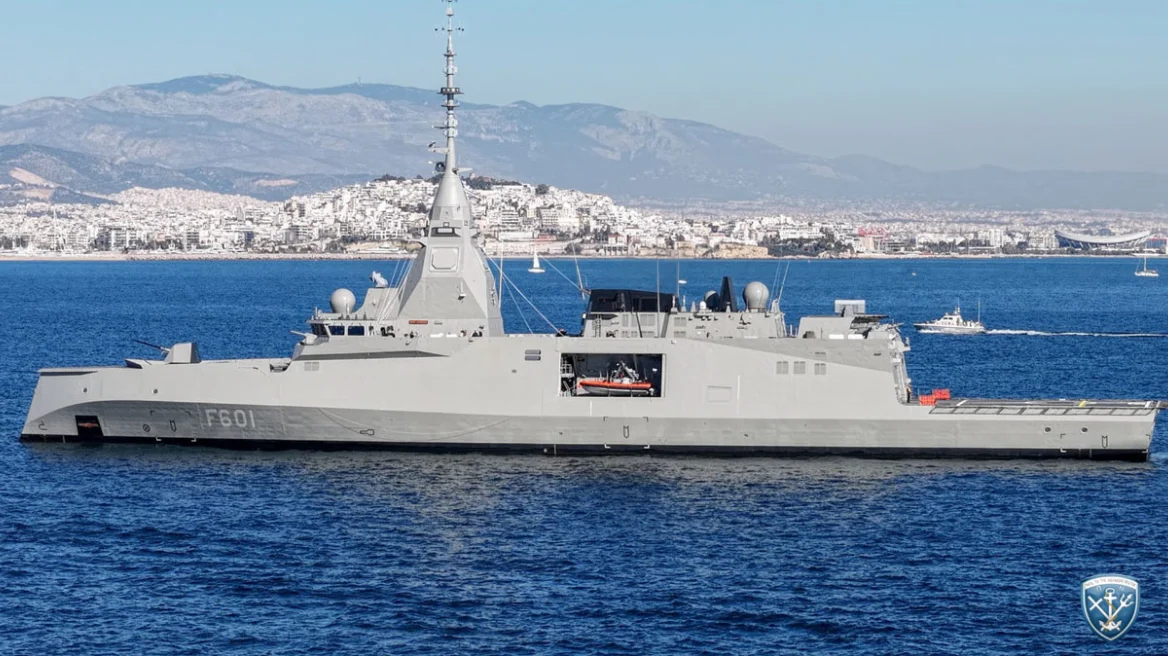
The system had already been at the center of recent developments, as the Cypriot government confirmed that one of the Greek frigates that arrived in the area carried a similar anti-drone protection system.
The difference now is that Cyprus will no longer rely solely on the presence of allied naval units or temporary deployments of forces. With four “Kentavros” systems, it will gain its own immediate-response capabilities and begin building an initial core of anti-drone defense.
This does not solve the problem entirely, but it changes the level of readiness. At a time when a drone can create a strategic headache at a cost far lower than a missile, Nicosia is forced to quickly adopt a different defense mindset.
Trilateral summit in Paphos
Within this environment comes tomorrow’s meeting in Paphos between Christodoulides, Macron, and Mitsotakis.
The French presidency has announced Emmanuel Macron’s visit to Cyprus, explicitly referring to support for a European Union member state exposed to the consequences of the conflict in the Middle East. Kyriakos Mitsotakis will also attend the meeting, giving the trilateral gathering a substantive rather than ceremonial character.
The President of the Republic of Cyprus is hosting the French President and the Greek Prime Minister at a moment when the island is not merely asking for expressions of sympathy but for resources, coordination, and political backing.
Athens has already demonstrated in practice that it stands beside Nicosia. Paris has made it clear that it considers Cyprus’s security to be a European matter. And Nicosia wants to turn this support into a more stable security architecture.
Tomorrow’s meeting is not only about the developments of the past few days. It is also about the next step.
Cyprus seeks to show that it will not remain the weak link that merely watches events and hopes they do not affect it. With the purchase of the “Kentavros” systems, it is sending a message that it is strengthening its operational protection. With the trilateral meeting in Paphos, it is sending the message that it has political and strategic backing from Greece and France.
Ask me anything
Explore related questions