





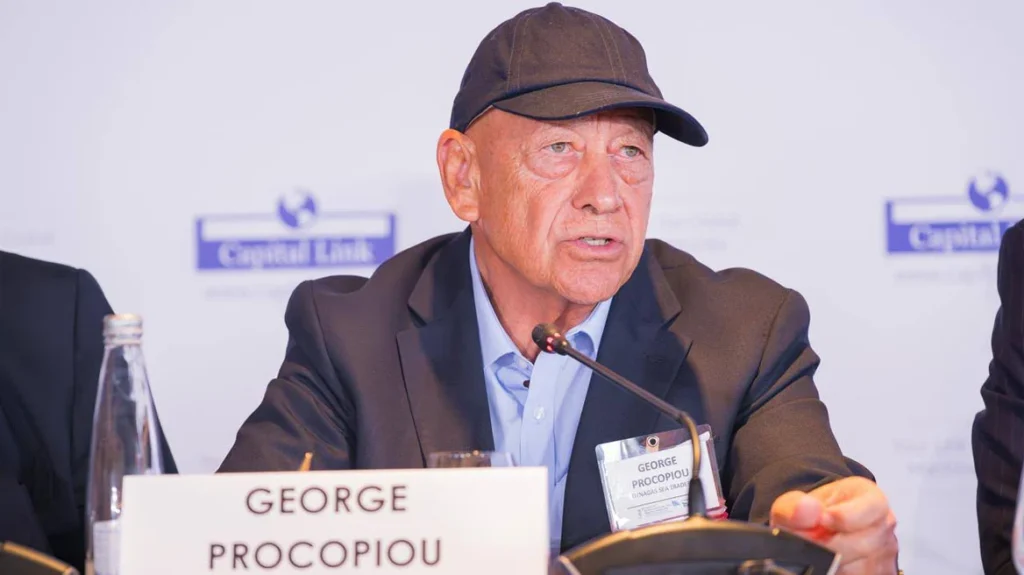
At least five tankers belonging to the Greek shipowner George Prokopiou passed through the Strait of Hormuz this week despite the military tension in the Middle East, in a high-risk move that could generate enormous profits due to the surge in freight rates.
As the Wall Street Journal reports, even in the dynamic and often extreme world of shipping, the billionaire shipowner George Prokopiou has for decades been considered a businessman who does not hesitate to take major risks in pursuit of profit.
This week he carried out one of the boldest moves of his 55-year career in tankers, sending at least five ships through the Strait of Hormuz while the war was escalating in the Middle East.
“Striking” his competitors
His ships are among the very few commercial vessels that sailed through this sea passage after the outbreak of the conflict, which trapped thousands of ships and raised fears of a global energy crisis.
Many of his competitors, several of whom have tankers trapped in the Persian Gulf, are avoiding sending additional ships because of the risk that either the vessels or their crews could end up on the list of casualties.
According to the report, Prokopiou’s strategy is based on the assessment that oil importers will pay extremely high freight rates to a shipowner willing to transport crude oil out of a war zone. Alternatively, oil producers in the Gulf could charter ships for temporary storage of crude at sea as their onshore tanks fill up. Producers in Iraq and Kuwait have already reduced their output because no storage space was available.
According to ship-tracking data and information from people familiar with the voyages, armed guards patrolled the decks of Prokopiou’s ships as they sailed through the Strait, while their tracking systems had been switched off to reduce the risk of becoming targets of attacks from Iran. However, in the event of missile, drone, or magnetic mine attacks, the ships would have very limited means of defense.
A strategy based on…risk
His strategy of moving toward danger has proved particularly profitable for the 79-year-old shipowner since the time he bought his first tanker in the early 1970s. Prokopiou founded Dynacom Tankers in 1991, while in 2013 he listed on the New York Stock Exchange a separate liquefied natural gas company under the name Dynagas. Forbes estimates the Prokopiou family fortune at about $4.7 billion.
“If you are not willing to take risks, you cannot operate in shipping,” he had said in 2014 to the shipping outlet Tradewinds.
According to reports, Dynacom pays particularly high wages to seafarers who agree to undertake the dangerous voyages to ports in Saudi Arabia and other Persian Gulf oil producers. A company representative did not respond to requests for comment.
The “king of real estate”
For Prokopiou—who often appears wearing a baseball cap and is known in the Greek press as the “king of real estate” because of his large investments in that sector—the reward could be some of the most profitable oil-transport deals ever made. According to reports, Dynacom offered tankers for charter at a daily rate of up to $440,000, four times the level before the war. By early Friday, however, no agreement had yet been reached.
Nearly one-fifth of the global supply of oil and liquefied natural gas passes through the sea passage between Iran and Oman. U.S. President Donald Trump said on Tuesday that the U.S. Navy would protect ships passing through the Strait, although maritime experts point out that this is an extremely difficult and dangerous undertaking.
Iran has sent mixed messages regarding the threat to commercial ships. On Thursday, the Iranian mission to the United Nations said that the United States had endangered maritime security, adding that Tehran does not intend to close the Strait of Hormuz.
On the same day, the Islamic Revolutionary Guard Corps announced that it had attacked an American tanker at the northern end of the Gulf. A U.S. shipping company reported that one of its tankers was shaken by an explosion.
Greek shipping companies collectively control the largest tanker fleet in the world, giving shipowners such as Prokopiou strong influence in the oil market as well as access to decision-making centers in Washington. These companies charter their ships to trading houses or oil companies that use them to transport crude oil around the world or, in rarer cases, to store it at sea.
Comparable to Onassis and Niarchos
In the 20th century, the legendary rivals of Greek shipping Aristotle Onassis and Stavros Niarchos made enormous profits when the Suez Crisis sent tanker freight rates soaring. Similarly, within hours of the arrest of Nicolás Maduro in January, shipowners in Athens contacted oil traders to organize shipments from Venezuela in case U.S. sanctions were eased.
Prokopiou owns more tankers than most of his competitors, controlling about 70 through Dynacom, according to a European Union database. Several of them were already in the Persian Gulf when the conflict broke out, according to the ship-tracking company Kpler.
Since then, the Greek shipowner has sent three crude-oil tankers and two refined-product carriers—such as gasoline—through the Strait.
A potential beneficiary of the blockade is also a South Korean company that recently bought dozens of tankers and had already positioned some in the Gulf before the war began. Sinokor is reportedly chartering several of them to the UAE’s state oil producer Adnoc as floating storage units at a daily cost of up to $500,000. A company representative did not respond to requests for comment.
It is not the first time Prokopiou has operated in markets where others hesitate to venture. According to ship-tracking data, his ships remained active in the Russian market in recent months. This activity remains legal, but stricter enforcement of sanctions—combined with high freight rates offered elsewhere—led many other Greek shipowners to reduce their presence last year.
One of the Dynacom tankers that passed through the Strait this week, the Smyrni, had just completed a shipment of crude oil from a Russian Black Sea port to India.
At the beginning of the war in Ukraine, Kyiv criticized Prokopiou and other shipowners for participating in the transport of Russian oil, arguing that this financed Moscow’s war effort.
He contributed to Europe’s energy security
At the same time, however, he also contributed to Europe’s energy security. Prokopiou’s liquefied natural gas company chartered two floating import terminals in Germany when Europe’s largest economy was urgently trying to build infrastructure to free itself from dependence on Russian natural gas.
“Sanctions have never worked,” Prokopiou said at a shipping conference in Athens in 2022. “The Iranians became stronger and more resilient, more self-sufficient. The Venezuelans suffered, but the rich did well.”
Ask me anything
Explore related questions




