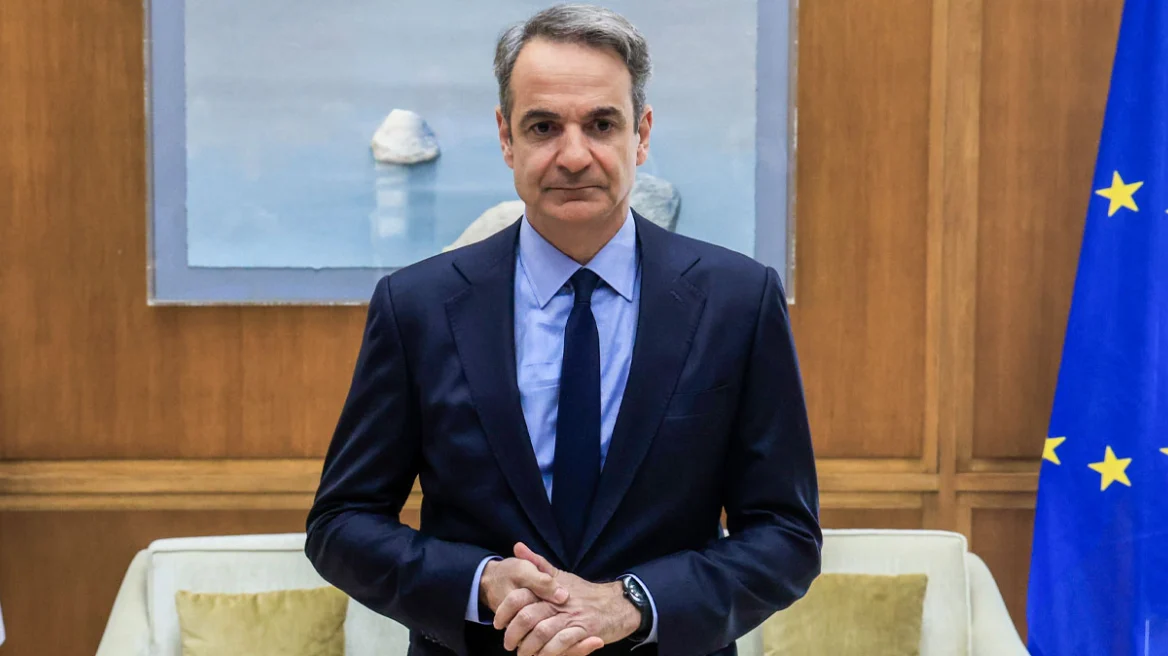
Prime Minister Kyriakos Mitsotakis made an extensive reference to the war in the Middle East in his Sunday post.
Initially, the Prime Minister referred to the European reinforcements sent to Cyprus after the attack carried out by Iran on the British base at Akrotiri, with Greece standing from the first moment alongside Nicosia.
“Our example was followed by other partners as well, extending a European network of air and naval protection around the island. This confirmed the obvious: when European territory is threatened by external dangers, our common response can only be immediate and strong,” the Prime Minister noted.
At the same time, Kyriakos Mitsotakis also referred to the repatriation flights of Greeks from the Middle East, noting that “these operations were extremely difficult due to extensive flight restrictions, ongoing alerts in the conflict zones, and the large number of countries involved.”
Speaking about the consequences of the war, he noted that “we will intervene immediately and forcefully in every speculative phenomenon.” “We have done so in the past, and we will not hesitate to do so again now,” the Prime Minister emphasized.
Full post by the Prime Minister:
“In the past week, we saw how the upgrading of our national diplomacy and defense in recent years is tangibly transformed into security and solidarity. Because, as soon as the conflict in the Middle East threatened the Greek community in Cyprus, Greece stood, without a second thought, by its side. Our example was followed by other partners as well, extending a European network of air and naval protection around the island. This confirmed the obvious: when European territory is threatened by external dangers, our common response can only be immediate and strong.
At the same time, the State organized ways of communication to provide useful instructions to our fellow citizens who found themselves in danger zones. Already, hundreds of them are returning safely to the country. In the past five days, through the central service of the Ministry of Foreign Affairs and our on-site embassies and consulates, a total of 1,039 people were repatriated from Qatar, Kuwait, Bahrain, Israel, Oman, the United Arab Emirates, as well as from the Palestinian territories.
Specifically, just yesterday, 90 citizens who were in Qatar, Kuwait, and Bahrain returned to Athens from Dammam in Saudi Arabia via an Air Force C-130 aircraft, and 448 citizens returned from Dubai on a special flight. For the repatriations, aircraft rented by the Ministry of Foreign Affairs, ground transportation, and military planes were used. These operations were extremely difficult due to extensive flight restrictions, constant alerts in the conflict zones, and the large number of countries involved. The Government will continue to provide assistance by all means to Greeks in these areas and to ensure the safe return to the homeland of those who wish. Congratulations are due to the many services that cooperated for this purpose.
With the same readiness and determination, our country will also face any negative consequences that may arise from the latest turmoil. Whether this concerns the energy market or certain price increases in goods as a result of increased production and maritime transport costs. We have the experience, knowledge, and, above all, the will to intervene immediately and forcefully in every speculative phenomenon. We have done so in the past, and we will not hesitate to do so again under the new conditions, always prioritizing the shielding of the homeland and supporting society.
In any case, the current situation confirms a critical dual conclusion: first, that the international reality is more uncertain than ever. This means that the policies of each state must now be shaped not so much by ideological criteria as by national criteria. And second, that amidst so many unprecedented geopolitical shifts on the world map, political stability and internal order in each country emerge as a strategic advantage. A fact that should concern all political forces, as well as every individual citizen. This is precisely the main concern of the government: in the uncharted waters of international developments, the country must have a steady hand at the helm. The crew of the national vessel must be united and armed with optimism stemming from confidence. And Greece’s compass must point forward, with certainty.
Meanwhile, the government’s work continues normally. From the week’s activity, here is what I highlight and share with you.
First, Parliament passed our initiative to extend postal voting to national elections for Greeks abroad. This is an institutional reform that brings Greece closer to the diaspora and allows Greeks abroad to participate more easily in national elections. The regulation received the required constitutional majority of 200 MPs – 201 votes to be precise – and will be implemented from the next national elections in 2027. However, the political boldness of the opposition was – allow me to say – partial. This is because the parties did not support the establishment of a special three-member Electoral District of the Greek Diaspora, where registered voters abroad could elect their representatives to the Greek parliament.
Thus, postal voting will be applied from the next national elections, while the special electoral district will take effect 18 months later. In any case, it is an achievement.
Second, and very important for those over 65 and people with disabilities: applications have opened for the “All Digital” program, which aims to help them become more familiar with the digital world. The response is already significant, as over 4,000 applications have been submitted in just a few days. Through the program, participants will learn in practice how to use basic digital services that facilitate daily life, from https://www.gov.gr/ and electronic payments to communication via digital applications. Lessons are being held at 195 locations across the country, and applications can be submitted until March 15 through the empower.gov.gr platform.
Another significant development in the labor sector is the signing of the first two-year Collective Labor Agreement in the confectionery industry, the first since the enactment of the National Social Agreement. The agreement provides significant salary increases, supplements for special categories, and allowances for seniority, marriage, and education. Once declared generally binding, it will cover over 23,000 workers in more than 2,000 enterprises in the sector. Very good news for sector employees and a positive signal for the labor market.
I continue with the special technical support agreement for Greece on air navigation matters, signed by the Civil Aviation Authority with the European Organization for the Safety of Air Navigation (Eurocontrol), as part of the National Action Plan for modernizing the Greek Air Traffic Management and Air Navigation Services system. The support concerns the provision of technical advice that will strengthen many areas of system upgrades and maximize aviation safety, enhancing interoperability and resilience of national infrastructure, and consequently improving the overall performance and reliability of the European air navigation network.
I am particularly pleased that, from the most official lips, the Regional Director for Europe of the World Health Organization recognizes the major positive changes in the public health system. Hans Kluge specifically referred to the preventive care programs we implement in our country, which are pioneering in Europe and have a strong response from society, as well as Mobile Health Units, which reach citizens’ homes even in the most remote areas.
The Ministry of Health is now launching another innovative national initiative regarding the health and daily lives of adolescent girls, opening the discussion around menstruation. The program is mainly aimed at girls but also at boys, because knowledge helps remove embarrassment and stereotypes and fosters greater respect in schools. Meetings, both in person and remotely, are planned for students in grades 5 and 6 in selected regions and for middle school students nationwide, as well as for parents and teachers. Nearly 80,000 children and adolescents have already participated.
In addition to the educational material, the program provides the free distribution of 18,288,000 menstrual products to approximately 125,000 female students. Already, during the pilot phase, products were distributed to 880 students from 12 schools in Attica and Thessaloniki.
Remaining in the health sector, I want to note the very important and generous donation of the Stelios Haji-Ioannou Foundation to the Greek State, aimed at financially supporting doctors serving on small islands with populations under 4,000, especially during the winter season. The donation, amounting to €10,080,000, covers the next seven years, until 2032. Each eligible doctor will receive €1,500 per month, net and tax-free, without deductions for the state or third parties, for twelve months a year, i.e., €18,000 per year and €126,000 over seven years, provided they are physically present at the health unit. In other words, they will receive an additional tax-free salary. I warmly thank the Haji-Ioannou Foundation for this patriotic contribution and hope it finds imitators.
Next, the truly impressive new Arsakeio Megaro in the center of Athens, which houses the Council of State. The highest administrative court is now in a fully accessible, renovated, and functional building, nearly two centuries old, worthy of its history and mission. The particularly demanding renovation was completed in less than two years and financed by the Recovery Fund, as part of investments we implement for the modernization of Justice. It is worth noting that, despite the temporary relocation of the Council of State to the historic building of the Commercial Bank, not only was the operation not interrupted, but the number of pending cases decreased, as well as the completion time by over 20%.
Five other foreign universities have applied for licenses to establish and operate in Greece. Four – Georgetown University, Iowa State University of Science and Technology, European University Cyprus, and Roger Williams University – aim to start operations in the 2026-2027 academic year, while the fifth, the University of Sunderland, plans to open a branch in 2027-2028. Additionally, within the relevant timeframe, five parent institutions requested re-evaluation of their initial license applications. The applications and respective files will be examined by the National Authority for Higher Education and the National Organization for the Certification of Qualifications and Vocational Guidance, if they meet the strictest criteria in Europe that we have set. Greece steadily strengthens public higher education while upgrading its position on the international academic map, creating new alternatives for its students.
Our country is also advancing rapidly in broadband. According to Ookla data released this week, Greece ranks 4th globally and 1st in Europe (!) in 5G Standalone network speeds, the full and most advanced version of 5G. In fixed broadband connections, we climbed 22 places in the global ranking within a year, thanks to innovative programs such as the Gigabit Voucher and Smart Readiness, which overall strengthen the country’s digital ecosystem. There is still progress to be made, but it is clear we are steadily moving forward.
Before I close today, I want to mention the streak of successes of the Financial Crimes Division of the Organized Crime Department. This time they dismantled a gang engaged in phone scams, which recently troubled many citizens, mainly the elderly. The members impersonated HEDNO employees or accountants and “phished” potential victims via a call center in Zephyri. Six people were arrested in the act while calling unsuspecting citizens. Police have identified more than 40 cases of fraud since October 2025, with estimated gains exceeding €300,000.
I close with the restoration of not only a historical and cultural but also a moral debt of our country, repatriating artifacts belonging to synagogues and families of Greek Jews stolen during World War II. After two years of efforts by the Ministries of Culture of Greece and Poland, Warsaw returned 91 artifacts, the first time from this country. The Greek State had claimed them since 2001, but the necessary legal framework for their return did not exist. The place of these valuable memory fragments is the Jewish Museum in Thessaloniki.
Work continues on all fronts, and we will speak again next Sunday. Wishing everyone a good Sunday.”
Ask me anything
Explore related questions