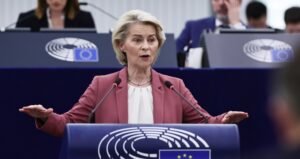
The EU’s solidarity with Cyprus was underlined by European Commission President Orsula von der Leyen in her speech to the European Parliament on developments in the war in Iran and the energy challenges facing Europe.
“We all stand in full solidarity with Cyprus. Your security is our security,” said the Commission President, stressing that “the first responsibility of Europe is to protect its citizens and prepare for the consequences of the conflict.”
Referring to the situation in Iran, von der Leyen noted that “many Iranians celebrated the fall of (Iran’s Supreme Leader Ayatollah Ali) Khamenei” and hoped that “this moment can pave the way for a free Iran”. At the same time, he underlined the EU’s unwavering commitment to the pursuit of peace, the principles of the UN Charter and international law.
He then addressed the energy implications of the crisis in the Middle East. He said that despite efforts to diversify energy sources, Europe was still vulnerable to price fluctuations on world markets. According to the figures he presented, since the beginning of the conflict “gas prices have risen by 50% and oil prices by 27%”, which means that “ten days of war have already cost European taxpayers an extra €3 billion in fossil fuel imports.”
Von der Leyen stressed that the EU’s strategy must continue to rely on domestic energy sources, namely renewables and nuclear energy. She said “we have energy sources produced in Europe – renewable and nuclear energy”, noting that their prices “have remained stable over the last ten days”. He even warned that a return to Russian fossil fuels “would be a strategic mistake” that would make Europe “more dependent, more vulnerable and weaker.”
Analysing the structure of energy bills, the Commission President said that the cost of energy itself accounts for about 56% of the bill, grid charges for 18%, taxes and levies for 15% and carbon costs for about 11%. The Commission is considering measures to reduce costs, including through better use of energy purchase contracts and possible interventions in the price of gas.
He also made particular reference to the European emissions trading system, known as the ETS. As he stressed, “without the ETS we would consume 100 billion cubic metres more gas today”, which would increase Europe’s dependence. However, he noted that the system “needs modernisation”, opening up the debate on possible reforms.
In closing, the Commission president announced that a new roadmap for boosting European competitiveness, entitled “One Europe, One Market”, will be presented soon. She said this blueprint will include key legislative measures with a clear timetable up to the end of 2027, with the aim of “delivering the necessary reforms for European citizens.”
Ask me anything
Explore related questions