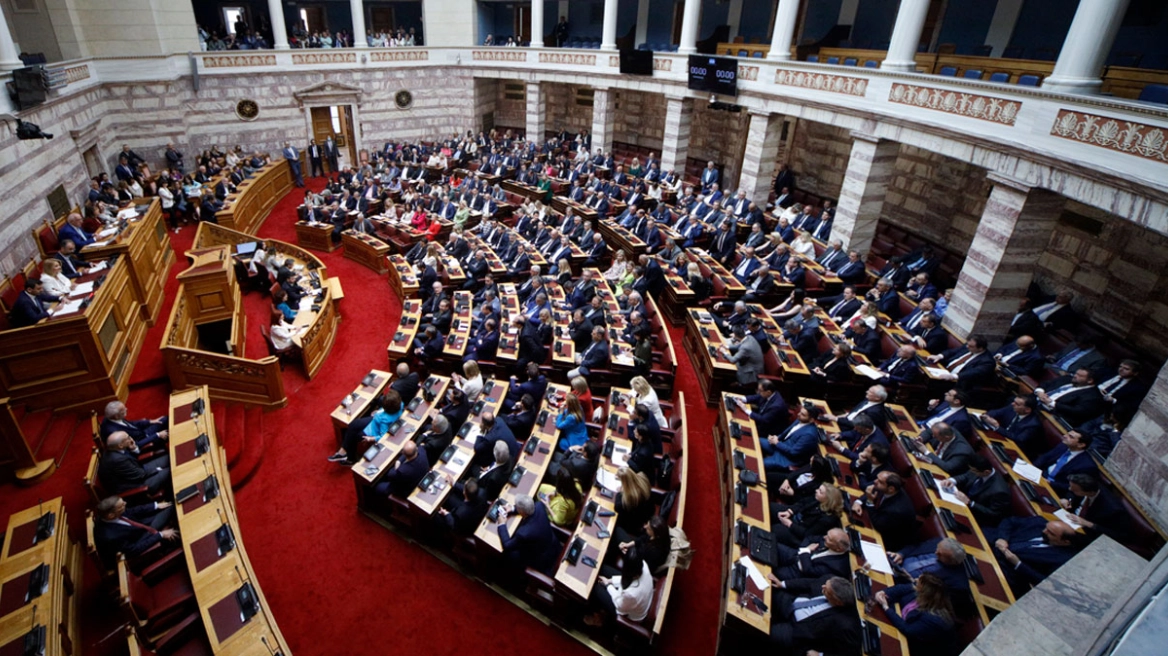
The plenary session of Parliament is discussing four contracts between the Hellenic Republic and the American giant Chevron for the exploration and exploitation of hydrocarbons in blocks south of Crete and the Peloponnese.
During the discussion that previously took place in the relevant parliamentary committee, Energy and Environment Minister Stavros Papastavrou stated, among other things, that “Greece is making a leap forward—from an energy hub it is laying the foundations, with agreements with Chevron and Exxon, for natural gas production… Our country has become a central gateway for American liquefied natural gas, and now we are seeking to become a natural gas producer.”
At the same time, the minister noted that the contracts undermine Libya’s illegal claims in practice, responding to criticism raised by former Prime Minister Antonis Samaras and opposition parties regarding the inclusion of a clause in the lease agreement for a block south of Crete.
“The government’s position is not that just because Chevron came, this automatically means security guarantees. Chevron comes, agrees, and signs for an area that objectively at the moment is not delimited, and Libya has submitted a diplomatic note to the UN saying that ‘83% of the areas the Greeks claim belong to us,’” Papastavrou said.
He added: “In this area, Chevron—the second-largest American company—ignores the diplomatic note and says to Libya, ‘we don’t hear you.’ For an area that Libya illegally and abusively claims at the UN as its own rather than Greece’s, a company comes and reinforces the Greek position.”
It should be noted that the bill is being discussed in Parliament through the procedure used for ratifying contracts. At the end of the process, each of the four contracts will be voted on as a single article, meaning MPs will either approve or reject the contracts as a whole, without the ability to isolate individual provisions—such as the “compensation clause,” which has drawn criticism from the opposition.
Positions of the parties – PASOK will not vote for the Crete contracts
New Democracy rapporteur Dimitris Markopoulos said that “the intensification of American interest not only provides potential economic and development benefits, but also produces immediate and tangible geopolitical results.” He added: “The agreement shields Greece. What the Belharra frigates are for our defense, these agreements are for the country’s energy future. They produce policy and stability.”
From PASOK, Fragkiskos Parasyris argued that the foundations for the exploration and utilization of Greece’s energy resources were laid by the party and former minister Giannis Maniatis. The MP from Heraklion focused his criticism on Article 30 of the contract concerning the block south of Crete, noting:
“The provision states that the geographic coordinates of the southern and lateral boundaries of the contract area may be revised. This is the first time such a clause appears in a contract. In practice this means two things: either the legislation up to now was flawed, or you were asked to add it.”
Parasyris concluded that his party would vote in favor of the general principle and of the contracts concerning the Peloponnese blocks, but would vote against the contracts concerning Crete.
SYRIZA rapporteur Miltos Zambaras questioned whether “the agreement implies a potential transfer of rights. How do the terms of the contract relate to the government’s celebrations about safeguarding our sovereign rights?”
He also said that his party would vote against the entire set of contracts, arguing: “We have absolutely no trust in you. Not for energy, not for the economy, not for the country’s energy security. You have failed.”
The Communist Party of Greece (KKE) also expressed opposition to the bill through Afrodite Ktena, while Vasilis Viliardos of Hellenic Solution said his party supports the exploitation of hydrocarbons but criticized certain individual terms of the agreements.
Ask me anything
Explore related questions