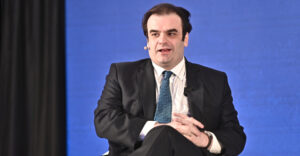
The Minister of National Economy and Finance, Kyriakos Pierrakakis, expressed the view that the old “Nikos Kazantzakis” airport in Heraklion could evolve into a new “small Ellinikon,” speaking at the conference Greece Talks, Crete Forward: Experience, Culture & Connection, organized by Travel.gr in collaboration with Proto Thema, with the support of the Region of Crete.
Mr. Pierrakakis focused particularly on Crete’s developmental potential, noting that this year looks very promising for tourism, while the island’s revenues show significant growth. He mentioned that Crete contributes roughly 20% of the country’s tourism income, while its overall contribution to GDP reaches 5%, highlighting the island’s importance to the national economy.
Referring to major infrastructure projects, he stressed that works that had remained stalled for years are now progressing, citing as examples the Northern Crete Highway (BOAK) and the new airport at Kastelli. He also emphasized that the country now possesses both the mechanisms and expertise to implement large projects more quickly and efficiently. Within this framework, he described the utilization of the old Heraklion airport area as critical, noting that it covers approximately 2,000 acres and could transform conditions for the city and for Crete as a whole.
The Minister of Finance highlighted that the developmental boost is not only linked to tourism but also to a broader set of interventions and funding mechanisms. He mentioned the Recovery Fund, as well as other available tools, saying that through these, significant projects can be promoted on the island, such as student dormitories being implemented via Public-Private Partnerships (PPPs). At the same time, he noted that the Ministry of Finance can play a key role in the country’s developmental trajectory through modern financing models.
Mr. Pierrakakis also emphasized that Crete’s wealth is not exhausted by tourism but includes its productive base, businesses, and exports. He stated that the island’s tourism offering must be transformed to achieve greater year-round sustainability, rather than being limited to the summer months. In the same context, he noted that the Greek economy has already made significant progress, with exports rising from 20% of GDP during the onset of the crisis to over 40%, with the next target being the European average of 51%.
Regarding the overall economic picture, Mr. Pierrakakis noted that Greece is on target, with debt on a downward trajectory and the country’s position strengthened in European institutions. He further emphasized that in an unstable international environment, safe predictions cannot be made, pointing out that even at the last Eurogroup, sentiment shifted depending on oil price trends. He clarified, however, that if a deep and lasting problem arises, the government will intervene, and no household will be left without support.
Finally, referring to his experience as President of the Eurogroup, he humorously noted that the Prime Minister told him, “If you win, you will have to work at 130% from now on.”
The panel also included Eurobank CEO Fokion Karavias and Plastika Kritis CEO Michalis Lempidakis, while the discussion was moderated by Antonis Sroiter.
Ask me anything
Explore related questions