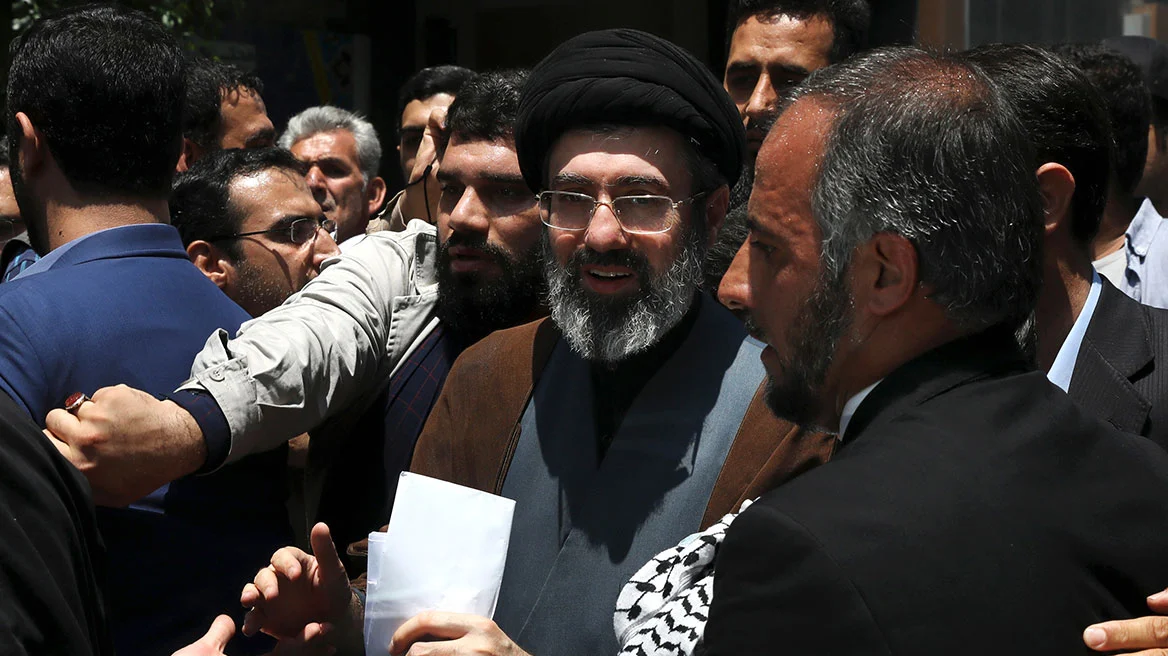
At a time when rumors about the health of Iran’s new supreme leader, Mojtaba Khamenei, are swirling — since no one has seen him in public either since the start of the war or after his selection — a new investigation sheds light on details concerning property ownership in London.
Specifically, evidence gathered and presented by the Israeli non-profit investigative journalism platform Shomrim in cooperation with the International Consortium of Investigative Journalists (ICIJ) shows that tens of millions of pounds used by Khamenei to buy luxury homes in the British capital came from a loan provided by a company linked to British-Israeli businessmen.
As the investigation reveals, a loan worth £36 million (about €42 million), granted in 2013, was directed to a company registered on the Isle of Man, a well-known low-tax jurisdiction.
At that time, none of the Iranians involved in the deal were under sanctions, and there were no legal restrictions on granting the loan. However, on Khamenei’s side, the choice of a company with Israeli ownership is seen by critics as evidence of the contradiction between the Iranian regime’s rhetoric toward Israel and the economic practices it follows.
Transfer of capital to Western countries and money laundering
About two months earlier — before the war had begun and before Khamenei’s father had been assassinated — Bloomberg published an extensive investigation into the younger Khamenei’s business empire.
According to that investigation, which was based on confidential business documents, property records, and testimony from Western intelligence services, Mojtaba Khamenei was at times able to circumvent sanctions imposed on Iran, as well as the personal sanctions imposed on him in 2019, by moving billions of dollars into Western countries.
The funds were allegedly derived from the sale of Iranian oil and “laundered” through a network of shell companies and multiple bank accounts in the United Kingdom, Switzerland, Liechtenstein, and the United Arab Emirates. Money routed through the network reportedly ended up with associates of the Revolutionary Guards, including the Khamenei family, and was used in part to purchase real estate in various countries.
Bloomberg identified 57-year-old Iranian businessman Ali Ansari, who also holds Cypriot citizenship, as a key figure in the network. His second nationality allegedly enabled him to open bank accounts and establish companies across Europe without attracting suspicion.
Ansari, who has reportedly known Mojtaba Khamenei since the 1980s, is said to have acted as the family’s main representative in Europe, including overseeing property purchases.
In London, according to Bloomberg, Khamenei controls more than 12 properties with a total value of around $120 million, including a villa worth more than $40 million. At the same time, he also holds stakes in two hotels in Germany, a luxury golf resort in Mallorca, properties in Paris, and a luxury villa in Dubai’s “Beverly Hills” area.
Ansari’s activities in Europe, which lasted at least fifteen years, ended last October when British authorities imposed sanctions on him, describing him as a “corrupt Iranian banker and businessman” who financed the Revolutionary Guards, while also freezing his assets.
He denied Bloomberg’s allegations and said he has no connection to Khamenei. After the investigation was published, authorities in Germany and Canada launched their own inquiries, while Cyprus announced that it was examining how his citizenship had been used. In one telling development, Booking.com removed from its listings the German hotels linked to the network.
According to Bloomberg, Khamenei’s London properties were bought and are held through a shell company called Birch Ventures, which is registered on the Isle of Man and lists Ansari as the ultimate beneficial owner.
The financing of a major real estate deal has an… Israeli connection
The new investigation by Shomrim and ICIJ now reveals the financing behind one of the biggest property transactions carried out by that company.
In 2013, the shell company received a £36 million loan to buy more than 20 dunams of property (about five acres) on Bishops Avenue in London, an area known as “Billionaires’ Row.”
It is not clear why the company needed the loan. However, financial crime experts note that loans are often used in money-laundering schemes, especially when authorities might question the origin of the funds.
At the time, Ansari was known simply as an active Iranian banker, and there were no sanctions or legal restrictions preventing cooperation with him.
Documents obtained by Shomrim show that the loan was issued by a subsidiary of a British private investment fund called LJ Partnership, which acted as an intermediary. The actual financing, however, came from another company, Topland Jupiter Limited.
Topland later described the loan as a successful transaction and even issued a relevant statement, but without naming the Isle of Man company. The statement said the loan had been given to the intermediary LJ Partnership.
The question raised is whether the Iranian side knew the source of the money. According to the documents, yes. Topland’s name appeared in the loan guarantee documents, where the 12 London residences were listed as collateral.
The documents also reveal that the loan was fully repaid about two years later, in September 2015.
Additional records show that cooperation between LJ Partnership and Ansari continued in the following years. In 2018, LJ granted another loan, of undisclosed size, to another company linked to Ansari, Ziba Leisure, using the same London properties as collateral.
The brothers from Ramat Gan
Topland Jupiter, the company that ultimately financed the loan, is part of Topland Group, a British investment company founded by businessmen of Israeli origin, Sol and Eddie Zakay, brothers originally from Ramat Gan.
According to an earlier profile in the Israeli financial newspaper TheMarker, Sol Zakay moved to London in the 1970s and entered the property business almost by accident, when he bought a warehouse for £40,000 and sold it three weeks later for £100,000.
Together with his brother Eddie, he built Topland into one of the UK’s largest real-estate investment companies, with assets worth billions of pounds. The two businessmen made major acquisitions during periods of economic downturn, including buying $600 million worth of Marks & Spencer properties and $1.2 billion in assets from supermarket chain Tesco.
In 2009, according to the report, Zakay left London when Britain introduced a tax policy requiring foreigners to pay 50% tax on overseas income, moving to Israel and Gibraltar. At the time, his fortune was estimated at around £1.5 billion, while associates described him as someone sitting “on a mountain of cash” from property sales and debt refinancing before the global financial crisis.
Since then, according to reports, Sol Zakay has also left Israel.
The Zakay brothers, often described as publicity-shy, have made donations to Jewish and Israeli humanitarian initiatives. For example, in 2018 Sol Zakay was listed as a supporter of the British branch of the Jewish National Fund, while in 2023 the two brothers hosted a lunch in honor of Holocaust survivors. In 2025, the Sunday Times estimated their combined wealth at $3.6 billion.
Ask me anything
Explore related questions