





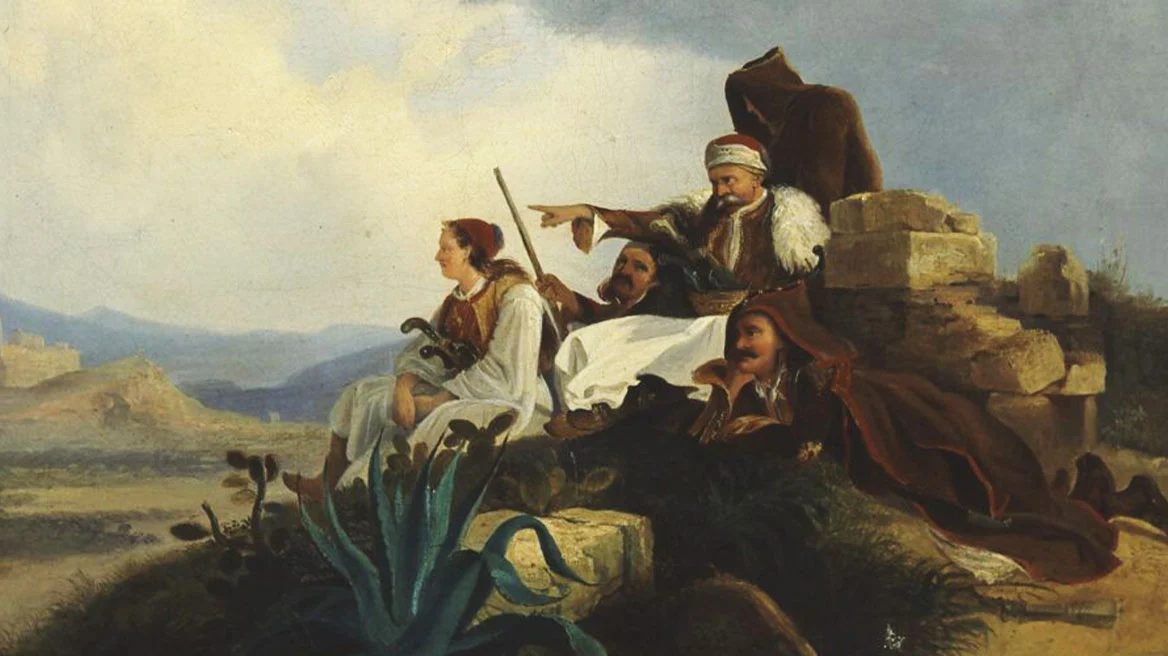
Today marks 205 years since the day that, according to tradition, the 1821 Revolution began, which led to the founding of the first independent Greek state in 1830. As we also wrote in an article on our blog, on 20/03/2026, the establishment of March 25th as a national holiday was made by Otto on March 15, 1838, and ten days later, on March 25, 1838, this day was celebrated for the first time as a national anniversary with splendor, dances, and festivities.
As is now generally acknowledged, the legend of the proclamation of the Revolution at Agia Lavra on March 25, 1821, is only a legend. In fact, Spyridon Trikoupis, who participated in the Struggle, writes in the History of the Greek Revolution: “…the idea prevailing in Greece that the flag of the Greek Revolution was first raised at the Monastery of Agia Lavra is false.” Moreover, Paleon Patron Germanos writes in his Memoirs that before March 16, 1821, he left Agia Lavra for Nezera. From there, he departed for Patras on March 23. He was in the Achaean capital on March 25, 1821. And since we mentioned Paleon Patron Germanos, we should briefly note the role of the Church and the clergy during the years of Ottoman rule and at the beginning of the Revolution. We omitted this in the March 20 blog post, and some readers rightly pointed it out.
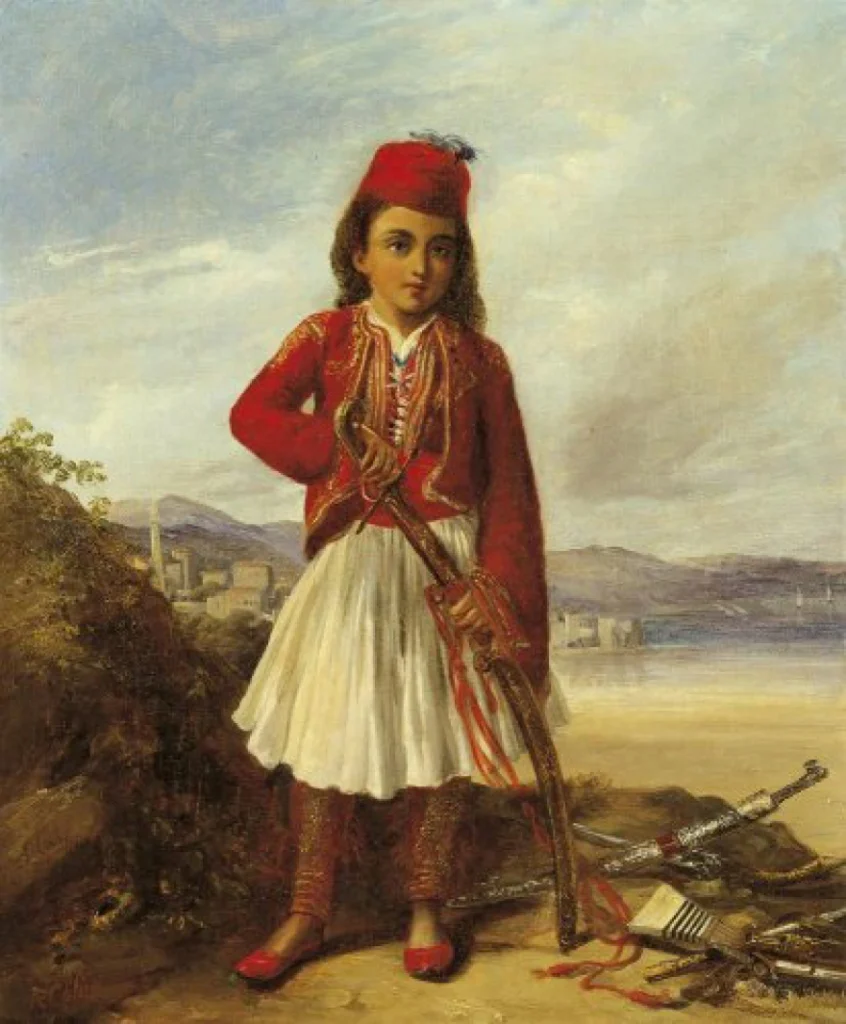
(“The Greek Boy”, painting by Alexandre‑Marie Colin, 1829–1830)
The Patriarchs and the Ordinary Clergy
The berat, an imperial decree by which Sultan Mehmed II granted the Patriarch Gennadius Scholarius the first major privileges, resulted in the creation of an entire administrative service for the functioning of the Patriarchate. The reigning Patriarch was the supreme administrator of churches and monasteries, could ordain and depose bishops, and also had judicial and administrative rights over the laity, absolute authority in matters concerning marriages, resolved civil disputes referred to him, could impose taxes in favor of the Church—not only on the clergy but also on the laity—and maintain guards. Based on Mehmed’s decree, the Church had the right to retain and manage its old estates, which remained untaxed. These rights were exercised by the local bishops, who acted as local governors of the Patriarch. With the relative freedom the Church enjoyed from the Ottomans, the bishoprics created inviolable sanctuaries, where national forces could develop and be maintained.
The spiritual renaissance of subjugated Hellenism was largely carried out by the clergy. They were the most educated and, during the darkest periods of Ottoman rule, the only ones with education. Living among the common people, the clergy, differing only in attire, were the connecting link between the Church and the people. The Church, where a learned clergyman from the popular classes could rise to the episcopal or even Patriarchal throne, operated far more democratically than the dimogerontia, which was confined by hereditary rights, wealth, and political influence. Finally, the monasteries, inviolable by the Turks, became refuges for many persecuted individuals and places of study for others.
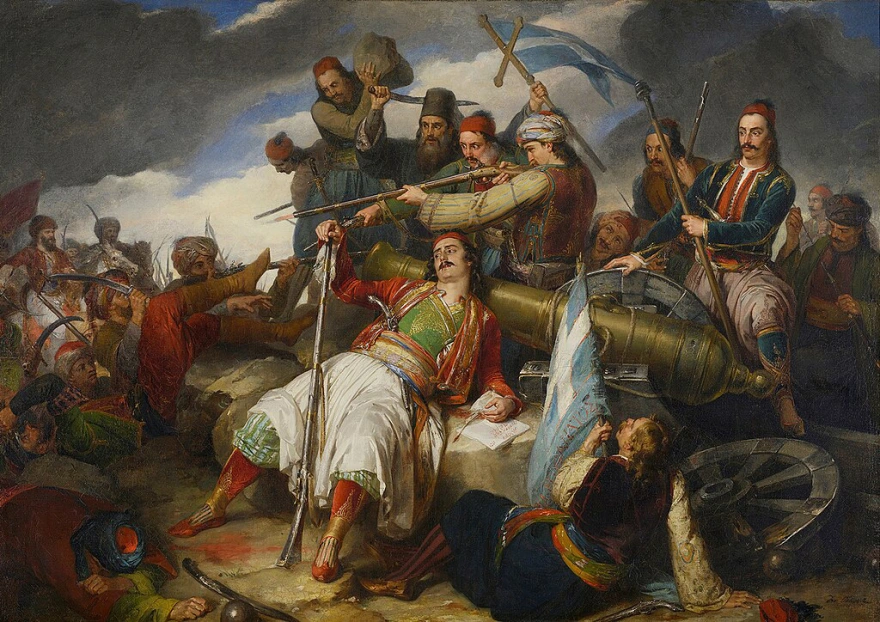
(The death of the Zakynthian fighter Spyros Dagliostros)
With the outbreak of the Revolution, high-ranking clergy were hanged, like Patriarch Gregory V, or massacred by the Turks. After Gregory, the Bishop of Myrioupolis, over 100 years old, was hanged, along with others such as the Bishops of Derkoi, Adrianople, Tyrnavos, and Thessaloniki.
And because various things have been written about Patriarch Gregory V, it should be noted that when the anti-Greek Metternich learned of his hanging, he remarked: “The Porte interprets as strength what is merely a premeditated act of terror.” The Emperor of Austria, Francis, expressed his grief over the Patriarch’s hanging and said it had the same significance as if it were against the Pope. Cypriot hierarchs also paid a heavy blood price: Metropolitan Kyprianos was hanged, while three others—the bishops of Paphos, Kiti, and Kyrenia—were beheaded. In Adrianople, former Ecumenical Patriarch Cyril was hanged, while the Turks’ rage was such that they slaughtered Greeks for no reason. As Dionysios Kokkinos notes, in Kos, at least one hundred “good islanders” were massacred, while the rest fled to the mountains in terror. These individuals had not even heard of the Filiki Eteria and did not know what was happening in the Peloponnese. For Turks today to talk about massacres in Tripolitsa and elsewhere 200 years ago, while their ancestors built pyramids with Greek heads and ears, is at least provocative.
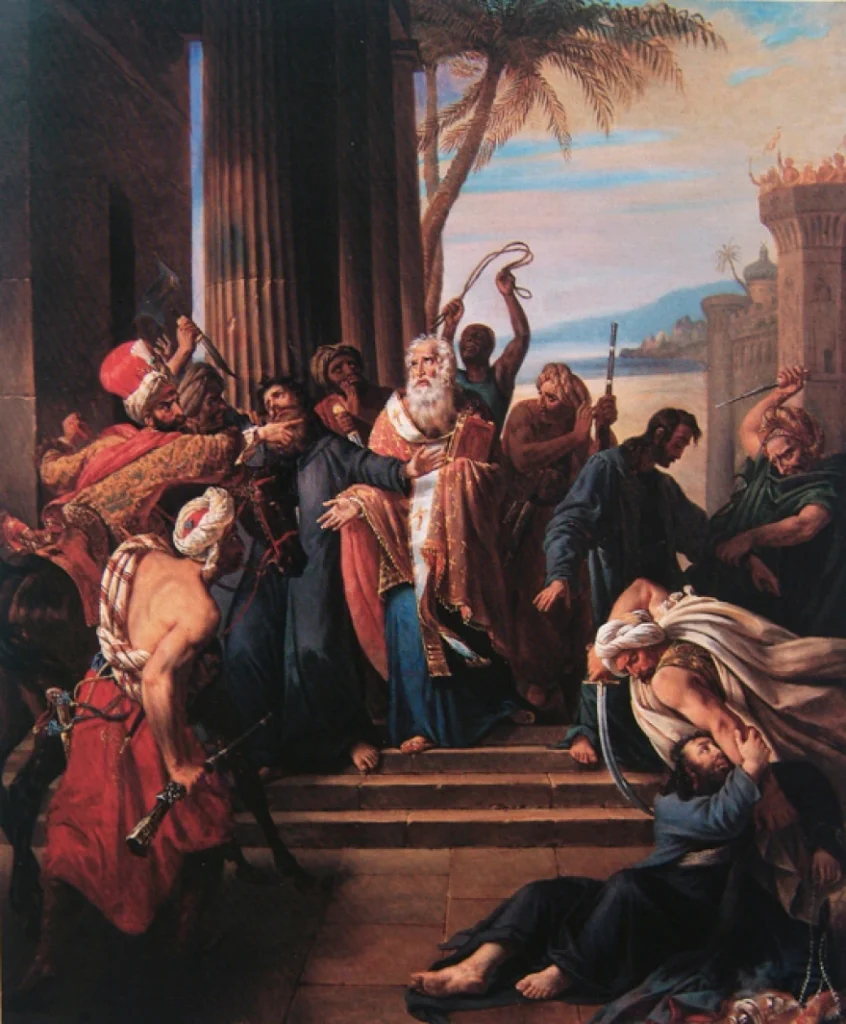
(“The Hanging of Gregory V”, painting by Fouraux)
The Battle of Dervenakia (July 1822)
Among the many significant events of the Revolution, we have chosen to focus on three: the Battle of Dervenakia, which secured the Revolution in the Peloponnese and definitively established Kolokotronis as the unquestionable military leader of the Struggle; the Exodus of Messolonghi, due to the greatness of the besieged and its strong impact on European public opinion; and finally, the Battle of Navarino, which undoubtedly played an important role in the final outcome of the Revolution. We have covered the Battle of Dervenakia extensively in our article of 26/03/2017. Today, we will briefly mention it and the significance of the Greek victory.
With the failure of Omer Vrioni to cross the Isthmus and join the besieged Turks in Tripolitsa in the summer of 1821, the Sultan assigned the highly capable and extremely dangerous Hurshid, who had suppressed Ali Pasha’s uprising in Ioannina and sent his head as a gift to the Porte, to organize a campaign to reconquer the Peloponnese. What followed is disputed.
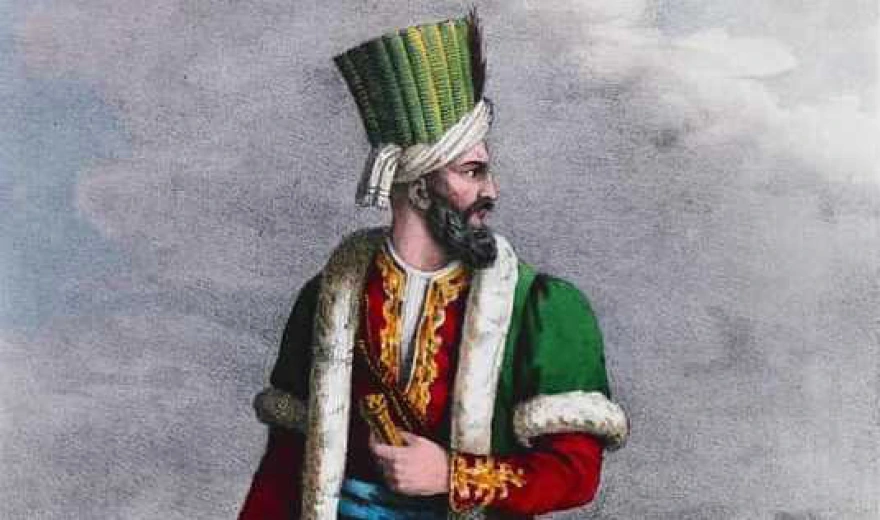
(Hurshid Pasha)
One version is that Hurshid had fallen out of favor, as some who envied him spread that he embezzled a large part of Ali Pasha’s treasures (of the 500,000 grosi estimated by the Sultan, Hurshid delivered only 40,000 grosi), and the command was ultimately given to Mahmut Pasha (or Dramali, born in Drama in 1780). According to another version, Hurshid had risen in the Sultan’s esteem and personally assigned Dramali, during a meeting near the Spercheios, to lead the campaign in the Peloponnese.
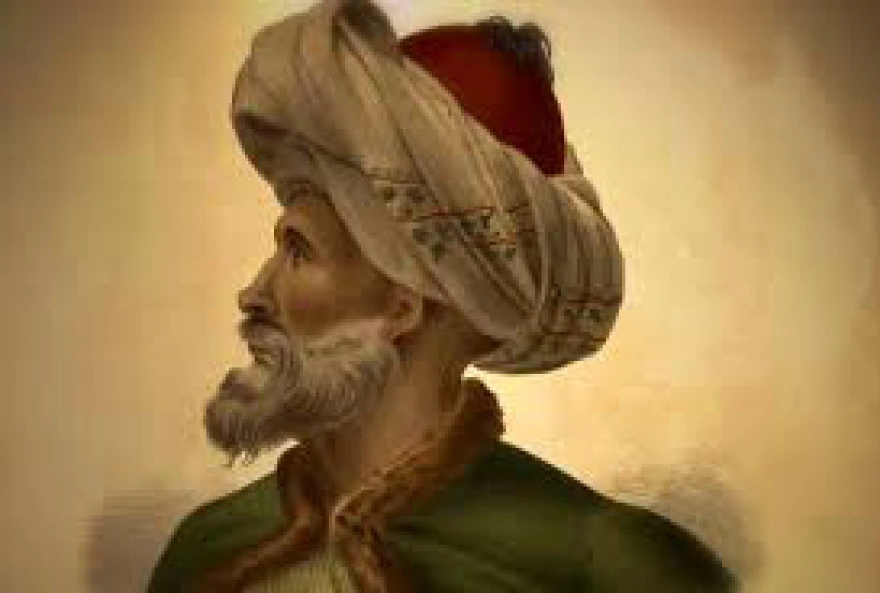
(Dramali)
Who was Dramali? He was born in Drama around 1780. He had participated in operations in the Balkans and elsewhere. He was favored by Sultan Mahmud II’s mother, who exercised great influence over her son and the then Grand Vizier Halet. Thus, he quickly attained the rank of serasker (commander-in-chief). He also had some early successes against the Greeks in southern Thessaly, Agrafa, Aspropotamos (Acheloos), Patrajtik (Ypati or Neai Patrai), and elsewhere.
His army consisted of 25,000–30,000 men, including cavalrymen and servants. Spyridon Trikoupis, who had information from the Turkish officer Cherhatzi Ali Pasha, who was with Dramali and captured in Nafplio, reports that the expedition numbered more than 30,000. Of these, 24,000 were fighters, three-quarters of whom were mounted. Most were Albanians.
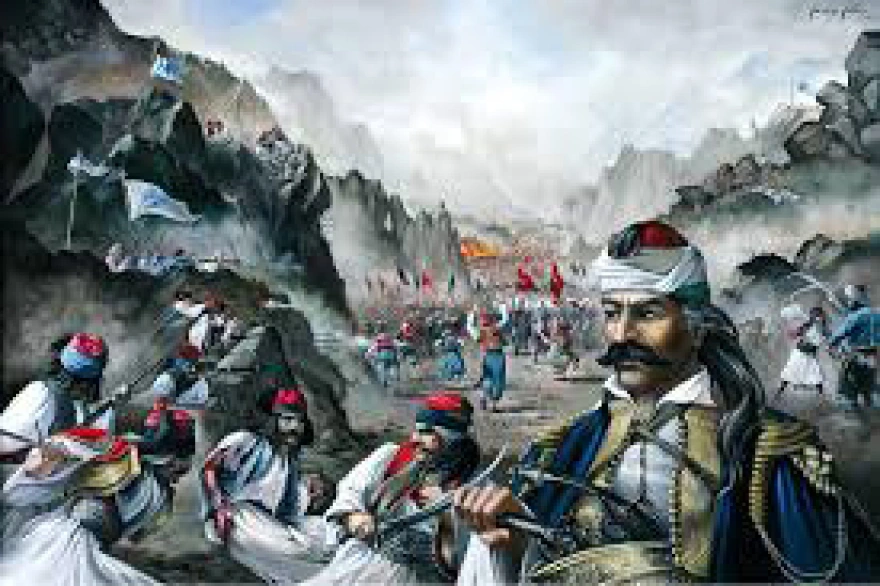
(The Battle of Dervenakia)
Dramali’s army reached Thebes on July 1, 1822, which they destroyed. Its residents had fled. Athenians feared he would move toward their city, but Mahmut Pasha instead headed to the Isthmus. The 600 Greeks who had blocked the passes of Geraneia in Megarida, led by Rigas Palamidis and G. Sekeris, fled in terror. On July 6, Dramali captured Acrocorinth, where Iakovos (Achilleas) Theodoridis had been appointed governor in May. According to S. Trikoupis, he abandoned his post “shamefully,” after ordering the execution of the captive Kiamil Bey. Theodoridis, who had risen from deacon to Brigadier (!) was stigmatized for this unacceptable act and committed suicide shortly afterward in Kranidi…
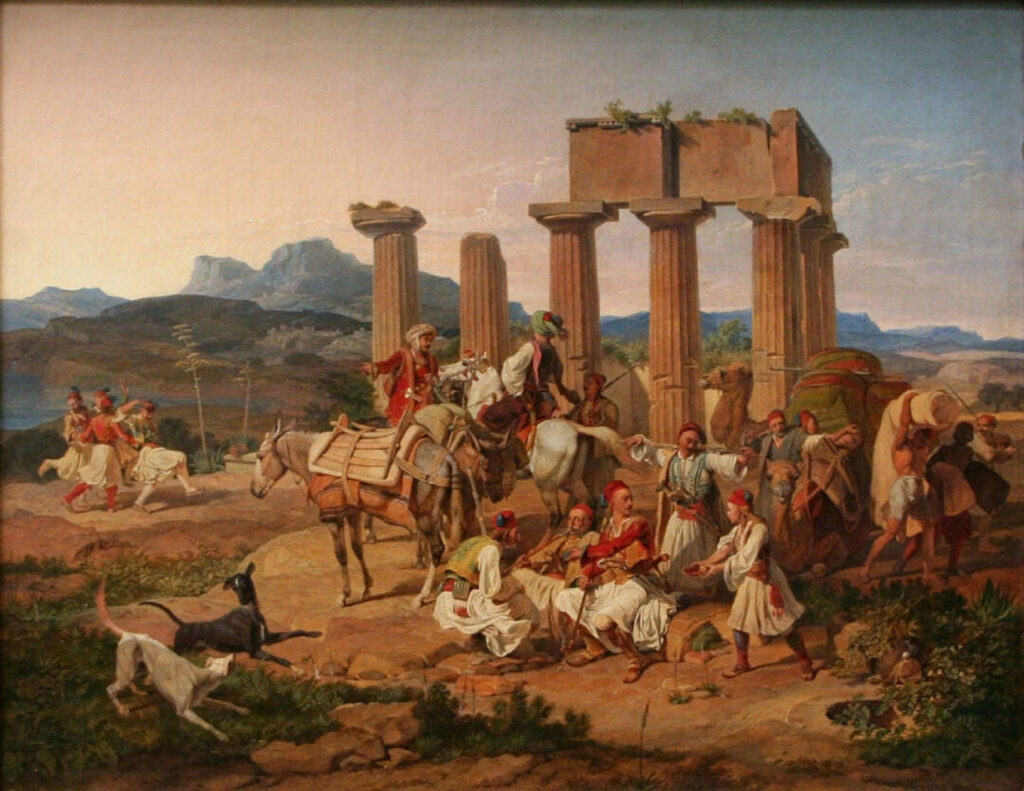
(“Greek fighters at Acrocorinth”, painting by Carl Wilhelm von Heideck)
Dramali married Kiamil’s widow to appropriate the immense treasures. On July 3, after capturing Argos, he prepared to move into central Peloponnese. Kolokotronis hurried from Patras to Tripolitsa and organized the defense, thwarting the Turkish plans. In a meeting at Achladokampos, it was decided: a) to occupy strategic positions to isolate Dramali in Argolida, b) to capture the fortress of Argos to engage the enemy for a long time, and c) to exhaust the Turks and cut them off from supply centers.
Dramali tried to capture the fortress of Argos until July 23, when the besieged managed to escape. This delay allowed the Greeks to organize defenses elsewhere, while the Turks attempted to trap the Greeks in other locations with deceptive moves. Kolokotronis, suspecting Dramali’s maneuvers, occupied the strategic positions to block the enemy’s advance.
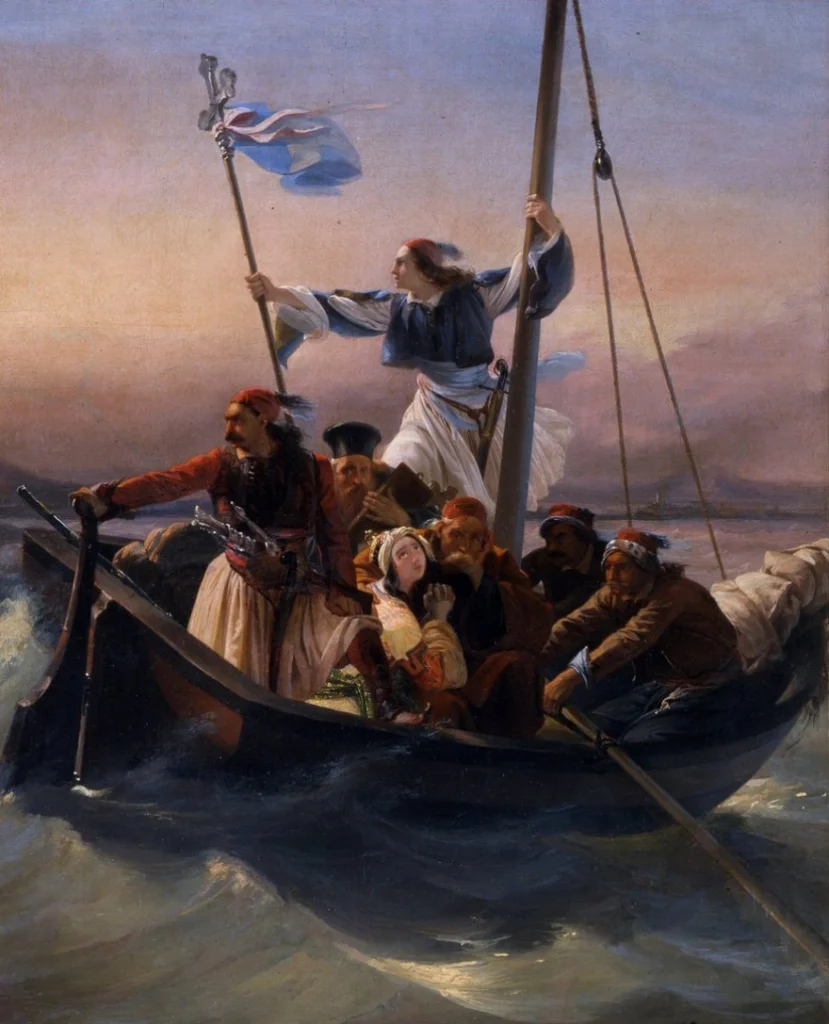
(Lodovico Lipparini, “Greece on the path to independence”)
On July 26, 1822, at Dervenakia, where most of the Turkish army had gathered, Dramali’s men suffered a total defeat. The same day, the mass of Albanians and Turks moving toward Agios Sostis was annihilated. Nikitaras and Antonis Kolokotronis (cousin or uncle of Theodoros Kolokotronis) played a leading role in the rout of the Turco-Albanians. On July 27, Dramali suffered another defeat at Agionori. Dramali was eventually trapped in Corinth, where he died of grief or typhus in October or November 1822. The defeat of Dramali and the heavy losses (2,500–3,000 killed at Dervenakia, although some, like A. Frantzis, mention 8,000 and at least 600 at Agionori) greatly encouraged the Greeks, consolidated the Revolution in the Peloponnese, and elevated Theodoros Kolokotronis as a leading figure of the Struggle. Dramali made many tactical errors, but the Sultan’s greatest mistake was not sending Hurshid to the Peloponnese. The capable Pasha fell out of favor and was ordered to be beheaded by imperial decree. Hurshid took his own life with poison in Larissa, where he was buried near the Peneios. However, three days later, the executioner who was to carry out the Sultan’s order arrived in Larissa. Hurshid’s grave was exhumed, and the executioner cut off his head and transported it to Constantinople.
The Exodus of Messolonghi (April 1826)
One of the most glorious events of the Revolution was the Exodus of Messolonghi. On April 15, 1825, 30,000 Turkish fighters, led by Kütahı Mehmed Reşit, arrived and camped in front of Messolonghi, while inside there were about 4,000 men (of whom 1,000 were elderly) and 12,000 women and children. The details of this second siege of Messolonghi became known through the Swiss Mayer’s newspaper, which was published regularly until February 20, 1826, five days before the Exodus. The circulation of the Greek Chronicles was interrupted when a hostile bomb destroyed their printing press, and all the material was moved to the ramparts.
Shortly before beginning the bombardment of the city, Kütahı proposed through negotiations the surrender of the city. After the Turkish proposals were rejected, Messolonghi was blockaded by land and by sea by the fleets of Hosref and Yusuf Pasha; the latter even managed to penetrate the lagoon. The besiegers began assaults, but the defenders successfully repelled them, repairing the ramparts and making repeated sorties. On June 3, the fleet’s strength increased with the arrival of 40 Greek ships under the command of Miaoulis and Sachtouris. For a short time, during which the naval blockade was temporarily lifted, the Greek fleet pursued the Turks as far as Mani, the city was resupplied with food and military supplies, and the morale of the besieged recovered.
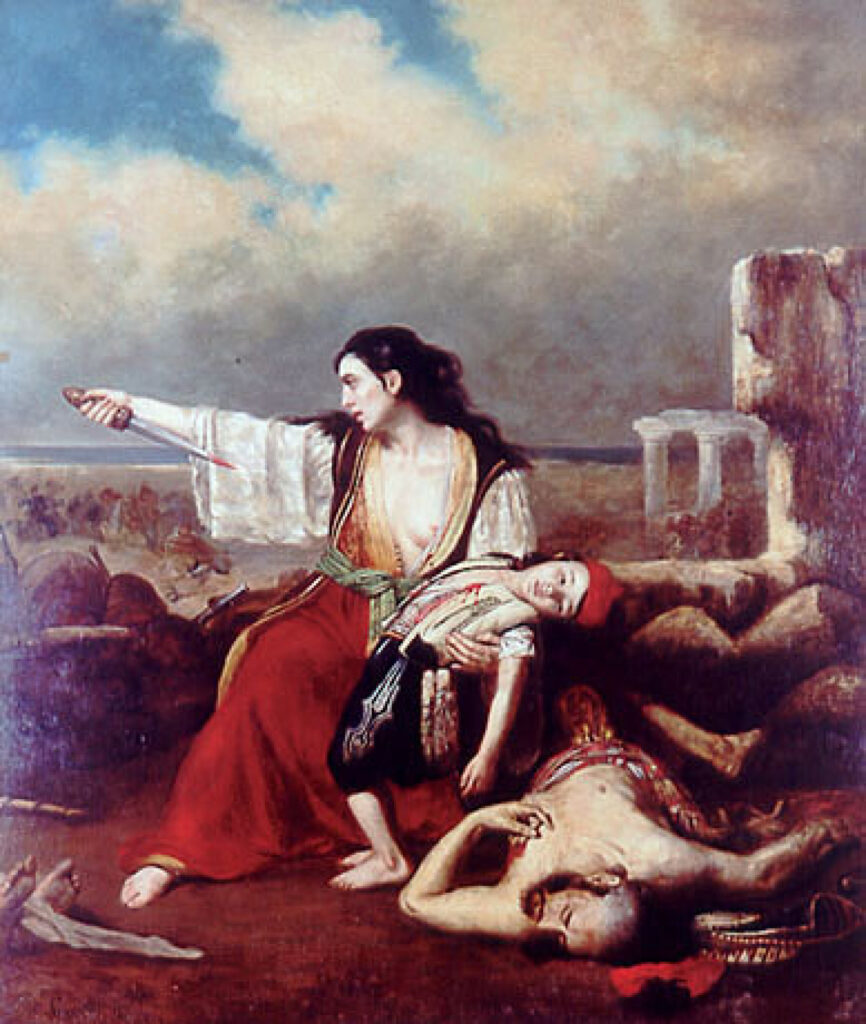
(The siege of Messolonghi)
Meanwhile, reinforcements of Souliots under Kitsos Tzavelas arrived in the city (August 7), joining the decimated garrison. At the Turkish camp, although losses were significant, Kütahı, fearing decapitation by the Sultan in case of failure, continued the siege. The situation changed when, at the end of 1825, Ibrahim arrived at the enemy camp with a considerable force (over 15,000 Egyptians). Hosref renewed the blockade, but Miaoulis managed to resupply Messolonghi with weapons and food. The pressure became unbearable after the Greek fleet withdrew and Ibrahim’s artillery systematically bombarded Messolonghi (2,000 shells per day). On February 15, the besiegers launched two assaults, which, although unsuccessful, caused serious losses on both sides.
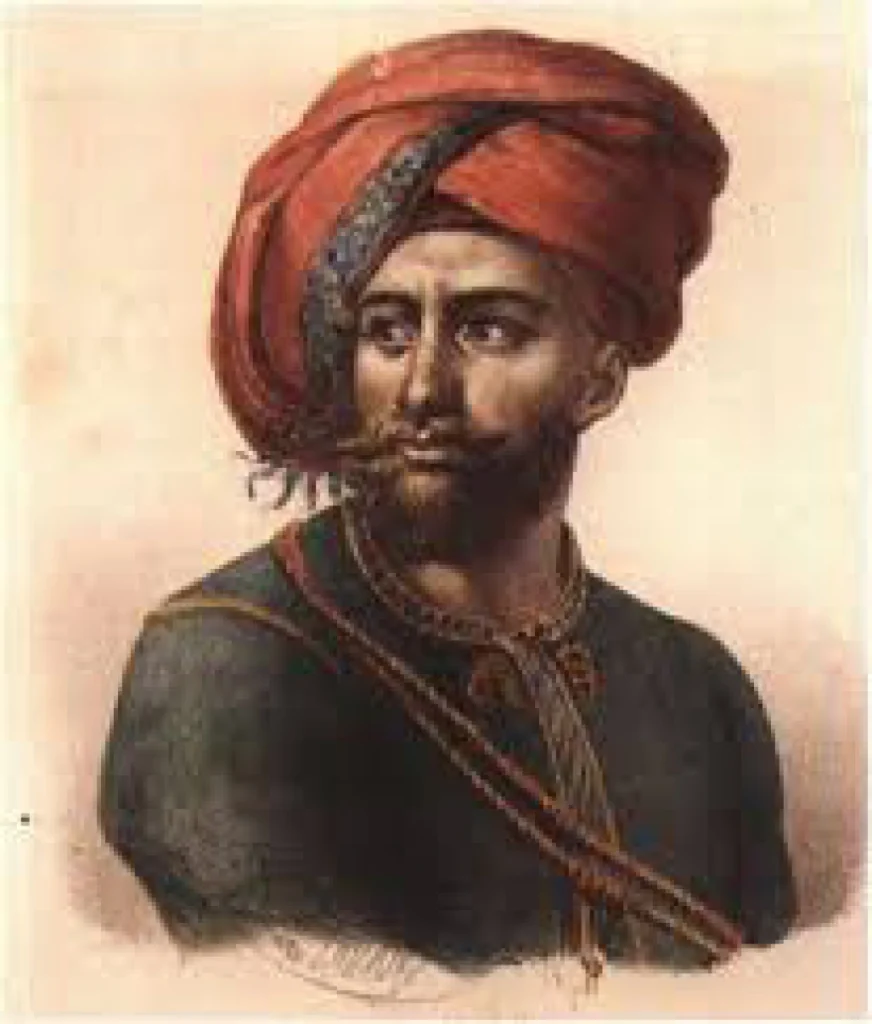
(Ibrahim)
The Turks captured Vasiladi, whose residents fled to Messolonghi, worsening the city’s food crisis. After several unsuccessful Ottoman operations against Kleisova, Ibrahim sought to exhaust the besieged by cutting off all communication and supply routes. Despite Miaoulis’ efforts, the blockade could not be lifted, and the garrison was forced to eat dogs, cats, and rats to avoid death by starvation. The unbearable living conditions (famine, disease, etc.) and Miaoulis’ inability to reach Messolonghi created a desperate situation among the besieged, who saw no other solution but the Exodus.
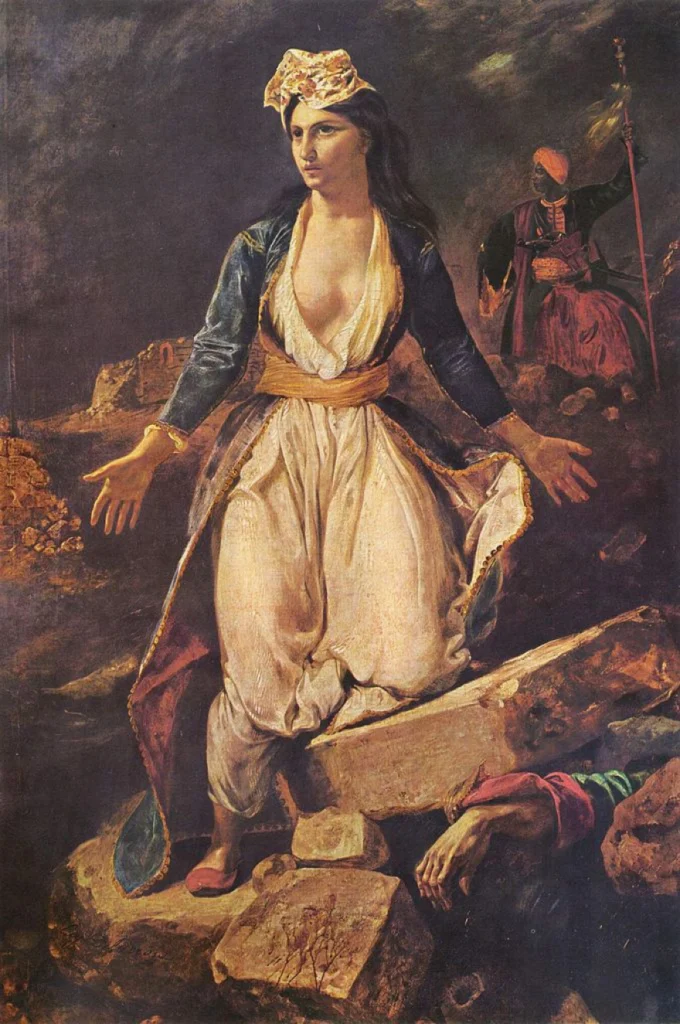
(“Greece on the ruins of Messolonghi”, painting by Eugène Ferdinand Victor Delacroix)
Thus, on the night of April 10, 1826, they organized their forces into three units, under the leadership of Notis Botsaris, Dimitrios Makris, and Kitsos Tzavelas; in the center of the triangle that these forces would form, the women and children were placed. Georgios Karaiskakis, although he had undertaken to attack from the slopes of Zygos, hoping to create a diversion against the besiegers, ultimately failed to fulfill his promise, as Ibrahim learned of the besieged’s plans from a Bulgarian deserter.
Therefore, when the massive body of Greeks began the Exodus at two o’clock after midnight, under the leadership of Athanasios Razi-Kotsikas, the men of Ibrahim and Kioutachis were prepared, and the ramparts (fortifications) designated as passage points for the Messolonghiots had been blocked. Ibrahim’s sudden move caused great confusion on the Greek side, with the result that the unequal struggle that followed proved devastating for the Greeks. The vanguard of the Exodus force, however, advanced, crossing the Turkish lines and reaching, greatly reduced in number, the slopes of Zygos and from there Amfissa. Those who had remained behind were forced to fight in deadly street battles.
Among those who escaped (1,300 fighters and about one hundred women and children) were Notis Botsaris, Dimitrios Makris, Kitsos Tzavelas, Christos Fotomaras, Panagiotis Sotiropoulos or Kravaritis—one of our favorite heroes of 1821—and others. Among the crowd that returned and was slaughtered inside the city were Bishop Joseph of Rogoi (the ecclesiastical leader of the besieged), Iakovos Mayer, Michail Kokkinis, and those who resisted alongside Christos Kapsalis in the powder magazines. It is estimated that on that day—Palm Sunday—2,000 people were burned alive, another 3,000 were slaughtered by the Turks, and about 1,000 were taken prisoner. And, as we mentioned recently, Ibrahim, five years later in 1831, crushed Kioutachis during the Turco-Egyptian war, proving his superiority.
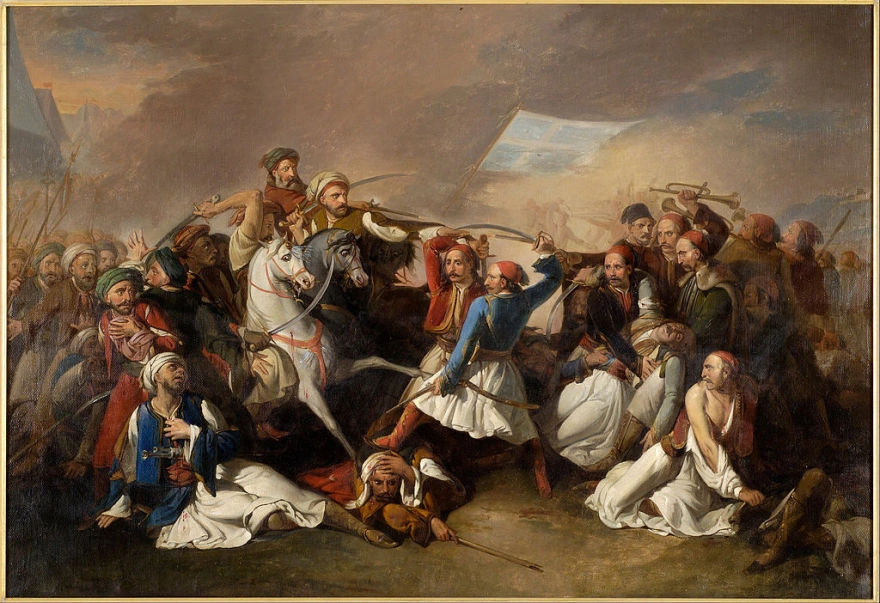
(Marsigli Filippo, “The death of Markos Botsaris”)
The Exodus of Messolonghi, apart from the number of victims, had a positive effect on the course of the Greek War of Independence. In France, Switzerland, Germany, England, and other European countries, demonstrations of sympathy and philhellenism took place. Most of these were directed against the European rulers who had abandoned the revolutionaries without aid, while others were expressed in the form of proclamations and appeals for more active participation in the war. There was also, of course, the publication of poems, theatrical works, articles, speeches, fundraising efforts, and other diplomatic actions.
The Battle of Navarino (October 1827)
Of decisive importance for the Revolution, in its final and critical phase, was the Battle of Navarino, which took place at Navarino (Pylos or Neokastro) on October 20, 1827. However, it did not in any way resurrect a finished struggle. Many have the impression that if the Battle of Navarino had not occurred, Ibrahim would have “ended” the Revolution. This, however, is not true. The Egyptian had by then slowed his advance and had been reduced to destroying crops, while the Maniots had dealt him severe blows (Vergas, Polyaravos, Diros). Kolokotronis, with “fire and axe,” had reduced acts of submission to a minimum, and on September 17–18, 1827, at the naval battle of Itea (or Agali), Thomas and Hastings sank many Turkish ships.
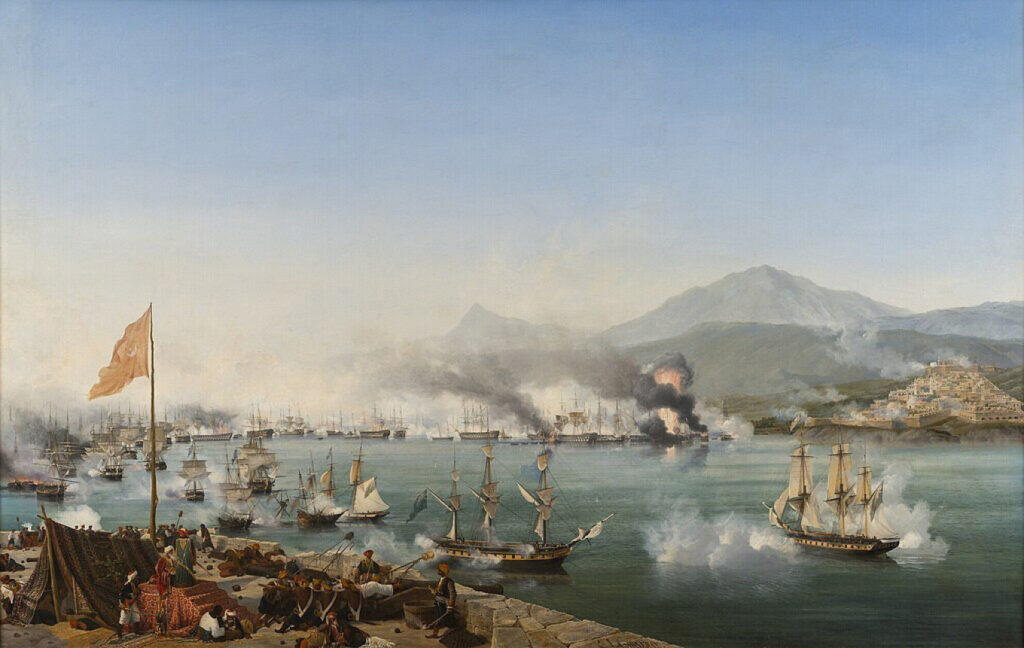
(The Battle of Navarino)
During the same period, Ibrahim terrorized the inhabitants of the Peloponnese, destroyed villages and crops, while many Greeks were captured and taken as slaves to Egypt. There was a widespread belief among philhellenic circles in Europe that he intended to expel all Greeks from the Morea and settle Egyptian Muslims there. At the same time, Sultan Mahmud II and the governor of Egypt, Mehmet Ali, Ibrahim’s father, planned to attack Hydra, which they believed was the main supplier of the revolutionary centers in Greece.
The arrival of the allied fleets in Greece and the likely inevitable clash with the Turks and Egyptians was clearly approaching… An important role in favor of the Greeks was played by the ambassadors of the Great Powers in Constantinople: the Englishman Stratford Canning, cousin of George Canning, and Ribopierre (Russian) and Guilleminot (French). These three diplomats announced (9/9/1827) to the Turkish officials that they had ordered their admirals to implement a “peaceful blockade.”
The last efforts to avoid conflict
On August 5, 1827, the British fleet, under Codrington, and the French fleet, under De Rigny, arrived at Nafplio, where they announced to the Greek government the Treaty of London. At the same time, they requested that the capital of the state be moved to Aegina, which indeed took place.
On September 12, Codrington arrived at Navarino, where the Turco-Egyptian fleet was stationed, and communicated the contents of the Treaty of London. De Rigny did the same with Ibrahim, who asked the two admirals (the Russian fleet had not yet arrived) for a twenty-day deadline to receive new instructions. An attempt by Ibrahim to transport supplies by ship to Patras failed, as he was prevented by Codrington. On October 3, 1827, the deadline requested by Ibrahim expired. The three allied fleets (the Russian fleet under Heyden had already arrived) anchored outside Sphacteria. On October 6, a meeting of the three admirals took place. All desired to take action, as they did not want winter to find them at Navarino. They also received a letter from Kolokotronis informing them that Ibrahim’s men were committing genocide in Messenia. Thus, they sent Colonel Cradock to deliver an ultimatum to Ibrahim demanding that he cease all hostile actions in the Morea. Ibrahim avoided meeting Cradock, and so the admirals decided to enter the Bay of Navarino to monitor the Turco-Egyptian fleet anchored there.
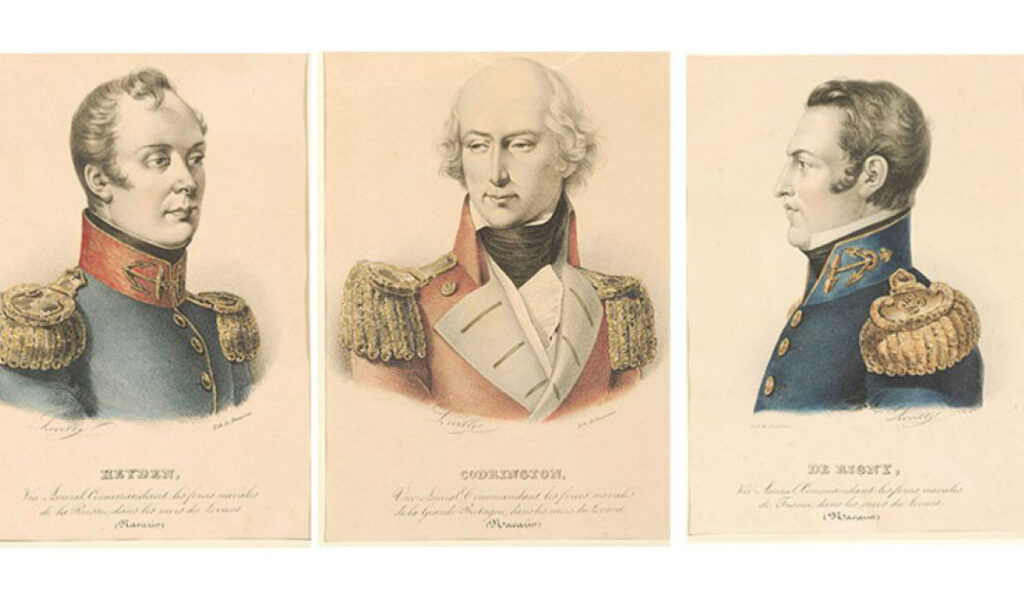
(Codrington, De Rigny and Heyden)
Shortly before the battle – The forces of the opponents
The Turco-Egyptian fleet consisted of 3 large ships, 24 frigates, and other smaller vessels. In total, 89 ships and 41 transports, of which 8 were Austrian. The Turkish commander was Tahir Bey, and the Egyptian commanders were Mustafa Bey and Muharrem Bey. The allied force was much smaller: 12 British ships—specifically “Asia” (flagship), “Genoa,” “Albion,” “Darmouth,” “Cabrian,” “Glasgow,” “Talbot,” “Rose,” “Mosquito,” “Brisk,” “Philomel,” and “Hind”; 8 Russian—“Azov” (flagship), “Ezekiel,” “Cangut,” “Aleksandr,” “Provornoy,” “Elena,” “Konstantin,” and “Kastor”; and 7 French—“Sirene” (flagship), “Scipion,” “Trident,” “Breslaw,” “Armide,” “Daphne,” and “Alcyone.” The overall commander of the allied forces was Codrington, who held the rank of Vice Admiral, while De Rigny and Heyden were Rear Admirals.
The battle
At noon on October 8/20, the two opposing fleets had taken their final positions. The atmosphere was extremely tense when an enemy fireship approached very close to the ship “Darmouth,” and its captain, Fellowes, sent a boat led by Lieutenant Fitzroy and a few men to ask the crew of the fireship to withdraw. The crew, however, killed the lieutenant and several of his men! Fellowes sent another boat to remove the fireship and ordered the “Darmouth” to return fire. At the same time, the French flagship “Sirene” was struck by the Egyptian frigate “Esmina,” and the “Asia” came under fire from the Turkish flagship. Codrington sent a delegation to the Egyptians to inform them that their intention was not to fight them, but to force them to return to their bases—the Turks to the Dardanelles and the Egyptians to Alexandria.
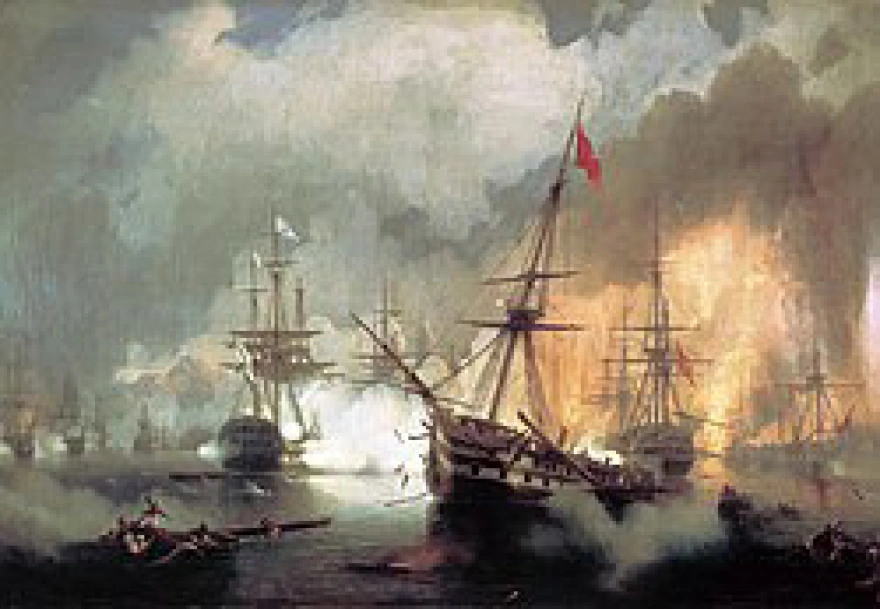
(Ivan Aivazovsky, “The Battle of Navarino”)
The Egyptians, without any reason, killed Codrington’s Greek pilot, Petros Mikelis, one of the envoys. Petros Mikelis was probably the only Greek killed in the Battle of Navarino. Immediately, the “Asia” began bombardment against the Egyptian flagship, resulting in its sinking. Fierce fire followed on both sides. Around 3 p.m., the Russian fleet arrived, which until then had been farther back. Its arrival caused enthusiasm among the allied forces. By around 6 p.m., everything was over. The allies had triumphed! Of the 89 ships of the Turco-Egyptian fleet, 60 had been sunk or destroyed, 15 had run aground in the shallows of Navarino Bay after suffering heavy damage, and only 14, under Ibrahim, escaped unharmed and reached Alexandria two months later. The dead among the Turks and Egyptians are estimated at 6,000.
No allied ships were sunk, though some, such as the “Asia,” suffered greater or lesser damage. 272 British, 185 French, and 198 Russians were killed or wounded. Paradoxically, although Codrington had essentially initiated the battle, he fell into disfavor. The British did not want a full-scale clash between the two sides, and Codrington—who tried to distance himself from what had happened—was recalled to his country (June 4, 1828), although he attempted through repeated letters to prove that he had not violated any orders. Eventually, his country recognized his contribution, promoted him to Admiral (1839), and awarded him the “Grand Cross of the Bath.”
In Greece, of course, the victory of the allied fleet over Ibrahim was celebrated with great enthusiasm, as it seemed that the hour of freedom was approaching. The French celebrated the victory due to the success of their navy, which had suffered a severe defeat at Trafalgar (1805) by Nelson. The Russians, beyond the strategic importance of the victory, were particularly pleased because they proved themselves equal sailors to the British and French. The British—especially the conservative government—received the success at Navarino with coldness, as they saw that it opened the way for Russia into the Mediterranean. Naturally, the Austrians were outraged. Emperor Francis described the battle as “murder,” and Metternich argued that general chaos would follow.
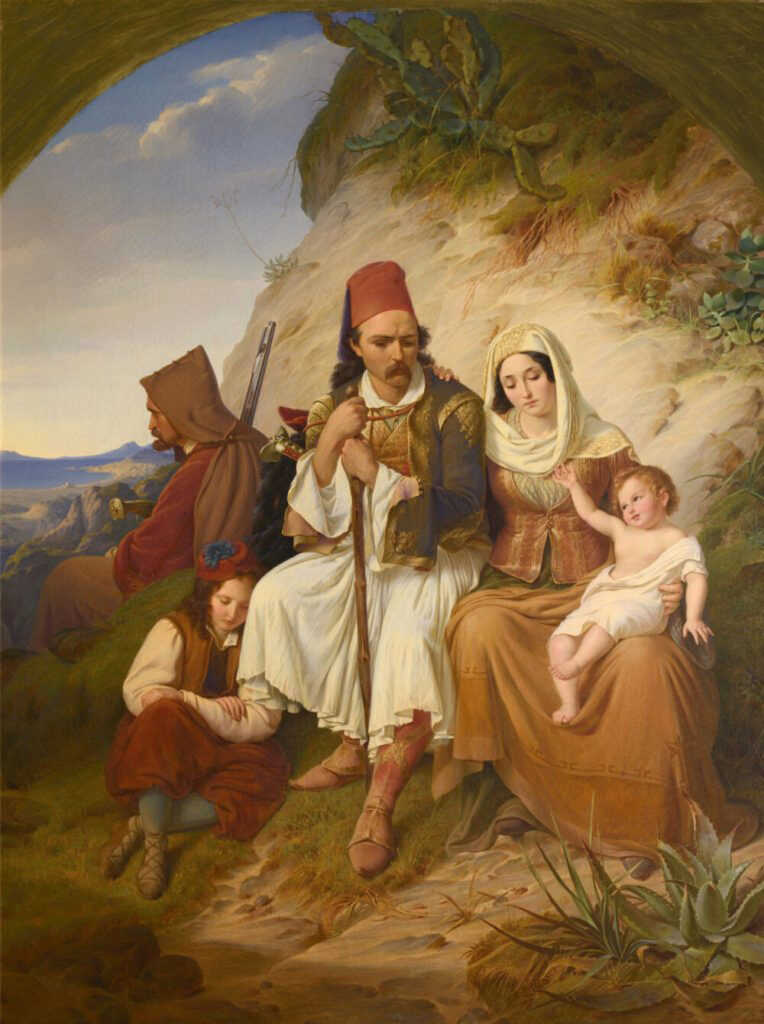
(Greek refugees after the destruction of Chios)
The news reached Constantinople on October 29, 1827 (with a ten-day delay…). The first to announce the event unofficially was Stratford Canning. On November 1, the Sultan learned the unpleasant news. He limited himself to threats, and no excesses followed. Mahmud believed that the defeat of the Turco-Egyptian fleet at Navarino would not have serious consequences—and he was likely mistaken—while he knew that any atrocities would provoke war with at least half of Europe.
Main sources:
“History of the Greek Nation,” vol. XII, Ekdotiki Athinon
Dionysios Kokkinos, The Greek Revolution, Volume 1, Melissa Publications
Encyclopedias Papyrus–Larousse–Britannica and Domi.
Ask me anything
Explore related questions




