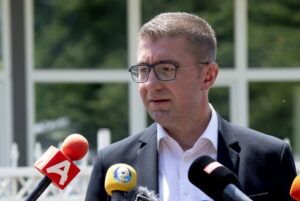
North Macedonia’s Prime Minister, Hristijan Mickoski, reiterated—this time in a particularly sharp tone—that his government will not agree, under any circumstances, to amend the country’s Constitution in order to include the Bulgarian minority living in the country.
“We will not retreat even a millimeter. If not us, future generations will continue this struggle. The ‘Macedonian’ identity cannot be subject to concessions,” Mickoski said.
He noted that his party (VMRO-DPMNE) will not support constitutional changes “until there are clear guarantees for the rights of the ‘Macedonian’ community in Bulgaria,” adding that his country may wait even decades, if necessary, to achieve its goals.
Disputes between North Macedonia and Bulgaria
Relations between Bulgaria and North Macedonia have been tense in recent years. The two countries have longstanding historical, national, and linguistic disputes.
Sofia argues that the language and identity of Skopje have Bulgarian roots and did not exist prior to 1945, when the region became part of then-Yugoslavia.
On the other hand, the government in Skopje insists that its national identity and language are distinct and have existed for centuries.
Bulgaria had blocked the start of North Macedonia’s EU accession talks. In the summer of 2022, the governments of both countries accepted a compromise proposal from the EU to resolve their differences. The proposal stipulated that Bulgaria would lift its veto on accession talks on the condition that Skopje amend its Constitution to include the Bulgarian minority.
The previous center-left government of North Macedonia, which had accepted the EU proposal, failed to secure a two-thirds parliamentary majority to pass the constitutional amendment, due to opposition from the right-wing VMRO-DPMNE party, now in power under Mickoski.
Both Brussels and Sofia have repeatedly stated that North Macedonia will only be able to open EU accession negotiation chapters after it amends its Constitution.
According to the latest census conducted in 2021, Bulgarians make up just 0.2% of North Macedonia’s population (around 3,500 people), a figure disputed by Sofia, which claims the actual number is much higher. Bulgaria argues that the census did not ensure full participation of Bulgarian citizens and accuses Skopje of downplaying the historical Bulgarian presence.
Relations between North Macedonia and Bulgaria have further deteriorated since VMRO-DPMNE came to power in June 2024.
Ask me anything
Explore related questions