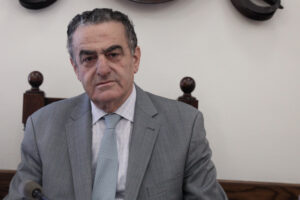
Greece is facing one of the most serious threats to its healthcare system, as over the past five years more than 5,400 young doctors have emigrated abroad in search of professional opportunities. According to the Athens Medical Association (ISA), the exodus of young physicians is intensifying existing shortages and putting the future sustainability of the Greek healthcare system at risk, with ISA president Giorgos Patoulis highlighting the strategic dimension of the phenomenon.
As Mr. Patoulis points out to the Athens-Macedonian News Agency (ANA-MPA), brain drain—the outflow of scientific talent—is one of the most serious threats to the system’s viability, worsening existing shortages and undermining its future adequacy.
“The mass migration of young doctors is one of the most serious challenges currently facing the country’s healthcare system. It is not just a numerical issue—it is deeply qualitative and strategic, as Greece is losing the most dynamic, scientifically trained, and promising part of its medical workforce,” he stresses.
Data from the Athens Medical Association
- 2020: 347 junior doctors and 554 specialists left (total 901). Most chose England (UK) (428 doctors), followed by Cyprus (162).
- 2021: 314 junior and 552 specialists (total 866). Again, England was first (379), Cyprus second (160).
- 2022: 808 doctors emigrated (304 junior, 504 specialists). Most went to England (288), followed by France (61), Germany (54), Switzerland (50).
- 2023: 808 doctors again (283 junior, 525 specialists). England remained the top choice (288), followed by Cyprus (97).
- 2024: Increase recorded—1,047 certificates issued (398 junior, 649 specialists). England again first (274), Cyprus second (118).
- 2025: Slight decline—384 junior and 584 specialists left. Most chose England (319), followed by Cyprus (142).
“Young doctors do not leave randomly. They leave in search of dignity. They leave because they want high-level training. They leave because in other countries in Europe and beyond, they find organized systems, clear professional prospects, and salaries that match their scientific value.
The truth is harsh: if we do not create a modern, competitive environment, we will not be able to retain young scientists. And then the problem will not concern only the medical profession—it will affect the very sustainability of the healthcare system,” Mr. Patoulis emphasizes.
Incentives that need to be provided
“The reversal of brain drain cannot happen through wishful thinking. It requires concrete, targeted policies,” notes the ISA president, proposing:
- Decent salaries, aligned with international standards, so staying in the country becomes a real choice rather than a forced sacrifice
- Modern and well-organized training system, with full implementation of rotations and continuous evaluation
- International collaborations, including partnerships with universities and medical institutions in Europe and the US
- Stable professional environment, without constant financial burdens and uncertainty
- Career development prospects, linked to scientific progress rather than circumstances
Mr. Patoulis adds that “the entire National Health System (ESY) must be placed at the service of training young doctors—not fragmentarily, but through strategic planning.”
ISA’s position and demands
The Athens Medical Association has repeatedly raised the issue with political leadership, calling for:
- Substantial salary increases for public healthcare doctors
- Creation of new residency positions and strengthening of training
- A framework allowing doctors to work with dignity, without exhausting burdens
- Abolition of distortions such as clawback, which undermine the profession’s sustainability
At the same time, it stresses that the solution is not pushing doctors outside the system to supplement their income, but building a strong public healthcare system.
Greece as an international health hub
Mr. Patoulis notes that Greece has a key comparative advantage: its highly skilled medical workforce.
“The ISA is systematically investing in the development of medical tourism, aiming for Greece to evolve into an international health destination. This is not just a development model—it is a strategic choice to turn brain drain into brain gain.”
To achieve this, however, it requires high-quality services, organization, public-private cooperation, and above all, human capital that remains and develops within the country.
From brain drain to return
Mr. Patoulis concludes:
“Greece can become a country that attracts scientists rather than exports them. It can turn loss into opportunity. But this requires political will, consistency, and long-term planning.
Young doctors are not asking for privileges. They are asking for the obvious: to be able to live, work, and develop with dignity in their own country.
The Athens Medical Association will continue to fight in this direction, aiming for a healthcare system that does not lose its people—but retains them and brings them back.”
Ask me anything
Explore related questions