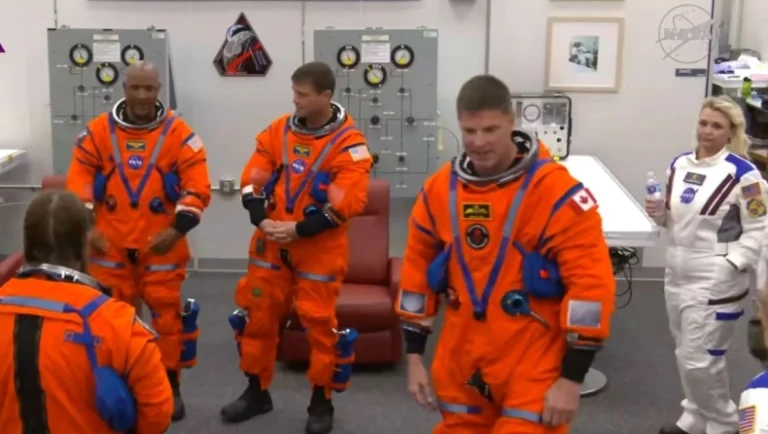
The salary of the astronauts on the Artemis II mission to the Moon is of great interest. Five decades after the Apollo 11 Moon Landing, the space race has proven that it can evolve at the same pace as geopolitics and technology. Images of the astronauts leading the Artemis II program are circulating worldwide and have captured global attention.
The mission, which involves a roughly ten-day flyby around the Moon, records daily life inside the Orion capsule of Reid Wiseman, Victor Glover, Christina Koch, and Jeremy Hansen, who will undergo critical tests in real conditions. Life-support systems will be checked and deep-space conditions will be evaluated—from autonomous navigation to the spacecraft’s resistance to radiation.
Although the purpose of this mission is less spectacular than that of the first Moon landing on July 20, the innovation in space systems has not increased at the same pace as crew salaries. The Artemis II crew do not have multi-million-dollar contracts, nor do they receive hazard bonuses. They are public employees.
NASA astronauts are classified within the U.S. federal system at GS-13 to GS-14 levels, which translates to salaries of approximately €90,000 to €150,000 per year. Contrary to what one might expect given the high qualifications of these professionals, the crew do not receive financial incentives tied to the mission’s risk. There are no bonuses for traveling to space, nor overtime pay.
A salary with one exception
The inclusion of Jeremy Hansen, an astronaut from the Canadian Space Agency, highlights the multinational nature of the Artemis program, in which many partners participate with shared scientific and strategic interests.
In the Canadian case, the salary is different. As part of Canada’s public system, pay levels can range between $97,000 and $190,000 annually, depending on experience and rank—slightly higher than those of American astronauts.
From a financial perspective, these amounts may seem low given the extreme demands placed on these professionals. The role of an astronaut requires exceptionally high qualifications and involves risks that other public employees do not face.
However, the value of the work is governed by the specific rules of NASA, which, as a federal agency, operates under standardized pay policies. Despite the salary limitations, the demand to become an astronaut remains enormous. Each recruitment call attracts thousands of applicants for just a few positions. While the motivation is not financial, the challenge is different: to contribute to the advancement of knowledge and science, which ultimately benefits all of humanity.
Ask me anything
Explore related questions