





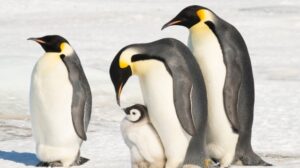
The imperial penguin is now listed as a “threatened” species, according to a new reference list compiled by the International Union for Conservation of Nature (IUCN), as it is threatened by climate change affecting Antarctica.
The iconic bird’s population will be halved by the 2080s due to rising temperatures caused by melting sea ice, according to the reference body, which includes governments, non-governmental organisations, and scientists.
“It’s a species very connected to sea ice. But since 2016-2017, there has been a big reduction in the extent of the ice around Antarctica as a whole, and therefore, without sea ice, it will find it very difficult to survive,” explains Christophe Barbreau, a researcher at the French National Centre for Scientific Studies (CNRS), to the Agence France-Presse.
The animal goes from “quasi-threatened” to “endangered” status on the IUCN Red List, the world’s reference list for the status of plant and animal species.
“After careful evaluation of several potential threats, we concluded that human-induced climate change represents the most significant threat to emperor penguins,” explained Philip Traithan, a member of the team of experts working on the new IUCN assessment.
These birds feed on species (fish, squid, krill, etc.) that depend on ice and are becoming increasingly rare.
The fragmentation and disappearance of sea ice also threatens the reproduction of these large penguins, which prefer this flat and stable surface to incubate their eggs by keeping them warm between their paws.
The chicks are then reared until they have waterproof wings. But if the ice melts too quickly under their tiny paws, they risk drowning or freezing.
“Colonies are beginning to relocate” and “will not necessarily breed on the sea ice, but will move up to the part of the Antarctic continent just behind,” observes Christophe Barbroeau.
“But sea ice changes and climate change are currently extremely rapid. And we fear that this species will not have enough time to adapt,” the researcher underlines.
“What is quite rare,” he insists, “is the speed of change.”
Ask me anything
Explore related questions
